- PHMSA to Share Research on Improving Corrosion Control for Aboveground Storage Tanks
- PHMSA Interpretation Request Raises Part 192 Classification Question
- Advancing AI in Energy: EnergyAI 2026 Comes to Houston
- Featured Service
- The Enforcement Corner
- Did You Know?
- Q&A Section
- Regulatory Watch: Key Dates & Deadlines
- Conference News
- PSI Training Schedule
- Suggest Changes
PHMSA to Share Research on Improving Corrosion Control for Aboveground Storage Tanks
PHMSA will hold a virtual public meeting on September 16, 2026, at 11:00 a.m. ET to present the results of agency-funded research focused on tank foundation and floor designs and improved corrosion control.
The research evaluated different tank foundations, bottom designs, and corrosion control equipment to identify methods and best practices for:
- Monitoring and controlling corrosion
- Detecting leaks
- Preventing damage caused by leaks
- Improving the safety and reliability of breakout tanks and other aboveground storage tanks
The project is intended to help establish clearer practices for the design and maintenance of aboveground storage tanks while improving their safety, reliability, and service life.
Interested parties can register and access the meeting agenda through PHMSA’s Public Meetings Registration page. PHMSA has also made the project’s final report and additional research information available through its Pipeline Safety Research & Development Program.
PHMSA Interpretation Request Raises Part 192 Classification Question
PHMSA has been called on to clarify a familiar pipeline jurisdiction question: When does a pipeline stop being regulated in transportation and become customer-owned piping?
Martin Operating Partnership has requested a formal interpretation involving a 1.8-mile natural gas line in Odessa, Texas. The Railroad Commission of Texas currently treats the line as transmission, but Martin argues that it falls outside 49 CFR Part 192 because it is downstream of the customer sales meter and carries gas solely for Martin’s own consumption.
The facts make the question particularly interesting. The line serves a single industrial facility, operates at 20 psig or less, has no downstream customers or delivery points, and does not resell or redistribute gas.
Martin has asked PHMSA to determine that the segment is customer-owned consumption piping and therefore not subject to Part 192. If PHMSA disagrees, Martin is asking for an alternative determination that the line is a distribution service line rather than a transmission line.
PHMSA’s response could offer useful clarification for operators facing similar questions about customer meters, industrial laterals, large-volume customers, and the boundaries of Part 192 jurisdiction.
Advancing AI in Energy: EnergyAI 2026 Comes to Houston
Artificial intelligence is quickly moving from experimentation to real-world application across the energy industry. On September 28, 2026, the EnergyAI Users Group Annual Conference will bring together engineers, data scientists, technology leaders, and energy professionals at the Thompson Houston for a full day focused on how AI is actually being deployed and scaled across oil and gas operations.
The program moves beyond the AI hype to explore practical applications, challenges, and lessons learned. Sessions will cover topics including agentic AI, autonomous field operations, enterprise AI governance, workforce adoption, asset integrity, infrastructure, and the technology needed to scale AI across energy organizations.
Speakers and panelists will represent organizations including ExxonMobil, Chevron, Shell, Aramco Americas, Halliburton, SLB, NOV, NVIDIA, Google, Dell Technologies, DataRobot, Cloudera, Wood, Booz Allen Hamilton, and others.
A few topics on the agenda include:
- Moving AI projects from pilot programs into production
- Agentic AI in drilling, completions, and production
- Responsible AI governance and enterprise adoption
- Using AI to improve industrial operations and planning
- AI applications across downstream, infrastructure, and asset integrity
- The data, computing, and technology infrastructure required for the next generation of energy AI
EnergyAI Users Group Annual Conference
September 28, 2026 | All Day
Thompson Houston
1717 Allen Parkway, Houston, TX 77019
For energy professionals evaluating where AI can deliver meaningful operational value, the conference offers an opportunity to hear directly from the companies and practitioners already putting these technologies to work.
Learn more and register: EnergyAI 2026 Conference
Featured Service

CorrosionIQ is a complete corrosion compliance and integrity management platform for pipeline operators.
From cathodic protection monitoring and CIS surveys to remediation tracking and compliance reporting, CorrosionIQ brings every component of your corrosion program together in a single system.
Collect data, manage inspections, track corrective actions, analyze trends, and demonstrate compliance with confidence.
Everything Your Corrosion Program Needs
CorrosionIQ covers the full corrosion lifecycle:
- Corrosion Work Management
- Cathodic Protection Monitoring
- CIS, DCVG, ACVG & ACCA Surveys
- Corrosion Remediation Tracking
- Corrosion Analytics & Reporting
- Dynamic Alignment Sheets
- GIS Mapping & Spatial Analysis
- Mobile Data Collection
- Compliance Documentation & Audit Support
Whether you’re managing transmission, gathering, distribution, hazardous liquid, or underground storage assets, CorrosionIQ provides a single source of truth for your entire corrosion program—helping your team spend less time managing data and more time protecting pipeline integrity.
Built for Pipeline Compliance
CorrosionIQ supports corrosion control requirements under 49 CFR Part 192 and 49 CFR Part 195, including:
- Cathodic protection (§192.463, §192.465, §195.573)
- Internal corrosion control (§§192.475–192.476, §195.579)
- Atmospheric inspections (§192.481, §195.583)
- External corrosion control (§§192.451–192.459, §§195.551–195.559)
- Integrity management programs (§§192.907–192.951, §195.452)
- Inline inspection and direct assessment (§192.921, §192.923, §195.452)
- Anomaly evaluation and repair (§192.933, §195.452)
- Reassessment intervals (§192.939, §195.452)
- Recordkeeping and documentation (§192.491, §195.589)
All requirements are tracked, scheduled, and documented in one place.
Why It Works
Most corrosion programs are spread across multiple systems. CorrosionIQ brings everything together so your team can:
- See the full picture
- Identify risk earlier
- Manage work in one place
- Reduce manual effort
- Stay compliant without the scramble
The Enforcement Corner
Reporting Period: August 2026
CAO: 2 NOA: 0 WL: 1 NOPV: 2
Review the cited regulations, proposed penalties, and year-to-date enforcement trends in the complete report.
Did You Know?
The U.S. has more than 3.3 million miles of regulated pipelines. That’s enough pipeline to circle the Earth more than 130 times.

Q&A Section
Do you have questions? RCP’s SMEs have the answers. Information will be posted here for questions we often get from clients or discussions we have with regulators regarding interpretations and pending regulatory deadlines.
Q: If a contractor has their own OQ program, is the pipeline operator still responsible for verifying their qualifications?
A: Yes. The operator is responsible for ensuring that anyone performing a covered task on its pipeline is qualified under the operator’s OQ program requirements. If a contractor uses their own OQ program, the operator must verify that it satisfies the operator’s requirements and document the contractor’s qualifications.
Ask the Experts
Do you have a question for the experts at RCP? Submit your question using this form. If your question is selected for a future newsletter, you will be eligible for a gift of your choice from RCP’s online Store.
Upcoming Deadlines:
And as a reminder, the “Stay of Enforcement” does not mean regulators don’t expect work toward getting compliance activities in place can be ignored.
If we can help, contact Jessica Foley.
These articles are maintained and updated as new information becomes available.
Regulatory Watch: Key Dates & Deadlines
Track PHMSA rulemaking, regulatory stages, and important compliance deadlines in RCP's Regulatory Watch.
View Full Regulatory Watch →Conference News
Pipeline Pigging and Integrity Management Conference
The 39th International Pipeline Pigging & Integrity Management Conference (PPIM) will take place at the George R. Brown Convention Center in Houston. The event brings together pipeline operators, engineers, and industry professionals to explore advancements in pipeline inspection, integrity management, risk assessment, and emerging technologies.…
RCP Team Attending
Heather Roark
Jessica FoleyPSI Training Schedule

| Date | Training Course | Price | Registration |
|---|---|---|---|
| Nov 17 – Nov 19, 2026 | DOT Pipeline Compliance Workshop | $2,150 | SOLD OUT |
| Feb 16 – Feb 18, 2027 | Pipeline Safety Audit Training | $2,150 | Register → |
| Feb 23 – Feb 25, 2027 | Advanced Pipeline Risk Assessment Workshop | $2,150 | Register → |
| Mar 23 – Mar 25, 2027 | DOT Pipeline Compliance Workshop | $2,150 | Register → |
WEBINAR RECORDING!
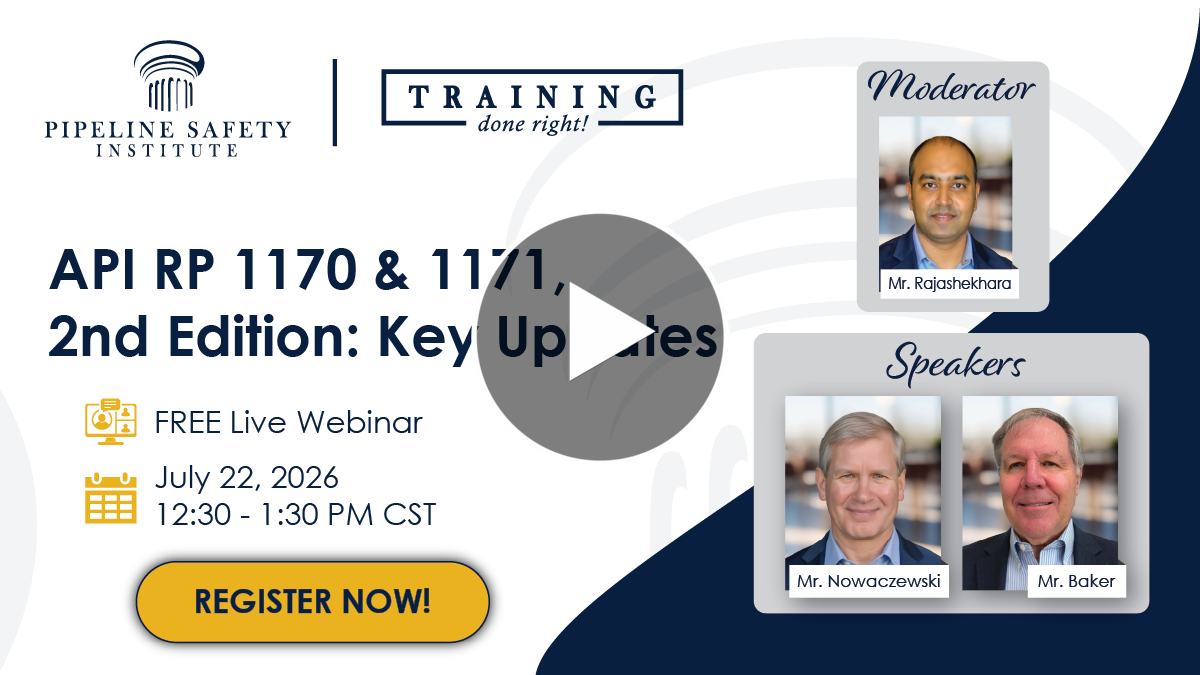
Unpacking the Key Updates in API RP 1170 & 1171, 2nd Edition
RCP and the Pipeline Safety Institute offered a free webinar exploring the 2nd Editions of API RP 1170, Design and Operation of Solution-mined Salt Caverns Used for Natural Gas Storage and API RP 1171, Functional Integrity of Natural Gas Storage in Depleted Hydrocarbon Reservoirs and Aquifer Reservoirs. Thank you to everyone who attended and participated in this informative webinar. The session recording is posted to our YouTube channel. Please watch, like, and subscribe to our channel!
New Workshop Alert!
Prepare Your Team for Pipeline Safety Audits with Confidence!
Our 3-day Pipeline Safety Audit Workshop is tailored for professionals responsible for the safe operation of hazardous liquid and natural gas pipelines. Designed for groups of 10-15 participants, this interactive training…
On-Site Training Request
We have conducted on-site training for oil and gas companies for over 25 years and can provide customized workshops for companies with groups of five or more.
We would welcome the opportunity to discuss our services with you.
Sincerely,

![]()
W. R. (Bill) Byrd, PE
President
RCP Inc.![]()

- PHMSA to Share Research on Improving Corrosion Control for Aboveground Storage Tanks
- PHMSA Interpretation Request Raises Part 192 Classification Question
- Advancing AI in Energy: EnergyAI 2026 Comes to Houston
- Featured Service
- The Enforcement Corner
- Did You Know?
- Q&A Section
- Regulatory Watch: Key Dates & Deadlines
- Conference News
- PSI Training Schedule
- Suggest Changes