Historic Pipelines
As part of its pipeline authorization process, FERC takes into account the effect that issuing such authorizations has on historic properties. In some pipeline projects, historic properties simply cannot be avoided because the existing natural gas pipelines and related pipeline facilities are themselves listed, or eligible for listing, in the National Register of Historic Places (“historic natural gas pipelines”). Natural gas pipelines and related pipeline facilities may be historic due to such things as their particular design and engineering features, or their association with important national or regional historic events and well-known persons. On October 19, 2001, the Advisory Council on Historic Preservation proposed a Program Comment to streamline the historic preservation review process for projects involving historic natural gas pipelines. The full text of the proposal is available on RCP’s website at 66 FR 53198 10-19-01 Historic Pipelines.pdf. Note that comments are due on or before November 9, 2001.
Pending Audits?
Has the DOT notified you of a pending audit? RCP can provide confidential internal auditing to help ensure that your facilities are up to the agency’s latest standards.
New OPS Pipeline Integrity Website
The Office of Pipeline Safety recently announced their new website dedicated to Pipeline Integrity Management issues. It is located at http://primis.rspa.dot.gov/iim/. We are sure that you will want to bookmark this site for future reference. As described in OPS’s notice concerning this new site: This web site provides information about OPS’s new Rule on Pipeline Integrity Management in High Consequence Areas for Hazardous Liquid Operators (49 CFR 195.452). The site provides information on the basic steps required for operator compliance with these new requirements. It also contains several useful resources, such as the rule and preamble text, a glossary of terminology, and a fact sheet summarizing the key requirements. This site is highly interconnected to assist users in locating information on a particular subject. For example, the major clauses in the rule all contain links to a set of “Frequently Asked Questions” that provide additional guidance and interpretation of the specific requirements.
The Frequently Asked Questions on this web site include the questions raised by participants at the August Integrity Management workshop. We had planned to discuss these issues at the October workshop. Since this workshop was cancelled for security reasons, our web site is now our primary vehicle for communicating this information.
Editor’s note: Our hats go off to OPS for getting this site up and running, and with such useful information, in the midst of very trying times in our nation’s Capitol. Great job!
IMP 500 Mile Criteria
Do you own or operate 500 miles of hazardous liquid pipeline? The answer may surprise you! The new OPS Implementing Integrity Management website (see article) contains the following Q&As; from the August Integrity Management workshop, concerning how the “500 mile” criteria should be applied when determining if the “Large Liquid” PIM rule applies to a pipeline operator:
Q – What is meant by “operator who owns or operates a total of 500 or more miles of pipeline” in 195.452 (a)? For example, if a large operator who operates more than 500 miles of pipeline also owns a small percentage of a small pipeline (less than 500 miles) that is operated by a different organization – does that smaller operator have to comply with the large operator rule – even if its O&M; manual, management processes, etc. are totally separate from the large operator?
A – The current rule applies to operators who own or operate a total of 500 or more miles of pipeline. This means that if an operator also is part owner of another pipeline operating company, the mileage of that other company is included in determining whether or not the 500 mile criteria is met. If the total pipeline mileage is equal to or greater than 500 miles, then the requirements of the current rule apply to both companies’ pipeline systems – even if they have totally distinct O&M; manuals, etc.
Q – If the operator of a small pipeline system (i.e. less than 500 miles) is partially owned by a large operator (i.e., one who operates more than 500 miles of pipeline), who is responsible for preparing the Baseline Assessment Plan and complying with the provisions of this rule – the operator, or the company that is part owner?
A – The operator is required to comply with OPS regulations, and thus is responsible for preparing a Baseline Assessment Plan that meets all of the requirements in 195.452 (c). Operators may use outside resources, including adopting management plans prepared by parent companies, but that does not relieve the operator of responsibility for having an acceptable plan.
Acquiring a pipeline?
RCP can provide due diligence audits to help you ensure that potential compliance issues have been addressed before the sale is final.
Olympic Pipeline Franchise Agreement
The Bellingham City Council has approved a new 10-year franchise agreement between Bellingham and Olympic Pipe Line Co. A franchise is a legal agreement that is technically required to permit a utility company to operate within the city. Key features of the agreement include:
- a $50,000-a-year fee that the company will pay to cover the city's costs in making sure the pipeline is operated safely.
- a requirement that pipeline operators notify the city of significant incidents in pipeline operations, such as leaks and spills, or when pressure limits are exceeded.
- a requirement to move a section of pipeline to a deeper location under Whatcom Creek.
- a requirement to notify the city 10 days in advance of any alterations or significant testing or repair work on the pipeline on city property.
- granting rights to the city to inspect pipeline testing results.
- annual meetings between city and company officials to discuss emergency procedures.
- a requirement for the company to maintain a $100 million insurance policy to protect the city from any liability in future accidents.
New contact information
Our president, Bill Byrd, recently got a new cell phone with a different number. If you have the old one, it won't work anymore. Call any of our offices to get the new number if you need it.
Help Wanted
Know someone with regulatory expertise who is interested in full or part time work? Our recruiting coordinator would be glad to get their resume! Have them sent to chandra@your-rcp.com, or FAX to 713-655-8083.
These articles are maintained and updated as new information becomes available.
Regulatory Watch: Key Dates & Deadlines
Track PHMSA rulemaking, regulatory stages, and important compliance deadlines in RCP's Regulatory Watch.
View Full Regulatory Watch →Conference News
Pipeline Pigging and Integrity Management Conference
The 39th International Pipeline Pigging & Integrity Management Conference (PPIM) will take place at the George R. Brown Convention Center in Houston. The event brings together pipeline operators, engineers, and industry professionals to explore advancements in pipeline inspection, integrity management, risk assessment, and emerging technologies.…
RCP Team Attending
Heather Roark
Jessica FoleyPSI Training Schedule

| Date | Training Course | Price | Registration |
|---|---|---|---|
| Nov 17 – Nov 19, 2026 | DOT Pipeline Compliance Workshop | $2,150 | SOLD OUT |
| Feb 16 – Feb 18, 2027 | Pipeline Safety Audit Training | $2,150 | Register → |
| Feb 23 – Feb 25, 2027 | Advanced Pipeline Risk Assessment Workshop | $2,150 | Register → |
| Mar 23 – Mar 25, 2027 | DOT Pipeline Compliance Workshop | $2,150 | Register → |
WEBINAR RECORDING!
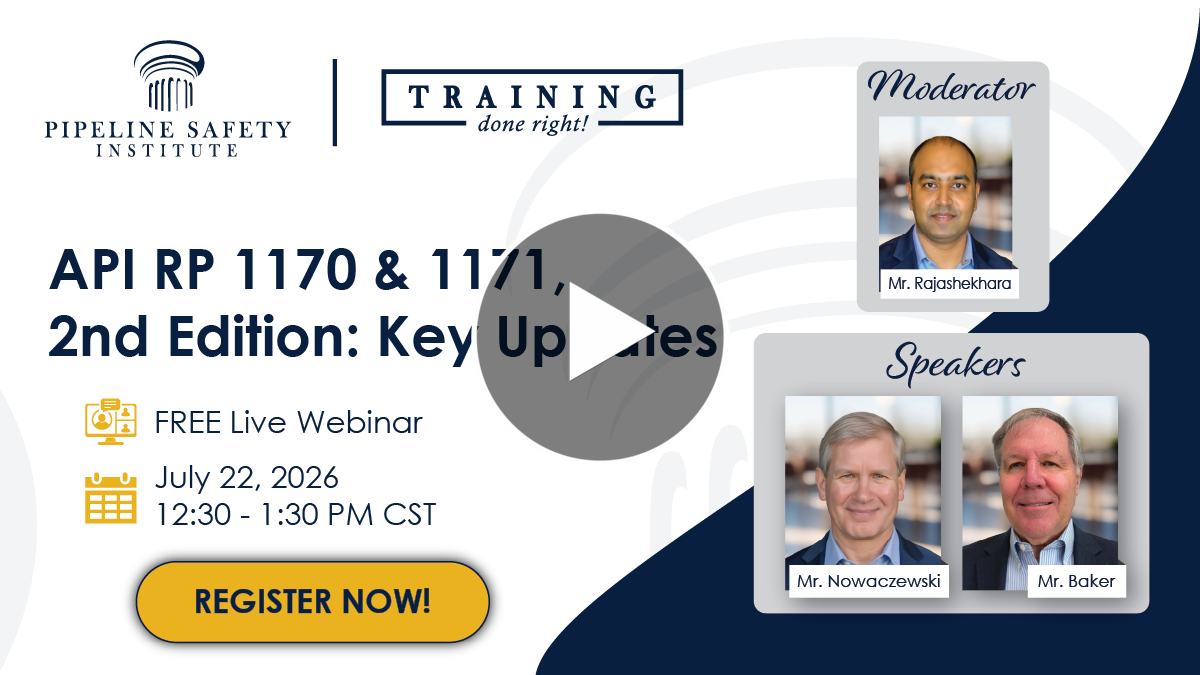
Unpacking the Key Updates in API RP 1170 & 1171, 2nd Edition
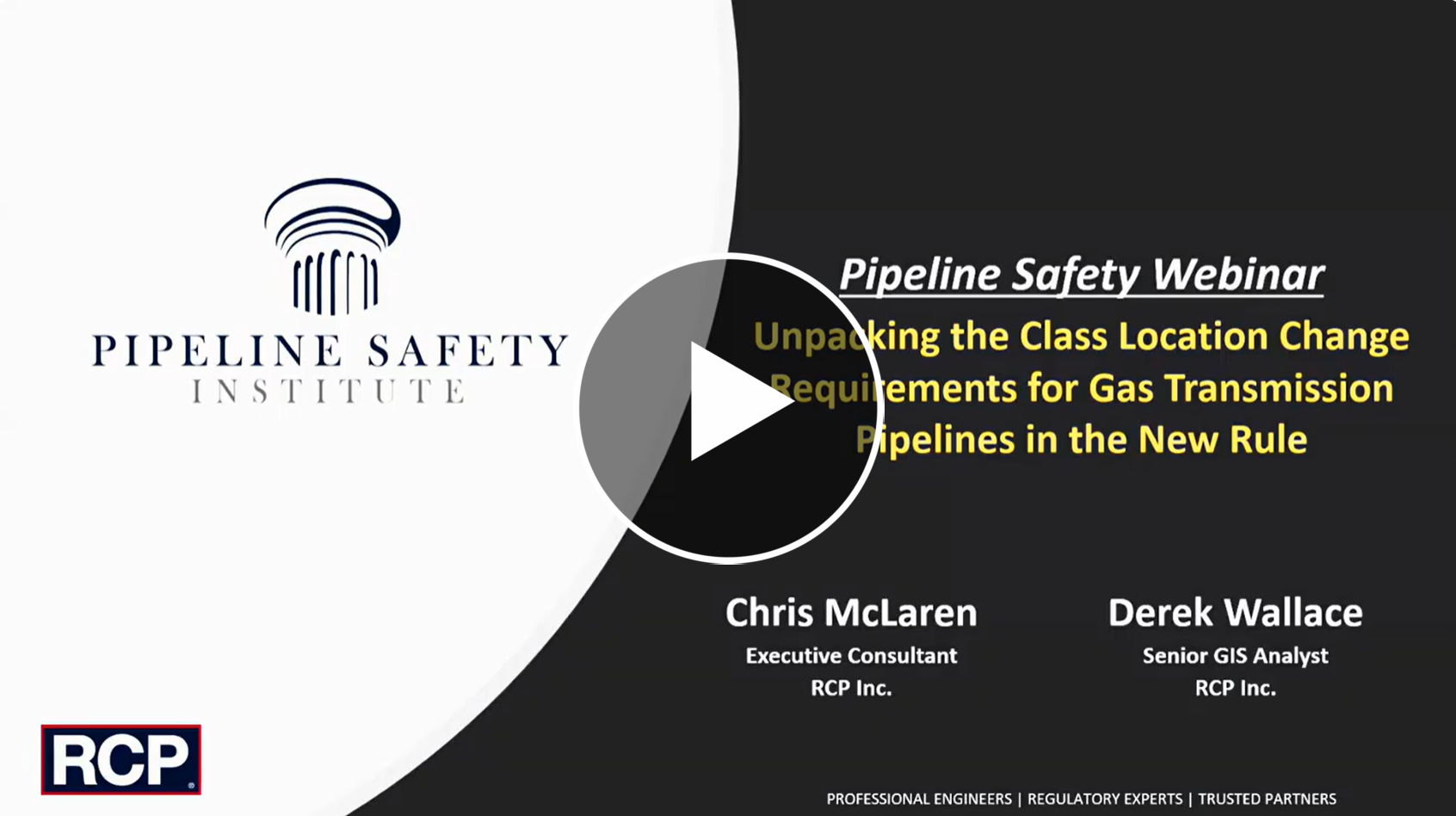
RCP and the Pipeline Safety Institute offered a free webinar exploring the 2nd Editions of API RP 1170, Design and Operation of Solution-mined Salt Caverns Used for Natural Gas Storage and API RP 1171, Functional Integrity of Natural Gas Storage in Depleted Hydrocarbon Reservoirs and Aquifer Reservoirs. Thank you to everyone who attended and participated in this informative webinar. The session recording is posted to our YouTube channel. Please watch, like, and subscribe to our channel!
New Workshop Alert!
Prepare Your Team for Pipeline Safety Audits with Confidence!
Our 3-day Pipeline Safety Audit Workshop is tailored for professionals responsible for the safe operation of hazardous liquid and natural gas pipelines. Designed for groups of 10-15 participants, this interactive training…
On-Site Training Request
We have conducted on-site training for oil and gas companies for over 25 years and can provide customized workshops for companies with groups of five or more.
We would welcome the opportunity to discuss our services with you.
Sincerely,

![]()
W. R. (Bill) Byrd, PE
President
RCP Inc.![]()