- Texas Railroad Commission Adopts New Rule Requiring Integrity Management Plans
- Upcoming RCP Seminars
- Drug Testing Regulations – Proposed Changes
- States Are Increasing Their Roles in Pipeline Safety Issues
- API Operator Qualification Conference II
- USA Identification and Mapping Contract
- Colonial Tops U.S. Pipelines for Safety, Protecting Environment
- Reader question of the month
- Help Wanted
- Regulatory Watch: Key Dates & Deadlines
- Conference News
- PSI Training Schedule
Texas Railroad Commission Adopts New Rule Requiring Integrity Management Plans
The Texas Railroad Commission Adopts New Rule Requiring Integrity Management Plans for Natural Gas and Hazardous Liquids Pipelines:
On April 10, 2001, the Texas Railroad Commission (TRRC) issued new regulations requiring integrity management plans for all natural gas and hazardous liquids pipelines within the state. The rule includes changes to the draft rule published in the Texas Register on November 24, 2000 and will be in 16 TAC Chapter 8 entitled "Pipeline Safety Regulations." Operators with both intrastate and interstate pipelines may use an assessment plan developed for interstate facilities provided that the interstate plan meets the requirements of the new § 8.101.
The rule requires Operators to develop pipeline integrity assessment and management plans for all intrastate transmission and gathering lines subject to 49 CFR 192 or 49 CFR 195. Each Operator's plan must be completed by February 1, 2002 on a system-by-system or segment within each system basis. An Operator may select either a "risk based" or a "prescriptive plan" assessment approach. The rule requires Operators to utilize either hydrostatic testing or in-line inspection for integrity assessments or to have TRRC's prior approval before using an alternative integrity assessment method such as direct assessment. Reassessment requirements and treatment of offshore segments are also addressed in the rule. Operators must notify the TRRC when the plan is complete and then TRRC staff has 185 days to either accept the plan or determine which sections are not in compliance.
If an Operator selects the "risk based" assessment approach, 50% of the initial integrity assessments must be completed by January 1, 2006 with the balance complete by January 1, 2011. The Operator must perform a risk analysis for each segment that considers such factors as population density, prior in-line inspection results, consequences of a leak or failure, previous leak history, etc. The Operator then ranks the results of the risk analyses and performs its first integrity assessments on those segments having the greatest risk
For Operators electing the "prescriptive plan", the rule contains tables that identify by service, pipe size and location the deadlines for making initial integrity assessments. Certain specified initial assessments must be complete by January 1, 2006 with all other initial assessments finished by January 1, 2011.
Upcoming RCP Seminars
RCP will conduct a 2 day workshop on DOT Pipeline Regulations on May 15 and 16th in Houston. This workshop will present an overview of all the current DOT regulations for pipeline operators, including recent regulatory initiatives such as operator qualification and pipeline integrity management. It will be followed by a half day workshop on May 17th dedicated to OPA-90 oil spill response planning for DOT pipelines. Both of these workshops are suitable for personnel who need a general introduction to DOT pipeline regulatory requirements. Additional information is available on our website HERE.
Due to a delay in mailing the registration materials for this seminar, the early registration discount is being extended to May 4th, 2001.
RCP will repeat our 2 day workshop on Pipeline Integrity Management on July 17 and 18th in Houston. This workshop presents a detailed analysis of the recent federal Pipeline Integrity Management regulation and the management programs / elements that it requires. We will also review recent state initiatives / proposed rules on pipeline integrity management. On the 18th we will discuss various methods of actually conducting a risk assessment for pipeline segments, and will work though several hands-on examples. We received very positive feedback from the Pipeline Integrity Management workshop that we conducted in March, and expect the July session to fill up rapidly. Additional information is available on our website HERE.
Drug Testing Regulations – Proposed Changes
On April 30, 2001, the Office of Pipeline Safety proposed to conform the pipeline facility drug and alcohol testing regulations with corresponding DOT regulations (Procedures for Transportation Workplace Drug and Alcohol Testing Programs). They also proposed miscellaneous changes to the pipeline facility drug and alcohol testing regulations to make them easier to apply and understand. The proposals are intended to ensure the pipeline facility drug and alcohol testing regulations are clear and consistent with the DOT regulations. The proposed rule can be downloaded from RCP's website HERE. FOR FURTHER INFORMATION CONTACT: L. M. Furrow by phone at 202-366-4559, by fax at 202-366-4566, by mail at U.S. Department of Transportation, 400 Seventh Street, SW., Washington, DC, 20590, or by e-mail at buck.furrow@rspa.dot.gov.
States Are Increasing Their Roles in Pipeline Safety Issues
States are becoming more aware of pipeline safety issues and are moving to assert their authority on safety issues. Some examples of this growing trend are identified below;
* State of Washington. The State Legislature passed and sent to the Governor for his signature on April 19, 2001 legislation funding a new pipeline safety program. The legislation requires interstate pipelines to pay for an inspection and monitoring program for pipelines transporting hazardous liquids. The program will fund four inspectors who will have responsibilities for both new and existing interstate systems.
* State of Texas.(See article above) The Texas Railroad Commission issued on April 10, 2001 regulations requiring integrity management plans for intrastate gathering and transmission lines subject to 49 CFR 192 or 49 CFR 195. The new rule can be found in 16 TAC chapter 8. Initial plans must be complete by February 1, 2002 and maintained in an on-going manner thereafter.
* State of Florida. The Florida Public Service Commission is preparing safety rules for intrastate natural gas pipelines. These rules will likely contain provisions for integrity management, leak surveys, odorization of gas, installation of pipeline valves, corrosion control and other related issues. The timing for issuing the new rules has not been determined.
API Operator Qualification Conference II
The API 2001 Operator Qualification Conference II is scheduled to take place at the Sheraton Baton Rouge on the 30th and 31st of May 2001. This conference is of particular importance not just because it affords opportunities to those who could not attend the February conference, but also because regulatory deadlines are just ahead. Pipeline operators must have a written qualification plan by April 27, 2001. And by October 2002, no person may perform a covered task on a pipeline unless the company has evidence that the person is qualified to perform that task. Consequently this conference is indeed a watershed for the pipeline industry. Workshop and seminar topics will include the covered tasks in API Pub 1161 and additional sub-tasks not included in Pub 1161. Participants will discuss the audited OQ plans with the auditors who reviewed the plans, as well as Learn what it takes for contractors and owners to work together to succeed with operator qualification. For more information on the conference please log on to http://www.api.org/training/Conferences/OQconference/.
Editor's Note: I look forward to meeting you at the conference!
Pending Audits?
Has the DOT notified you of a pending audit? RCP can provide confidential internal auditing to help ensure that your facilities are up to the agency's latest standards.
USA Identification and Mapping Contract
On April 13, 2001, the U.S. Department of Transportation (DOT) announced the award of a five-year, $5 million contract to Research Planning, Inc. (RPI) of Columbia, S.C., to complete the identification and mapping of unusually sensitive areas (USAs). RPI will finish gathering drinking water and ecological data from state agencies and other sources in order to map USAs. The maps will be made available through the Research and Special Programs Administration's (RSPA) Office of Pipeline Safety web site at http://www.npms.rspa.dot.gov/default.htm.
The USA identification and mapping will assist operators in complying with the Department's hazardous liquid pipeline integrity management requirements. Under these rules, which are effective May 29, 2001, pipeline operators must assess, repair, and make other improvements to their hazardous liquid pipelines that could affect unusually sensitive or populated areas.
Editor's note: USA mapping may not be completed by the end of this year. However, each operator of more than 500 miles of hazardous liquid pipelines must still complete their identification of pipeline segments which are in or could affect High Consequence Areas (including USAs) by December 31, 2001. OPS has indicated that operators should just use the USA data as it is available. But operators will be expected to ensure that all populated areas and navigable waters are properly identified in their plans by the December 31, 2001 deadline.
Colonial Tops U.S. Pipelines for Safety, Protecting Environment
Colonial Pipeline swept the top awards for environmental stewardship and worker safety at the API (American Petroleum Institute) Pipeline Conference in San Antonio, and was presented a special Distinguished Performance Award for distinguished performance among the nation's larger pipeline companies. Atlanta-based Colonial operates 5,500 miles of liquid petroleum pipelines from Houston to New York. "Colonial's performance and this award epitomizes the finest in pipeline company operations," said George M. Rootes, chairman of API's Pipeline Committee. "It is particularly noteworthy that Colonial won both the safety and environment awards. It shows consistency and that the company is an across-the-board performer."
API is the largest oil and gas industry trade association, representing more that 400 companies. In judging the Distinguished Performance Award, API compared companies' safety and environmental records as well as their record of accomplishment in proactively enhancing public safety, environmental and safety performance, and in community outreach. The occupational safety award recognizes that Colonial, which carries 20 percent of all liquid petroleum product consumed in the United States, has worked more than two million hours without an accident that caused a lost workday. In capturing the environmental award, Colonial experienced no product releases during 2000 that met the Department of Transportation's minimum volume requirements for reporting.
"Our first priority, everyday, is being safe," said Dave Lemmon, Colonial's President and CEO. "We have made this commitment to the public, to our owners and to the government regulators who share our goal of protecting workers' safety and the environment." Bill Scott, Senior Vice President and Chief Operations Officer said Colonial derives its safety and environmental goals from the commitment the company has to spill-free error-free operations. "We are honored by the recognition," Scott said. "We measure ourselves by whether we meet public expectations for environmental protection and safe operations. This responsibility required constant vigilance on the part of every Colonial employee to sustain this level of safety."
Acquiring a pipeline?
RCP can provide due diligence audits to help you ensure that potential compliance issues have been addressed before the sale is final.
Reader question of the month
In the case of a huge organization, how do they organize compliance management and educate all employees? Are there any good examples regarding (industry omitted) companies? In our company, each division has a lot of regulations and rules, but we are not centralized. I have the task to organize compliance management.
Mr. (name omitted),
Having been responsible for compliance management systems in a large company myself, I have given this topic a lot of thought. I believe the essential elements of a large corporate compliance management system are:
1. Survey – identify all the requirements that apply to the activity / organization (EPA regulations x, y, and z; OSHA regulations a, b, and c, etc.)
2. Organize – develop compliance programs that address the requirements identified during step 1 above. This includes forms, procedures, checklists, filing systems, and guidance manuals as appropriate.
3. Train – develop and conduct training programs for the people who will be required to understand and follow the applicable requirements.
4. Audit – conduct periodic audits of the operations and compliance programs to ensure that the compliance programs are working as desired.
5. Consult – have knowledgeable experts available to answer questions as they arise. These people typically reside at the headquarters level, or could be outside consultants (such as ourselves).
6. Monitor – since the rules are constantly changing, someone (normally the experts in step 5 above) must continually monitor the rules to ensure that the compliance programs are kept up to date. For example, the Department of Transportation rules for pipelines in the US are changed once a month on average. EPA and other agency rules change at least that often.
7. Influence – In the US, companies are given the opportunity to influence new and proposed rules. Most companies do not spend any time or effort in doing this, but they should. The major corporations are willing to spend the time and effort (and $s) to work with the regulatory agencies up-front to ensure that new rules are acceptable from the company's standpoint.
I hope this has been helpful. I have some specific examples of how to organize and conduct each of the steps identified above. We have developed the nationwide compliance manual for a large US pipeline system, and are currently working with other companies on their compliance programs. Please contact me if you need any assistance in developing a compliance process for your company – especially for facilities in the US.
Help Wanted
Know someone with regulatory expertise who is interested in full or part time work? Our recruiting coordinator would be glad to get their resume! Have them sent to chandra@your-rcp.com, or FAX to 713-655-8083.
Visit Regulatory Compliance Partners on the Web at
or call us at 1-888-RCP-X-YES to see what we can do for you.
These articles are maintained and updated as new information becomes available.
Regulatory Watch: Key Dates & Deadlines
Track PHMSA rulemaking, regulatory stages, and important compliance deadlines in RCP's Regulatory Watch.
View Full Regulatory Watch →Conference News
Pipeline Pigging and Integrity Management Conference
The 39th International Pipeline Pigging & Integrity Management Conference (PPIM) will take place at the George R. Brown Convention Center in Houston. The event brings together pipeline operators, engineers, and industry professionals to explore advancements in pipeline inspection, integrity management, risk assessment, and emerging technologies.…
RCP Team Attending
Heather Roark
Jessica FoleyPSI Training Schedule

| Date | Training Course | Price | Registration |
|---|---|---|---|
| Nov 17 – Nov 19, 2026 | DOT Pipeline Compliance Workshop | $2,150 | SOLD OUT |
| Feb 16 – Feb 18, 2027 | Pipeline Safety Audit Training | $2,150 | Register → |
| Feb 23 – Feb 25, 2027 | Advanced Pipeline Risk Assessment Workshop | $2,150 | Register → |
| Mar 23 – Mar 25, 2027 | DOT Pipeline Compliance Workshop | $2,150 | Register → |
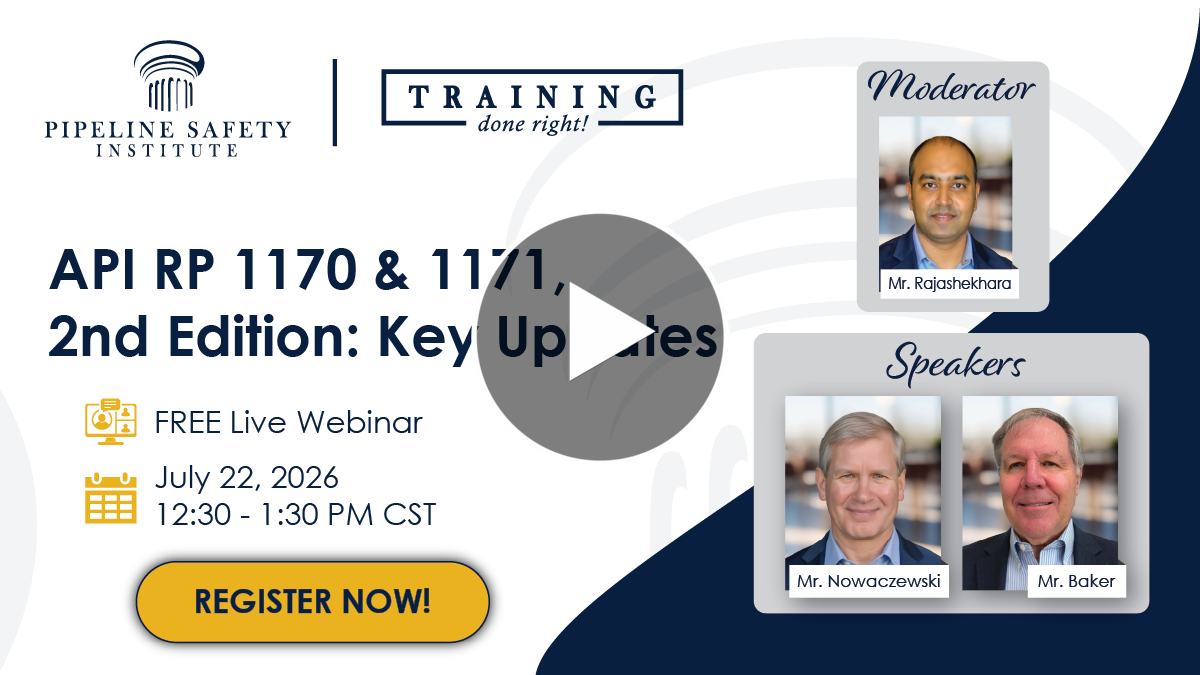
WEBINAR RECORDING!
Unpacking the Key Updates in API RP 1170 & 1171, 2nd Edition
RCP and the Pipeline Safety Institute offered a free webinar exploring the 2nd Editions of API RP 1170, Design and Operation of Solution-mined Salt Caverns Used for Natural Gas Storage and API RP 1171, Functional Integrity of Natural Gas Storage in Depleted Hydrocarbon Reservoirs and Aquifer Reservoirs. Thank you to everyone who attended and participated in this informative webinar. The session recording is posted to our YouTube channel. Please watch, like, and subscribe to our channel!
New Workshop Alert!
Prepare Your Team for Pipeline Safety Audits with Confidence!
Our 3-day Pipeline Safety Audit Workshop is tailored for professionals responsible for the safe operation of hazardous liquid and natural gas pipelines. Designed for groups of 10-15 participants, this interactive training…
On-Site Training Request
We have conducted on-site training for oil and gas companies for over 25 years and can provide customized workshops for companies with groups of five or more.
We would welcome the opportunity to discuss our services with you.
Sincerely,

![]()
W. R. (Bill) Byrd, PE
President
RCP Inc.![]()

- Texas Railroad Commission Adopts New Rule Requiring Integrity Management Plans
- Upcoming RCP Seminars
- Drug Testing Regulations – Proposed Changes
- States Are Increasing Their Roles in Pipeline Safety Issues
- API Operator Qualification Conference II
- USA Identification and Mapping Contract
- Colonial Tops U.S. Pipelines for Safety, Protecting Environment
- Reader question of the month
- Help Wanted
- Regulatory Watch: Key Dates & Deadlines
- Conference News
- PSI Training Schedule