PHMSA Announces $128.2 Million in Pipeline and Hazardous Materials Safety Grants

The Pipeline and Hazardous Materials Safety Administration (PHMSA) announced $128.2 million in federal funding on September 30, 2026, to support pipeline safety, hazardous materials transportation, emergency response training, and inspection programs nationwide.

The funding includes 164 grants, with $97.3 million allocated to pipeline safety programs and $30.8 million to hazardous materials safety initiatives.

The grants will support several key activities:

  • Pipeline Safety Inspections: Provide state inspectors with equipment and resources to conduct safety inspections and enforcement activities involving natural gas pipelines, hazardous liquid pipelines, and underground natural gas storage facilities.
  • Emergency Response Training: Support training programs and exercises to prepare emergency responders for hazardous materials incidents, including rail derailments and industrial spills.
  • Advanced Inspection Technology: Fund drone technology for aerial hazard mapping and thermal imaging along pipeline corridors.
  • Hazardous Materials Oversight: Support inspections of hazardous materials shippers to identify packaging violations before transportation.

The investment is intended to strengthen federal and state safety oversight, improve emergency preparedness, and expand the use of technology in pipeline and hazardous materials safety programs.

PHMSA has also made state-specific funding allocations available for review.

PHMSA NPRM for Liquified Natural Gas (LNG)

The Pipeline and Hazardous Materials Safety Administration (PHMSA) is expected to publish a Notice of Proposed Rulemaking (NPRM) proposing updates to federal safety regulations for liquefied natural gas (LNG) facilities under 49 CFR Part 193.

The anticipated rulemaking, Pipeline Safety: Amendments to Liquefied Natural Gas Facilities (RIN 2137-AF45), is intended to modernize existing requirements, incorporate updated industry standards, and address safety considerations associated with today’s LNG facilities.

RCP will continue monitoring this rulemaking and provide updates as additional information becomes available.

PHMSA Hiring Deputy Associate Administrator for Field Operations

The Pipeline and Hazardous Materials Safety Administration (PHMSA) has announced an opening for the Deputy Associate Administrator for Field Operations within its Office of Pipeline Safety (OPS). The position plays a key leadership role in overseeing PHMSA’s nationwide pipeline safety compliance and enforcement program, including inspections, accident investigations, and enforcement activities aimed at improving safety and ensuring regulatory compliance across the nation’s high-pressure energy pipeline system. PHMSA is seeking highly qualified candidates to join its executive leadership team and has encouraged interested professionals to apply through the USAJOBS vacancy announcement. The Senior Executive Service position is based in Washington, D.C.

Why it matters: The Deputy AA for Field Operations helps shape and direct federal pipeline safety oversight, making this a significant leadership position for professionals with extensive pipeline operations, compliance, and regulatory experience.

Applications will be accepted through October 19, 2026. Click here to learn more about this opportunity.

PHMSA Seeks Public Comments on Pending Pipeline Regulatory Interpretations

The Pipeline and Hazardous Materials Safety Administration (PHMSA) has published two pending regulatory interpretation requests for public review and comment under 49 CFR § 190.11(b).

The requests address the following topics:

  • PI-26-0007 – Portable Gas Supply Systems: Submitted by Schoonover Executive Solutions. Comments are due October 29, 2026.
  • PI-26-0006 – Pipeline Classification Definitions: Submitted by Martin Operating Partnership LP. The request addresses definitions of service, distribution, and transmission lines under 49 CFR § 192.3. The comment period closed October 9, 2026.

PHMSA provides a 30-day public comment period for each posted request. Comments received will be considered before the agency issues a written regulatory interpretation.

Pipeline operators are encouraged to review pending interpretations that may affect their operations or regulatory compliance programs.

Click here to view Pending Pipeline Interpretations and Submit Comments.

PHMSA Announces Summer Research & Development Public Debriefs

PHMSA’s Office of Pipeline Safety (OPS) has announced a series of upcoming virtual events. We’ve provided a summary of the remaining meeting on the schedule below.

Last Updated: October 2026
DatePHMSA DebriefDetails
Nov 17, 2026 Use of Gamification and Generative AI to provide more effective training for hazardous conditions and emergency response. View Details →
Nov 18, 2026 Advanced Leak Detection Capabilities for Compressible Hydrocarbon Products View Details →
Nov 19, 2026 Liquefied Natural Gas (LNG) Knowledge Development, Consequences of Catastrophic Failure of LNG Storage Tanks View Details →
Nov 19, 2026 Standardize the Application of Vapor Corrosion Inhibitors View Details →

These meetings include a presentation of the project’s findings, an overview of its safety benefits, and an opportunity for attendees to ask questions. The completed research reports from all the meetings in this series are intended to provide practical guidance that operators can use to improve pipeline integrity, reduce risk, and support regulatory compliance.

Registration information, meeting agendas, and final project reports are available through PHMSA’s Pipeline Safety Research & Development Program.

Colorado Methane Tracking: New Requirements, One Practical Solution

Colorado’s Greenhouse Gas Intensity Program is moving beyond traditional emissions reporting toward measurement-informed emissions inventories.

Under Regulation 7, Part B, Section VIII, operators subject to the state’s greenhouse gas intensity requirements must use a measurement-informed inventory to demonstrate compliance. Operators can use Colorado’s state default intensity verification factor or an operator-specific program that incorporates methane measurement data into the emissions inventory.

For operators choosing an operator-specific program, the requirements go well beyond simply collecting methane measurements. Operators must maintain the measurement strategy, monitoring records, emissions calculations and supporting documentation necessary to demonstrate how their reported emissions were developed.

What This Means for Colorado Operators

The challenge isn’t just measuring methane. It’s managing the data behind it. Operators need a reliable way to:

  • Maintain asset and emissions data
  • Track methane emissions across facilities and components
  • Calculate emissions and emissions intensity
  • Incorporate field information and measurement data
  • Maintain supporting records and documentation
  • Analyze emissions trends
  • Prepare consistent, defensible reports
  • And those records become increasingly important as Colorado’s verification program matures. Operator-specific programs include third-party audits of measurement-informed inventories for specified reporting years, including calendar year 2025.

RCP has the expertise and the tools to assist Operators in managing the verification requirements,

Meet MethOp: Simplifying Methane Emissions Management

Managing methane emissions requires more than collecting measurements. Operators must organize asset information, maintain accurate calculations, and document the data supporting their emissions reports.

RCP developed MethOp to simplify this process. By bringing emissions tracking, calculations, field data, and supporting documentation into one centralized platform, MethOp helps operators manage their reporting responsibilities without relying on disconnected spreadsheets.

Track it. Calculate it. Document it. Report it.

Learn more about MethOp or contact RCP to discuss your methane emissions management needs.

Featured Service

CorrosionIQ is a complete corrosion compliance and integrity management platform for pipeline operators.

From cathodic protection monitoring and CIS surveys to remediation tracking and compliance reporting, CorrosionIQ brings every component of your corrosion program together in a single system.

Collect data, manage inspections, track corrective actions, analyze trends, and demonstrate compliance with confidence.

Everything Your Corrosion Program Needs

CorrosionIQ covers the full corrosion lifecycle:

  • Corrosion Work Management
  • Cathodic Protection Monitoring
  • CIS, DCVG, ACVG & ACCA Surveys
  • Corrosion Remediation Tracking
  • Corrosion Analytics & Reporting
  • Dynamic Alignment Sheets
  • GIS Mapping & Spatial Analysis
  • Mobile Data Collection
  • Compliance Documentation & Audit Support

Whether you’re managing transmission, gathering, distribution, hazardous liquid, or underground storage assets, CorrosionIQ provides a single source of truth for your entire corrosion program—helping your team spend less time managing data and more time protecting pipeline integrity.

Built for Pipeline Compliance

CorrosionIQ supports corrosion control requirements under 49 CFR Part 192 and 49 CFR Part 195, including:

All requirements are tracked, scheduled, and documented in one place.

Why It Works

Most corrosion programs are spread across multiple systems. CorrosionIQ brings everything together so your team can:

  • See the full picture
  • Identify risk earlier
  • Manage work in one place
  • Reduce manual effort
  • Stay compliant without the scramble

The Enforcement Corner

Enforcement SnapshotOctober 2026
Reporting Period: September 2026
$1,953,719Proposed penalties
14Reported enforcement actions
10Listed violations

CAO: 4   NOA: 3   WL: 2   NOPV: 5  

Review the cited regulations, proposed penalties, and year-to-date enforcement trends in the complete report.

View Full Enforcement Report →

Did You Know?

Natural Gas Doesn’t Smell. It’s Just Dressed Up for Halloween.

Natural gas is naturally odorless, but odorants like mercaptans give it that unmistakable rotten egg smell.

While most people associate the smell with a gas leak, pipeline professionals know it’s actually a carefully engineered safety feature.

Turns out, natural gas wears a disguise year-round. 👻

Q&A Section: What’s Lurking Beneath the Surface?

Q: Can a pipeline pass an integrity assessment and still have threats lurking in the shadows?

Yes. Yes! An integrity assessment provides a snapshot of pipeline conditions at a specific point in time. Threats such as corrosion, cracking, and third-party damage can develop or worsen between assessments.

That’s why 49 CFR Parts 192 and 195 include ongoing integrity management requirements, including preventive and mitigative measures, monitoring, and reassessments, as applicable.

The takeaway? Just because nothing showed up during the last inspection doesn’t mean there’s nothing lurking in the pipeline. 👻

Ask the Experts

Do you have a question for the experts at RCP?  Submit your question using this form. 

Name
Ongoing Resources

These articles are maintained and updated as new information becomes available.

Regulatory Watch: Key Dates & Deadlines

REGULATORY SNAPSHOT Last updated November 3, 2026
38Tracked regulations
8Proposed / DFR
18Final rules

Track PHMSA rulemaking, regulatory stages, and important compliance deadlines in RCP's Regulatory Watch.

View Full Regulatory Watch →
Last Updated: October 2026

Conference News

Jan252027

Pipeline Pigging and Integrity Management Conference

▦ January 25, 2027 – January 28, 2027⌖ George R. Brown Convention Center, Houston, TX

The 39th International Pipeline Pigging & Integrity Management Conference (PPIM) will take place at the George R. Brown Convention Center in Houston. The event brings together pipeline operators, engineers, and industry professionals to explore advancements in pipeline inspection, integrity management, risk assessment, and emerging technologies.…

Exhibiting · Booth 524
RCP Team Attending
Heather RoarkHeather Roark
Jessica FoleyJessica Foley
Event Details

Last Updated: November 2026

PSI Training Schedule

Date Training Course Price Registration
Nov 17 – Nov 19, 2026 DOT Pipeline Compliance Workshop $2,150 SOLD OUT
Feb 16 – Feb 18, 2027 Pipeline Safety Audit Training $2,150 Register →
Feb 23 – Feb 25, 2027 Advanced Pipeline Risk Assessment Workshop $2,150 Register →
Mar 23 – Mar 25, 2027 DOT Pipeline Compliance Workshop $2,150 Register →

WEBINAR RECORDING!
Unpacking the Key Updates in API RP 1170 & 1171, 2nd Edition

RCP and the Pipeline Safety Institute offered a free webinar exploring the 2nd Editions of API RP 1170, Design and Operation of Solution-mined Salt Caverns Used for Natural Gas Storage and API RP 1171, Functional Integrity of Natural Gas Storage in Depleted Hydrocarbon Reservoirs and Aquifer Reservoirs. Thank you to everyone who attended and participated in this informative webinar. The session recording is posted to our YouTube channel. Please watch, like, and subscribe to our channel!

WEBINAR RECORDING
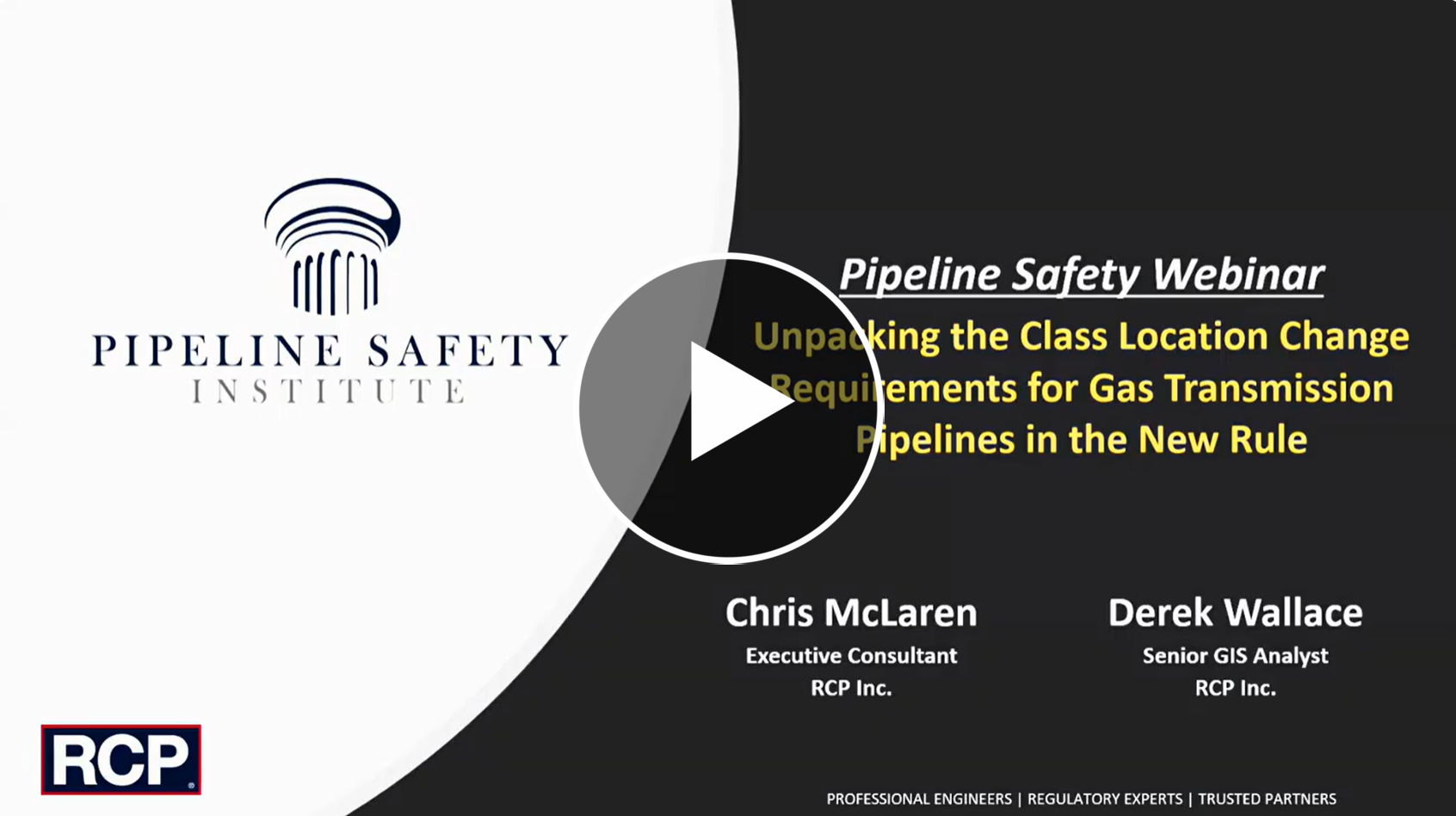
Pipeline Safety: Unpacking the Class Location Change Requirements

Thank you to everyone who attended and participated in this informative webinar. The session recording is posted to our YouTube channel. Please watch, like, and subscribe to our channel!
New Workshop Alert!

Prepare Your Team for Pipeline Safety Audits with Confidence!

Our 3-day Pipeline Safety Audit Workshop is tailored for professionals responsible for the safe operation of hazardous liquid and natural gas pipelines. Designed for groups of 10-15 participants, this interactive training…

On-Site Training Request

We have conducted on-site training for oil and gas companies for over 25 years and can provide customized workshops for companies with groups of five or more.

We would welcome the opportunity to discuss our services with you.

Sincerely,

W. R. (Bill) Byrd, PE
President
RCP Inc.