- DOT Pipeline Compliance Workshop – November 4 & 5, 2008
- Cased Piping IM Assessment
- Voluntary Survey of Regulated and Unregulated Low-Stress Pipeline Information
- MMS Electronically Stored Records NTL No. 2008-G13
- Distribution Integrity Management (DIMP) Workshop
- International Pipeline Conference 2008
- RCP Participation at the International Pipeline Conference 2008
- TEEX Pipeline Training Facility / Emergency Responders
- 2008 International Pipeline Security Forum
- Regulatory Watch: Key Dates & Deadlines
- Conference News
- PSI Training Schedule
DOT Pipeline Compliance Workshop – November 4 & 5, 2008
RCP will be hosting our very popular 2-day workshop on DOT Pipeline Compliance on November 4 & 5, 2008, in Houston, TX. Join us for an informative, lively, and interactive workshop on DOT Pipeline Compliance.
Day 1 (November 4): Gas Pipeline Regulations (49CFR192): Covering all the topics below but special emphasis will be placed on the changes in **GAS GATHERING** regulations.
Day 2 (November 5): Liquid Pipeline Regulations (49CFR195)
Each day of the workshop will address the following issues as they specifically relate to either Gas or Hazardous Liquid pipelines:
- PHMSA Overview
- PHMSA Jurisdictional Boundaries
- Compliance Requirements:
- New/Proposed Regulations – including liquid rural low stress and new gas production pipeline rules in Texas and other states.
For additional information go to our website here.
Cased Piping IM Assessment
PHMSA recently published correspondence from Jeff Weiss (Associate Administrator for Pipeline Safety) to AGA concerning the use of External Corrosion Direct Assessment (ECDA) on cased pipelines. PHMSA agrees that neither current regulations nor the NACE RP0502-2002, ‘External Corrosion Direct Assessment Methodology,’ explicitly requires the use of Guided Wave Ultrasonics (GWUT) for cased piping. And, offered clarifications to 49 CFR 192 Subpart O with respect to integrity assessments on cased pipelines:
- Operators are required to assess all pipe segments that can affect high consequence areas (HCAs), including cased piping [49 CFR 192.919(c) and 921(a)]. This rule requires operators to perform a risk assessment of the covered segments to prioritize segments for assessment, but does not allow a risk assessment to be used to not conduct an integrity assessment of all line pipe in a covered segment.
- Though casings make up a very small percentage of the total gas transmission system, some cased piping segments cannot be assessed using in-line inspection (ILI) or pressure testing. The NACE ECDA standard referenced in the Gas IMP regulation does not explicitly reference or identify any technology to assess carrier pipe inside a non-shorted casing. Other technology can be used if the operator demonstrates it can provide an equivalent understanding of the condition of the line pipe [49 CFR 192.921(a)(4)].
PHMSA held a workshop in July to assist pipeline operators, trade associations, and others in addressing concerns with successfully using External Corrosion Direct Assessment integrity evaluation methods and use of other technologies to assess casings in HCAs. See RCP’s related story in the July edition of the DOT Compliance News.
Voluntary Survey of Regulated and Unregulated Low-Stress Pipeline Information
PHMSA's Office of Pipeline Safety (OPS) is requesting each operator of a rural low-stress hazardous liquid pipeline to complete a voluntary survey to gather information concerning the mileage and characteristics of these pipelines to assess the costs of subjecting rural low-stress pipeline mileage to the pipeline safety standards and regulations pursuant to the PIPES Act. The purpose of this notice is to request all operators of LSPs to complete the voluntary survey, including operators of low-stress pipelines that will not be subject to the pipeline safety standards and regulations until Phase II of the rulemaking proceeding.
To complete the voluntary survey, go to the OPS Online Data Entry Web Site. For those individuals that cannot access the Internet, contact Carson Poe at 617-494-2765 for filing instructions. Surveys are to be completed by September 15, 2008.
For further information contact: Roger Little at 202-366-4569 or by e-mail at roger.little@dot.gov.
MMS – Electronically Stored Records NTL No. 2008-G13
MMS – Electronically Stored Records
NTL No. 2008-G13
The U.S. Dept. of the Interior, Minerals Management Service (MMS) issued a notice to lessees and operators in the Gulf of Mexico OCS region, NTL No. 2008-G13 to clarify the policy of the availability and inspection of electronically stored records and documents. Pursuant to the requirements of 30 CFR 250.804(b) and 1630(b), operators must maintain testing records for each installed surface and subsurface safety device “at the lessee’s field office nearest the OCS facility or other locations conveniently available to the District Manager.” Other MMS regulations require operators to maintain various additional records related to operations, testing, training, and inspections at OCS facilities, including, but not limited to: crane records; pollution inspection records; operating pressure-recorder charts; records of flaring and venting gas and burning liquids; measurements or estimates of volumes of gas lost or used; and meter site security seal records.
Many lessees and lease operators currently use compliance management systems (CMS) to schedule and document testing and inspections. One of the major benefits of using an electronic system over paper is that information can be immediately and remotely available. Use of electronic systems to manage inspections and follow-up activity is recognized and encouraged by MMS and is viewed as a tool that has the potential to reduce incidents of non-compliance and improve compliance with the regulations if used properly.
If you use a CMS and store your test records and other documentation in an Internet-accessible central database or electronic filing system, MMS may recognize this as your official records storage location pursuant to 30 CFR 250.186(a)(3) if your system meets certain criteria. If you would like MMS GOMR to use your electronic CMS for records inspection, submit a letter to the MMS GOMR regional office requesting approval of an alternate procedure under 30 CFR 250.141.
Effective date for NTL 2008-G13 is July 9, 2008.
For more information or the full text of NTL No. 2008-G13, contact Jessica Roger.
Interested in Web-Based Compliance Management Systems?
RCP has the latest technology to help manage all of your permits, inspections, procedures, and data requirements and neatly organize them into one overall compliance assurance system. This includes regulatory tasking, data management, and exception reporting. Because it is web-based, there are no IT issues to struggle through to get started. An institutional memory is created of the compliance history and ongoing compliance requirements, despite operator or personnel turnover. For more information, click here to contact Jessica Roger.
Distribution Integrity Management (DIMP) Workshop
The American Gas Association (AGA), Gas Distribution Integrity Management Workshop will be held on Wednesday, August 13, 2008 at the Chicago Hyatt Regency O’Hare Hotel. The meeting is for Full, Limited, and Associate AGA members. The meeting will be a forum for regulators to present their understanding of the proposed rule for distribution integrity management. Operators will explain their view of the proposed rule and discuss effective ways to implement integrity management. Visit the AGA Website for more information.
International Pipeline Conference 2008
Pipeline industry professionals from around the world will gather for the 7th International Pipeline Conference (IPC) on September 29 – October 3, 2008 in Calgary, Alberta, Canada at the TELUS Convention Centre and Hyatt Regency Hotel. Organized by volunteers representing international E&P;, transmission, and distribution corporations, energy and pipeline associations and governments, the IPC has become internationally renowned as the world’s premier pipeline conference. Visit the IPC website for more information.
RCP Hideout at the IPC Conference
If you are planning to attend the International Pipeline Conference in Calgary (September 29 – October 3) ask Donna for directions to the RCP Hideout. Wii’ll be hosting a two-day competition with the Nintendo Wiis®. Drop by for food, drinks, and some friendly competition. Practice your electronic tennis, bowling, and baseball skills. Win a Wii®! Your family will love you for it!
RCP Participation at the International Pipeline Conference 2008
RCP will be presenting papers at the International Pipeline Conference in Calgary. Presenting authors from RCP include: Bill Byrd, P.E.; Larry Decker, P.E., and Ken Palmer, PhD. This month’s featured abstracts are by Larry Decker – hopefully you will join us in Calgary for the full presentations.
Pipeline Integrity Management – Estimating and Prioritizing the Risk Resulting from Pipeline Facility Operations
Recent efforts to develop a consistent approach to understanding the risk associated with operating a cross country pipeline have focused primarily on the pipe itself. Integrity management plans often include a prioritized risk profile that all but ignores the specific risks associated with operating tank farms, terminals, pumps and compression. This paper outlines a detailed logical approach that can be utilized to evaluate the relative safety, environmental and cost risk associated with operating diverse types of equipment within a pipeline station. Topics covered include the basic objectives of a facility risk model while providing the detail (granulation) necessary to continuously improve. A specific methodology is suggested as a systematic tactic to make an “apples to apples” comparison of diverse stations, lines and types of equipment, from a risk standpoint.
What tools are available to help maintain a code compliant MAOP for a highly complex and changing gas pipeline system?
Companies that operate large and complex gas pipeline systems face the difficult task of maintaining those assets while complying with code and continuing to operate. Continuous system additions and changes, implemented by diverse groups across the company, result in tedious data driven studies to ensure that operating pressure strictly complies with code. This document presents a model and an approach that utilizes Geographic Information Systems (GIS) data to accurately and efficiently calculate a code-compliant Maximum Allowable Operating Pressure (MAOP), for systems that have thousands of miles of wide-ranging pipe segments and components.
TEEX Pipeline Training Facility / Emergency Responders
The Texas Engineering Extension Service (TEEX) is world renowned for its hands-on customized training – providing training and technical assistance to more than 204,000 workers last year. This year, TEEX is building a pipeline prop at their facility which will benefit the industry in training emergency responders. It will be fully functional for training on both gas and liquid pipelines. Phase I is complete which includes 6 stand alone props and 2,300 ft. of underground pipeline. Phase II features a Chemical Complex which will tie into the pipeline prop. Once completed, this complex will enable TEEX to continue to remain the flagship for training in the pipeline emergency response field.
For more information regarding TEEX and how you can make a monetary or equipment donation to the “Chemical Complex Program” please contact: Kevin McMaughan at (979) 458-0171, or by email: james.mcmaughan@teexmail.tamu.edu.
2008 International Pipeline Security Forum
The International Pipeline Security Forum (IPSF) will be held in Salt Lake City, UT at the Hilton Salt Lake City Center Hotel on October 29 & 30, 2008. The Forum is sponsored by the Transportation Security Administration (TSA) in collaboration with Natural Resources Canada. Registration and attendance at the forum is limited to pipeline, energy and security representatives and officials from private industry and government. This event is not open to the general public and media. IPSF Registration is free and hotel reservations can be made directly with the Hilton Salt Lake City Center Hotel no later than Sunday, September 28, 2008 for the discounted room rate.
Forum registration procedures and hotel reservation information can be found at the TSA Website.
The Forum agenda is currently being developed. Click here for the Draft Agenda.
Need A Security Plan or Audit?
We have the expertise to develop a security plan and perform risk assessments for pipeline and terminal facilities to meet recent DOT Hazmat Transportation & Pipeline regulations. We can also assist you in USCG security plans for dock facilities and vessels. Please contact Jessica Roger for more information.
These articles are maintained and updated as new information becomes available.
Regulatory Watch: Key Dates & Deadlines
Track PHMSA rulemaking, regulatory stages, and important compliance deadlines in RCP's Regulatory Watch.
View Full Regulatory Watch →Conference News
Pipeline Pigging and Integrity Management Conference
The 39th International Pipeline Pigging & Integrity Management Conference (PPIM) will take place at the George R. Brown Convention Center in Houston. The event brings together pipeline operators, engineers, and industry professionals to explore advancements in pipeline inspection, integrity management, risk assessment, and emerging technologies.…
RCP Team Attending
Heather Roark
Jessica FoleyPSI Training Schedule

| Date | Training Course | Price | Registration |
|---|---|---|---|
| Nov 17 – Nov 19, 2026 | DOT Pipeline Compliance Workshop | $2,150 | SOLD OUT |
| Feb 16 – Feb 18, 2027 | Pipeline Safety Audit Training | $2,150 | Register → |
| Feb 23 – Feb 25, 2027 | Advanced Pipeline Risk Assessment Workshop | $2,150 | Register → |
| Mar 23 – Mar 25, 2027 | DOT Pipeline Compliance Workshop | $2,150 | Register → |
WEBINAR RECORDING!
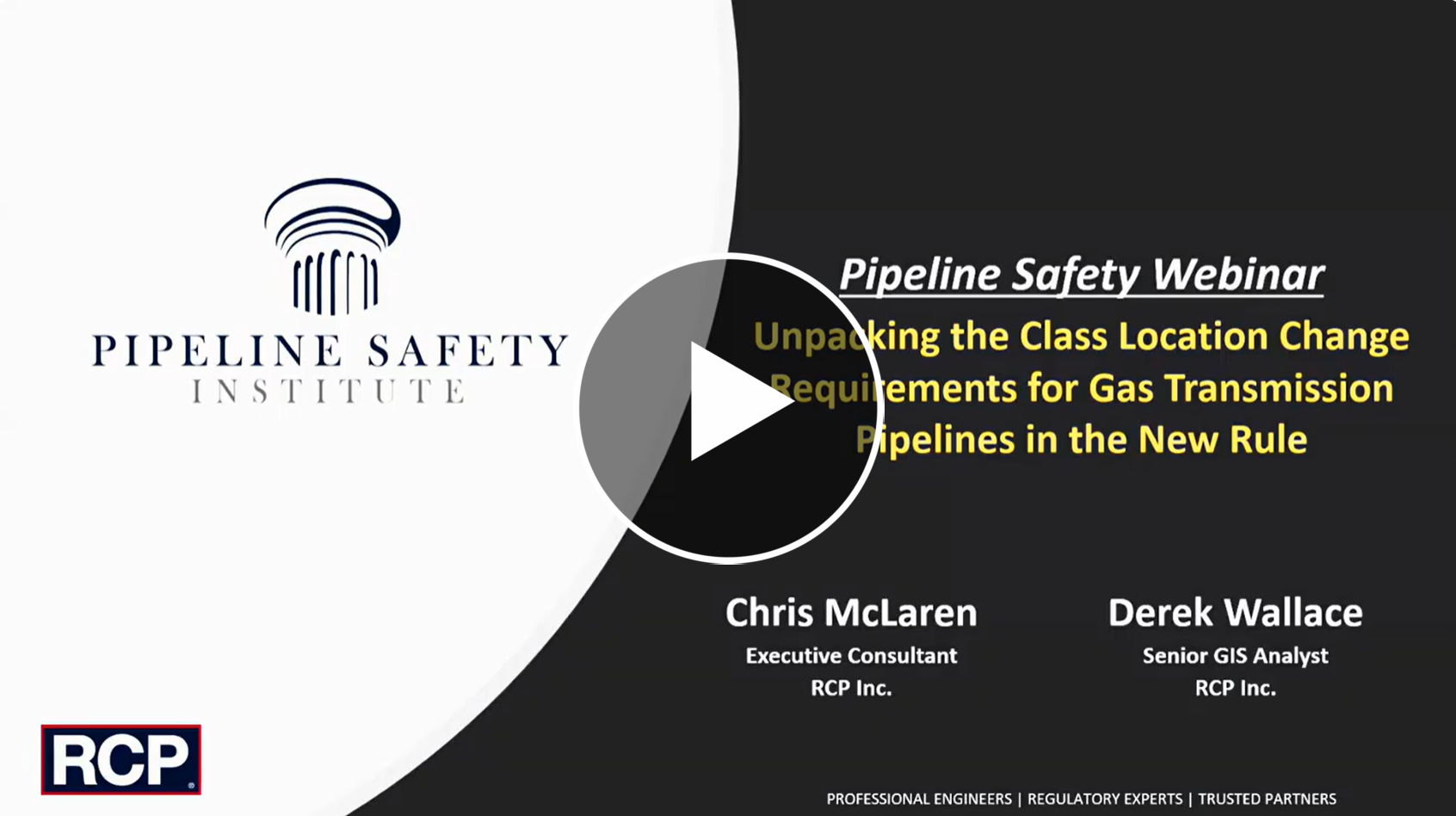
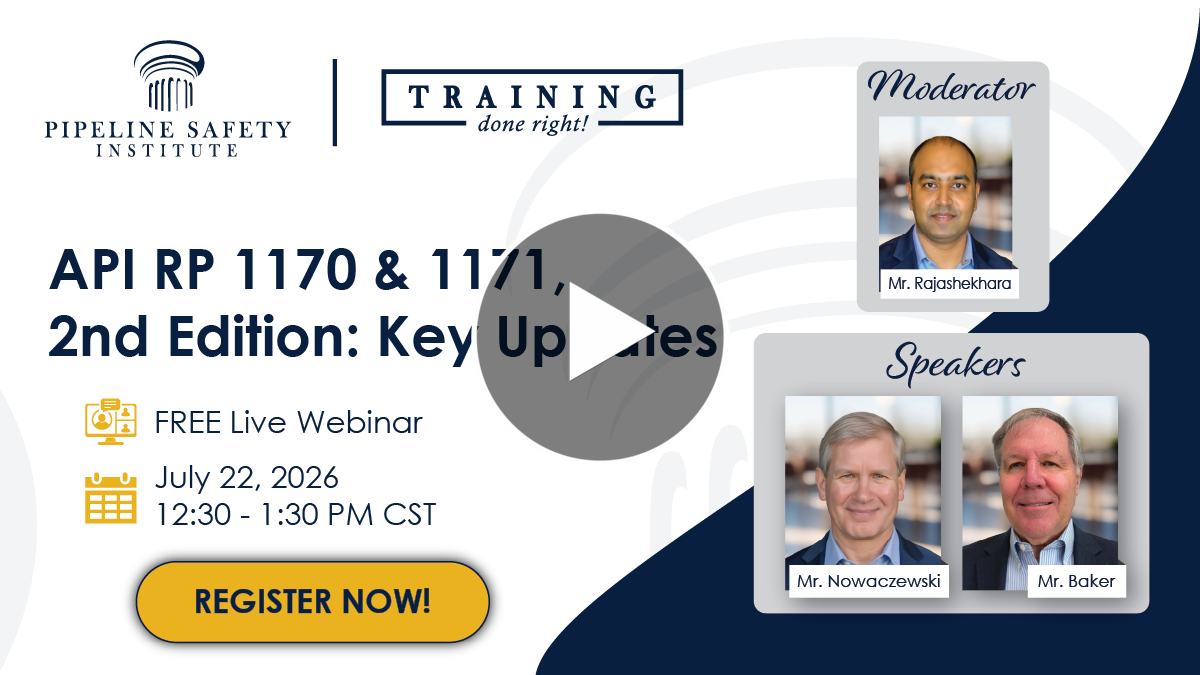
Unpacking the Key Updates in API RP 1170 & 1171, 2nd Edition
RCP and the Pipeline Safety Institute offered a free webinar exploring the 2nd Editions of API RP 1170, Design and Operation of Solution-mined Salt Caverns Used for Natural Gas Storage and API RP 1171, Functional Integrity of Natural Gas Storage in Depleted Hydrocarbon Reservoirs and Aquifer Reservoirs. Thank you to everyone who attended and participated in this informative webinar. The session recording is posted to our YouTube channel. Please watch, like, and subscribe to our channel!
New Workshop Alert!
Prepare Your Team for Pipeline Safety Audits with Confidence!
Our 3-day Pipeline Safety Audit Workshop is tailored for professionals responsible for the safe operation of hazardous liquid and natural gas pipelines. Designed for groups of 10-15 participants, this interactive training…
On-Site Training Request
We have conducted on-site training for oil and gas companies for over 25 years and can provide customized workshops for companies with groups of five or more.
We would welcome the opportunity to discuss our services with you.
Sincerely,

![]()
W. R. (Bill) Byrd, PE
President
RCP Inc.![]()
- DOT Pipeline Compliance Workshop – November 4 & 5, 2008
- Cased Piping IM Assessment
- Voluntary Survey of Regulated and Unregulated Low-Stress Pipeline Information
- MMS Electronically Stored Records NTL No. 2008-G13
- Distribution Integrity Management (DIMP) Workshop
- International Pipeline Conference 2008
- RCP Participation at the International Pipeline Conference 2008
- TEEX Pipeline Training Facility / Emergency Responders
- 2008 International Pipeline Security Forum
- Regulatory Watch: Key Dates & Deadlines
- Conference News
- PSI Training Schedule