PHMSA Liquid Pipeline Final Rule – Low Stress and Gathering Line Exemptions

[Docket ID PHMSA-RSPA-2003-15864]

Effective July 3, 2008, PHMSA has amended its hazardous liquid pipeline safety regulations to:

  • Define “regulated rural gathering line” as an onshore gathering line in a rural area that has a nominal diameter of 6 5/8” to 8 5/8”, located within ¼ mile of an Unusually Sensitive Area (USA), with an MOP greater than 20% of the SMYS (or greater than 125 psi if the SMYS is unknown or the pipe isn’t made of steel); and require operators of these lines to comply with a subset of the existing pipeline safety requirements.
  • Narrow the regulatory exception for rural onshore low-stress hazardous liquid pipelines by extending all existing safety regulations, including integrity management requirements, to low-stress pipelines with a nominal diameter of 8 5/8” or more located within ½ mile of a USA. Operators of newly regulated low-stress pipelines that can show an undue economic burden from complying with all pipeline safety regulations may be able to obtain a special permit from PHMSA to comply with alternative safety requirements in order to keep operating.
  • Require operators of all low-stress pipelines (even those that continue to be exempt), to comply with annual reporting requirements.

These rule modifications were first proposed in a Notice of Proposed Rulemaking on September 6, 2006, and revised by a Supplemental Notice of Proposed Rulemaking on May 18, 2007. Additional rulemaking is anticipated that will ultimately eliminate the low stress piping exemption for all hazardous liquid pipelines.

PHMSA also reorganized and streamlined the applicability section of the hazardous liquid regulations to make them easier to interpret. This streamlining made it clear that PHMSA intends to regulate gathering pipeline segments that cross navigable waters, and that it does not intend to regulate non-low-stress pipelines that are already regulated by the US Coast Guard.

For a copy of the Final Rule on Low Stress and Gathering Line Exemptions, contact Jessica Roger.

PHMSA ADB-08-04- Installation of Excess Flow Valves into Gas Service Lines [Docket ID PHMSA-RSPA-2004-19854]

PHMSA ADB-08-04- Installation of Excess Flow Valves into Gas Service Lines

[Docket ID PHMSA-RSPA-2004-19854]

PHMSA issued an advisory bulletin to advise gas distribution pipeline operators of a statutory requirement to install excess flow valves in selected gas service lines. The Pipeline Inspection, Protection, Enforcement, and Safety (PIPES) Act of 2006 mandates that PHMSA require operators of natural gas distribution systems to install excess flow valves (EFV) on certain gas service lines. The statute directs that installation of EFVs will be required on single family residence service lines:

  • That are installed or entirely replaced after June 1, 2008;
  • That operate continuously throughout the year at a pressure not less than 10 psi gauge;
  • That are not connected to a gas stream with respect to which the operator has had prior experience with contaminants the presence of which could interfere with the operation of an EFV, and
  • For which an excess flow valve meeting the performance standards of 49 CFR 192.381 is commercially available.

The PIPES Act directs PHMSA to include this requirement in a regulation addressing distribution integrity management programs (DIMP). PHMSA is working on its DIMP regulation and expects a proposed rule to be published shortly. PHMSA intends to analyze public comments and prepare a final rule in an expeditious manner. It is apparent, however, that the final rule cannot be in place before the June 1, 2008, deadline for EFV installation that is in the Act.

PHMSA encourages all gas distribution pipeline operators to take actions to ensure that EFVs are installed on the appropriate service lines that are installed or completely replaced after June 1, 2008.

For a copy of PHMSA Advisory ADB-08-04, contact Jessica Roger.

Proposed Rule: Increasing MAOP for Gas Transmission Pipelines [Docket ID PHMSA-2005-23447]

Proposed Rule: Increasing MAOP for Gas Transmission Pipelines

[Docket ID PHMSA-2005-23447]

The Department of Transportation / Pipeline Hazardous Materials Safety Administration (DOT/PHMSA) proposed to amend the pipeline safety regulations to prescribe safety requirements for the operation of certain gas transmission pipelines at pressures based on higher stress levels. The result would be an increase of maximum allowable operating pressure (MAOP) over that currently allowed in the regulations. Please reference RCP's newsletter article on the proposed rule in the April 2008 edition of DOT Pipeline Compliance News. PHMSA is extending the period for written comments on the proposed rule until May 19, 2008, and will consider late filed comments so far as practicable. Comments should reference Docket ID PHMSA-2005-23447 and may be submitted to the E-Gov Web Site: http://www.regulations.gov. For a complete copy of the proposed rulemaking, contact Jessica Roger.

Advisory Bulletin ADB-08-01 – Direct Sales Pipelines Jurisdiction [Docket No. PHMSA-RSPA-2004-19856]

Advisory Bulletin ADB-08-01 – Direct Sales Pipelines Jurisdiction

[Docket No. PHMSA-RSPA-2004-19856]

Editor’s Note: If you ever wondered why a lot of companies hire us to do jurisdictional determination work, the following article should help make the reasons clear

PHMSA has issued an advisory bulletin stating that the Pipeline Inspection, Protection, Enforcement, and Safety Act of 2006 eliminated the former exception of direct sales natural gas pipelines from the definition of an interstate gas pipeline facility.

The Federal pipeline safety laws (49 U.S.C. 60101 et seq.) define an "interstate gas pipeline facility" as a facility subject to the jurisdiction of the FERC under the Natural Gas Act (15 U.S.C. 717 et seq.). Prior to the passage of the Pipeline Inspection, Protection, Enforcement, and Safety Act of 2006 (PIPES Act) (Pub. L. 109-468), the interstate gas pipeline facility definition contained an exception for a gas pipeline facility transporting gas:

  • from an interstate gas pipeline in a State
  • to a direct sales customer in that State
  • buying gas for its own consumption

Because of this exception, these pipelines were considered to be intrastate pipelines and were regulated on a state-by-state basis. Section 7 of the PIPES Act changed this by eliminating the exception. As a result, direct sales gas transmission pipelines subject to FERC jurisdiction formerly considered to be intrastate pipelines for purposes of the pipeline safety laws are now considered to be interstate pipelines.

As interstate gas pipeline facilities, direct sales pipelines are subject to the applicable Federal pipeline safety regulations and PHMSA is responsible for regulatory oversight and enforcement. In cases where a State has both an annual certification for gas under 49 U.S.C. 60105 and an agreement under 49 U.S.C. 60106(b), inspections of these direct sales pipelines may continue to be conducted by a State pipeline safety agency acting as PHMSA's representative although any enforcement action must be referred to PHMSA.

If the line has a State certification from the State Public Utility Commission (PUC) that such State PUC has regulatory jurisdiction over the rates and service of the line and is exercising it (i.e. the State PUC is exercising economic regulatory jurisdiction, not FERC), that would be grounds for concluding that the line is not subject to FERC jurisdiction and therefore can be regulated as an intrastate pipeline by a State having a certification for gas under 49 U.S.C. 60105.

This change does not affect direct sales pipelines that are intrastate pipelines because they extend from another intrastate line to the consumer.

For a copy of Advisory Bulletin ADB-08-01 contact Jessica Roger.

Has the Gas Gathering definition affected your pipelines?

RCP can conduct a detailed analysis of your gas pipelines to determine end points of production and gathering based upon the recently finalized definition of gas gathering pipelines. The analysis will also determine whether your gathering pipelines are regulated and whether they are classified as Type A or B regulated gas gathering. For more information, click here to contact Jessica Roger.

PHMSA Workshop on Integrity Assessments of Transmission Pipelines in Casings

On July 15-16, PHMSA plans to conduct a 2-day public workshop to discuss integrity assessments of transmission pipelines in casings. The workshop will feature presentations from operators, regulators and other industry stakeholders. The workshop is not yet posted on PHMSA’s website calendar, but should be held in Chicago close to O'Hare airport.

International Pipeline Conference 2008

Pipeline industry professionals from around the world will gather for the 7th International Pipeline Conference (IPC) on September 29 – October 3, 2008 in Calgary, Alberta, Canada at the TELUS Convention Centre and Hyatt Regency Hotel. Organized by volunteers representing international E&P;, transmission, and distribution corporations, energy and pipeline associations and governments, the IPC has become internationally renowned as the world’s premier pipeline conference. Visit the IPC website for more information.

RCP Hideout at the IPC Conference

If you are planning to attend the International Pipeline Conference in Calgary (September 29 – October 3) ask Donna for directions to the RCP Hideout. Wii’ll be hosting a two-day competition with the Nintendo Wiis®. Drop by for food, drinks, and some friendly competition. Practice your electronic tennis, bowling, and baseball skills. Win a Wii®! Your family will love you for it!

Department of Homeland Security Chemical Facility Anti-Terrorism Standards (DHS CFATS) and Impact on Underground Storage of Natural Gas Operations

(Courtesy of the AGA Associate newsletter)

Following extensive discussions and a formal technical session with DHS at which AGA-member company storage operators provided a tutorial of storage operations, member company security professionals detailed storage vulnerability/consequence analyses, and the associations (AGA & INGAA) proposed a more applicable consequence evaluation (C-FER circle and High Consequence Area analysis), DHS has amended the online Top Screen application and analysis to include questions which take into account the differences between underground natural gas storage and underground storage of other types of chemicals (e.g., underground tanks). In the absence of these additional questions, all underground natural gas storage facilities (due to mass quantity, alone) should plan for compliance with the CFATS regulations.

A letter indicating how the facility ranked as a result of the preliminary analysis by the unamended Top Screen tool will be distributed by DHS to the facility operator in June. At that point, the operator will have the option to re-submit facility information (in its entirety) to the amended online Top Screen application. If an operator selects to re-submit, the likelihood significantly increases that the re-evaluation would demonstrate a more favorable analysis for the facility and ideally, would drop the facility from the current CFATS program.

Need A Security Plan or Audit?

We have the expertise to develop a security plan and perform risk assessments for pipeline and terminal facilities to meet recent DOT Hazmat Transportation & Pipeline regulations. We can also assist you in USCG security plans for dock facilities and vessels. Please contact Jessica Roger for more information.

Draft National Pollutant Discharge Elimination System (NPDES) General Permit for Stormwater Discharges From Construction Activities

Federal Register: May 16, 2008 (Vol. 73, No. 96)

EPA is proposing for public comment the issuance of their 2008 National Pollutant Discharge Elimination System general permits for stormwater discharges from new dischargers engaged in large and small construction activities. This draft 2008 CGP contains the same limits and conditions as the Agency's 2003 CGP with the exception of a few minor modifications detailed below. As proposed, EPA is issuing this CGP for a period not to exceed two (2) years. All comments must be postmarked by June 16, 2008. In addition, EPA is also requesting comments on the criteria to be used by the Agency to incorporate, by reference, "qualifying local program requirements" for erosion and sediment control.

Significant changes from the 2003 CGP include clarification that: eligibility for coverage under the 2008 CGP is limited to operators of new and unpermitted ongoing construction projects; operators of ongoing permitted construction projects are not eligible for coverage under the 2008 CGP and removal of eligibility for operators in Tribal Lands in Maine from the list of areas in Appendix B where this permit is effective.

For a copy of the Draft NPDES, contact Jessica Roger.

Need to Update your SPCC Plan?

RCP has created and/or updated over 200 Spill Prevention Control & Countermeasures Plans. We have the expertise to update your SPCC Plan. Please email Jessica Roger for more information.

Court Vacates Storm Water Permit Exemption

On May 23, 2008, the U.S. Court of Appeals for the Ninth Circuit vacated a U.S. Environmental Protection Agency rule exempting certain natural gas construction activities (including gas transmission and storage construction projects) from Clean Water Act permitting requirements for storm water discharges. Construction activities that disturb more than 1 acre of soil may be impacted by this ruling, and may need storm water permits even if they were previously exempt. Click here for a copy of the petition for review.

MMS NTL 2008-G05 Shallow Hazards Program

The U.S. Dept. of the Interior, Minerals Management Service (MMS) issued a Notice to Lessees and Operators and Pipeline Right-of-way Holders (NTL) No. 2008-G05 effective May 1, 2008. This supersedes NTL No. 2007-G01, effective February 15, 2007. It (1) specifies the group intervals for acquiring medium penetration seismic profiler information, (2) discontinues the process of obtaining prior approval if you want to substitute 3-D data and information for high-resolution subbottom profiler or a medium penetration seismic profiler information, (3) clarifies the procedures for submitting shallow hazards reports on CD-ROM’s, (4) amends the format for listing magnetic anomalies and sidescan sonar contacts in shallow hazards reports, (5) clarifies that the onsite provisions for mitigation of shallow hazards apply to lift and jack-up boats, and (6) allows a MODU or other vessel to depart a location without fully raising its legs or mat as long as they are raised sufficiently to ensure no contact with pipelines and other potential hazards.

For a copy of MMS NTL 2008-G05, contact Jessica Roger.

TEEX Pipeline Training Facility / Emergency Responders

The Texas Engineering Extension Service (TEEX) is world renowned for its hands-on customized training — providing training and technical assistance to more than 204,000 workers last year. This year, TEEX is building a pipeline prop at their facility which will benefit the industry in training emergency responders. It will be fully functional for training on both gas and liquid pipelines. Phase I is complete which includes 6 stand alone props and 2,300 ft. of underground pipeline. Phase II features a Chemical Complex which will tie into the pipeline prop. Once completed, this complex will enable TEEX to continue to remain the flagship for training in the pipeline emergency response field.

For more information regarding TEEX and how you can make a monetary or equipment donation to the "Chemical Complex Program" please contact: Kevin McMaughan at (979) 458-0171, or by email: james.mcmaughan@teexmail.tamu.edu.

ERCB Directive 071 – Emergency Preparedness & Response Requirements for the Petroleum Industry

The Energy Resources Conservation Board (ERCB) issued revised Directive 071 on April 8, 2008. This directive provides the requirements for petroleum industry operators. It covers not only sour operations but any activity where a hazard exists with the potential to cause a risk to the public. The format of the Directive has changed and is now divided into two parts: one for planning purposes and the other for response requirements. There are significant changes including new planning and response zones. Changes made are detailed in Table 1, "Summary of New Requirements" of the directive.

For a copy of this revised Directive 071, contact Jessica Roger.

Save the Dates!

RCP DOT Workshops in 2008

November 4 & 5 — Houston, Texas

Registration begins in August!!

Visit our Seminars webpage for updates & registration information.

2008 International Pipeline Security Forum

The International Pipeline Security Forum (IPSF) will be held in Salt Lake City, UT at the Hilton Salt Lake City Center Hotel on October 29 & 30, 2008. The Forum is sponsored by the Transportation Security Administration (TSA) in collaboration with Natural Resources Canada. Registration and attendance at the forum is limited to pipeline, energy and security representatives and officials from private industry and government. This event is not open to the general public and media. IPSF Registration is free and hotel reservations can be made directly with the Hilton Salt Lake City Center Hotel no later than Sunday, September 28, 2008 for the discounted room rate.

Forum registration procedures and hotel reservation information can be found at the TSA Website.

The Forum agenda is currently being developed. Click here for the Draft Agenda.

Canadian NEB Pipeline Integrity Management Workshops

The National Energy Board (NEB) is partnering with pipeline regulators in B.C., Saskatchewan and Manitoba to deliver workshops on pipeline integrity management programs and pipeline pigging.

Upcoming sessions will be held in Winnipeg, MB – June 24-25. Other workshops will be held in Lloydminster, Calgary, Edmonton, Regina, Grand Prairie, Bonnyville and Estevan in the Fall.

For more information about upcoming sessions, please download this document.

Ongoing Resources

These articles are maintained and updated as new information becomes available.

Regulatory Watch: Key Dates & Deadlines

REGULATORY SNAPSHOT Last updated November 3, 2026
38Tracked regulations
8Proposed / DFR
18Final rules

Track PHMSA rulemaking, regulatory stages, and important compliance deadlines in RCP's Regulatory Watch.

View Full Regulatory Watch →
Last Updated: October 2026

Conference News

Jan252027

Pipeline Pigging and Integrity Management Conference

▦ January 25, 2027 – January 28, 2027⌖ George R. Brown Convention Center, Houston, TX

The 39th International Pipeline Pigging & Integrity Management Conference (PPIM) will take place at the George R. Brown Convention Center in Houston. The event brings together pipeline operators, engineers, and industry professionals to explore advancements in pipeline inspection, integrity management, risk assessment, and emerging technologies.…

Exhibiting · Booth 524
RCP Team Attending
Heather RoarkHeather Roark
Jessica FoleyJessica Foley
Event Details
Last Updated: November 2026

PSI Training Schedule

Date Training Course Price Registration
Nov 17 – Nov 19, 2026 DOT Pipeline Compliance Workshop $2,150 SOLD OUT
Feb 16 – Feb 18, 2027 Pipeline Safety Audit Training $2,150 Register →
Feb 23 – Feb 25, 2027 Advanced Pipeline Risk Assessment Workshop $2,150 Register →
Mar 23 – Mar 25, 2027 DOT Pipeline Compliance Workshop $2,150 Register →

WEBINAR RECORDING!
Unpacking the Key Updates in API RP 1170 & 1171, 2nd Edition

RCP and the Pipeline Safety Institute offered a free webinar exploring the 2nd Editions of API RP 1170, Design and Operation of Solution-mined Salt Caverns Used for Natural Gas Storage and API RP 1171, Functional Integrity of Natural Gas Storage in Depleted Hydrocarbon Reservoirs and Aquifer Reservoirs. Thank you to everyone who attended and participated in this informative webinar. The session recording is posted to our YouTube channel. Please watch, like, and subscribe to our channel!

WEBINAR RECORDING
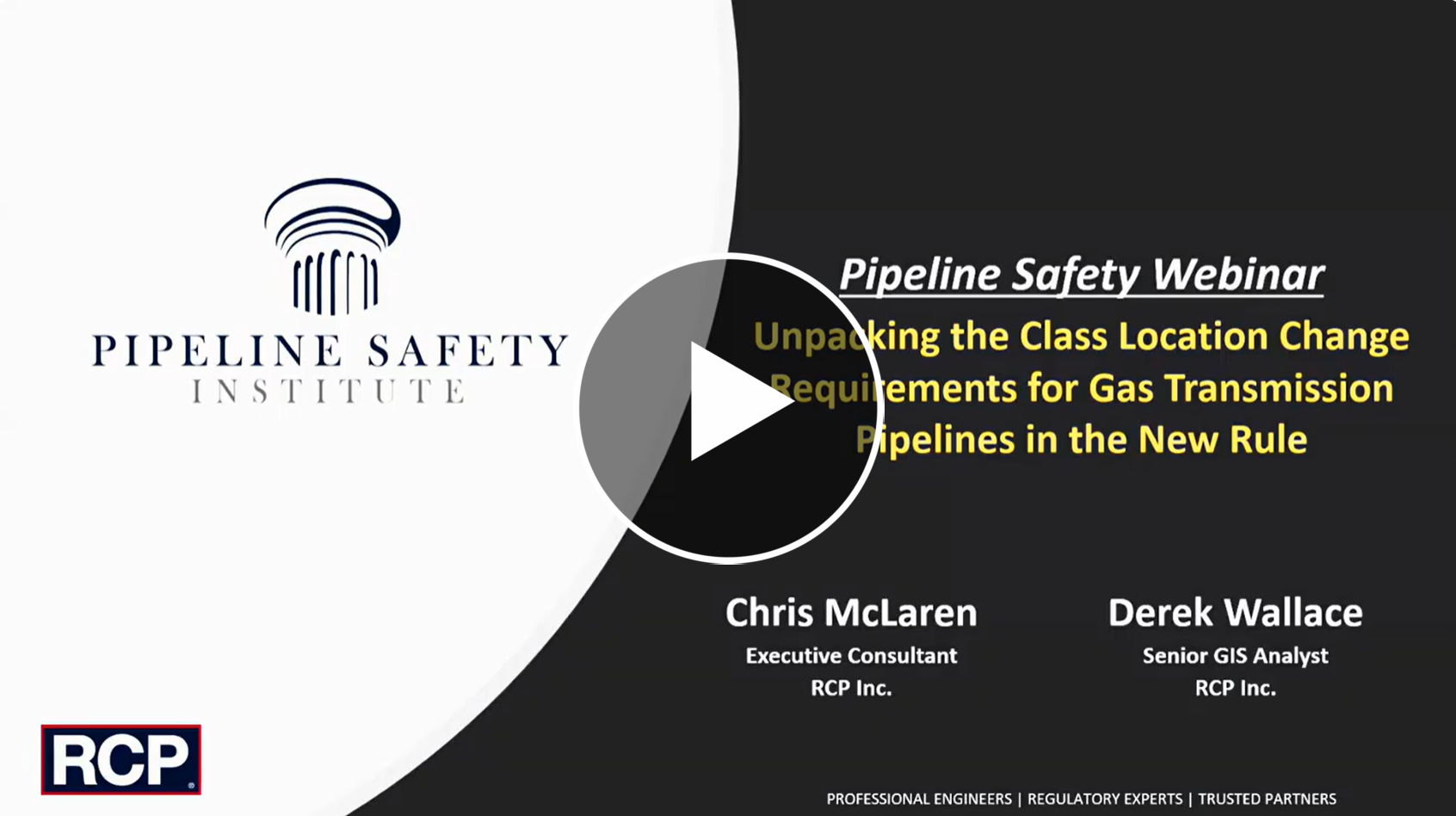
Pipeline Safety: Unpacking the Class Location Change Requirements

Thank you to everyone who attended and participated in this informative webinar. The session recording is posted to our YouTube channel. Please watch, like, and subscribe to our channel!
New Workshop Alert!

Prepare Your Team for Pipeline Safety Audits with Confidence!

Our 3-day Pipeline Safety Audit Workshop is tailored for professionals responsible for the safe operation of hazardous liquid and natural gas pipelines. Designed for groups of 10-15 participants, this interactive training…

On-Site Training Request

We have conducted on-site training for oil and gas companies for over 25 years and can provide customized workshops for companies with groups of five or more.

We would welcome the opportunity to discuss our services with you.

Sincerely,

W. R. (Bill) Byrd, PE
President
RCP Inc.