- PHMSA ADB-2012-02 Pipeline Safety: Post Accident Drug & Alcohol Testing
- PHMSA ADB 2012-03 Driscopipe® 8000 High Density Polyethylene Pipe Potential Material Degradation
- US Coast Guard PREP Guidelines Update Notice
- Misc. Changes to New York State PL Regulations
- PHMSA Leak Detection and RCV Workshops March 27 & 28 – Washington, DC
- 2012 Industry Conferences at a Glance
- Ongoing Resources
- Regulatory Watch: Key Dates & Deadlines
- Conference News
- PSI Training Schedule
PHMSA ADB-2012-02 Pipeline Safety: Post Accident Drug & Alcohol Testing
[Docket No. PHMSA-2011-0335]
PHMSA
issued Advisory Bulletin ADB-2012-02 to Operators of Gas, Hazardous Liquid, and
Carbon Dioxide Pipelines and Liquefied Natural Gas Facilities. Operators and
contractors are encouraged to review and update, where necessary, plans and
procedures governing post-accident substance abuse/misuse testing and train all
those involved with ensuring that such testing is performed promptly and in an
effective manner.
PHMSA regulations in Part 199 require pipeline operators and operators of
Liquefied Natural Gas (LNG) facilities to conduct post-accident drug and
alcohol tests of covered employees. Within the mandated timelines after a
reportable pipeline accident or incident, operators must drug and alcohol test
each covered employee whose performance either contributed to the accident or
cannot be completely discounted as a contributing factor to the accident or
incident. Operators must make the determination of employee contribution to the
accident or incident promptly to meet the timelines for testing required by the
regulations. This was further emphasized by the National Transportation Safety
Board (NTSB) in its report of the September 9, 2010, incident in San Bruno,
California.
For a copy of ADB-2012-02, contact Jessica Roger.
PHMSA ADB 2012-03 Driscopipe® 8000 High Density Polyethylene Pipe Potential Material Degradation
[Docket No. PHMSA–2012–0044]
The
Pipeline and Hazardous Materials Safety Administration (PHMSA) issued Advisory
Bulletin ADB 2012-03 to alert operators using Driscopipe® 8000 High Density
Polyethylene Pipe (Drisco8000) of the potential for material degradation.
Degradation has been identified on pipe between one-half inch to two inches in
diameter that was installed between 1978 and 1999 in desert-like environments
in the southwestern United States. However, since root causes of the
degradation have not been determined, PHMSA cannot say with certainty that this
issue is isolated to these regions, operating environments, pipe sizes, or pipe
installation dates. While the manufacturer has attempted to communicate with
known or suspected users, PHMSA and the National Association of Pipeline Safety
Representatives (NAPSR) have identified several operators currently using
Drisco8000 pipe who had not received communications about the issue. PHMSA is
issuing this advisory bulletin to all operators of Drisco8000 pipe in an effort
to ensure they are aware of the issue and communicating with the manufacturer
and their respective regulatory authorities to determine if their systems are susceptible
to similar degradation.
For a copy of ADB 2012-03, contact Jessica Roger.
US Coast Guard PREP Guidelines Update Notice
[Docket No. USCG-2011-1178]
The
National Preparedness for Response Exercise Program (PREP) is designed to
facilitate the periodic testing of oil spill response plans of certain vessels
and facilities. The Coast Guard, Environmental Protection Agency (EPA),
Department of Transportation’s Pipeline and Hazardous Materials Safety
Administration (PHMSA), and Department of the Interior’s Bureau of Safety and
Environmental Enforcement (BSEE) are working to revise the PREP Guidelines to
reflect changes to regulations, agency reorganizations, and lessons learned
from past preparedness activities and recent response activities. The PREP
Guidelines were last revised in 2002.
The USCG is requesting comments and suggestions for updating the PREP
Guidelines. Comments can be submitted online using the Federal eRulemaking Portal> before April
23, 2012. Include docket number USCG-2011-1178. If you have questions regarding
this notice, contact LTJC Nicole Tourot, Office of Incident Management &
Preparedness, Oil and Hazardous Substances Division at 202-372-2230, or email.
Misc. Changes to New York State PL Regulations
The PSC in New York has recently made numerous changes to their pipeline safety regulations. The State of New York has chosen to re-codify the pipeline safety regulations into the NY regulatory code (as opposed to simply adopting the federal pipeline regulations by reference, and then adopting specific changes). This approach makes it much more difficult to explain how the NY pipeline safety regulations differ from the federal pipeline safety regulations, as it requires a word-by-word comparison of the NY State versus federal regulations in every section of each code. A detailed comparison of this type isn’t within the scope of our monthly newsletter – but anyone with pipelines regulated by the NYPSC who is interested in a detailed comparison should let us know by contacting Jessica Roger.
PHMSA Leak Detection and RCV Workshops March 27 & 28 – Washington, DC
The Department of Transportation/Pipeline Hazardous Materials Safety Administration (PHMSA) is conducting a 2-day workshop on “Improving Pipeline Leak Detection System Effectiveness and Understanding the Application of Automatic/Remote Control Valves.” This event is to provide an open forum for exchanging information on leak detection systems and Automatic/Remote Control Valves for hazardous liquids and natural gas pipelines.
- March 27 will focus specifically on leak detection systems.
- March 28 will focus on automatic/remote control valves.
The 2-day workshop will be held at the Hilton Washington DC /
Rockville Hotel from 8:00 a.m. to 4:00 p.m. A draft Agenda, hotel and on-line
registration information can be found on PHMSA’s website.
The workshop will also be webcasted in its entirety and no prior registration
is required for the webcast.
2012 Industry Conferences at a Glance
It’s
not too early to make plans to attend these upcoming events. RCP will have
representatives and/or presentations at each of these conferences. We hope to
see you there!
SGA Spring Gas Conference and Expo
Charlotte, NC
March 19 – 22
API 2012 Pipeline Conference
Phoenix, AZ
April 17 – 19
AGA Operations Conference
San Francisco, CA
May 1 – May 4
LGA 191/192 & 195 Pipeline Safety Conference
New Orleans, LA
July 23 -27
SGA Operating Conference & Exhibits
Ft. Worth, TX
July 23 – 25
International Pipeline Conference
Calgary, Canada
September 24 – 28
These articles are maintained and updated as new information becomes available.
Regulatory Watch: Key Dates & Deadlines
Track PHMSA rulemaking, regulatory stages, and important compliance deadlines in RCP's Regulatory Watch.
View Full Regulatory Watch →Conference News
Pipeline Pigging and Integrity Management Conference
The 39th International Pipeline Pigging & Integrity Management Conference (PPIM) will take place at the George R. Brown Convention Center in Houston. The event brings together pipeline operators, engineers, and industry professionals to explore advancements in pipeline inspection, integrity management, risk assessment, and emerging technologies.…
RCP Team Attending
Heather Roark
Jessica FoleyPSI Training Schedule

| Date | Training Course | Price | Registration |
|---|---|---|---|
| Nov 17 – Nov 19, 2026 | DOT Pipeline Compliance Workshop | $2,150 | SOLD OUT |
| Feb 16 – Feb 18, 2027 | Pipeline Safety Audit Training | $2,150 | Register → |
| Feb 23 – Feb 25, 2027 | Advanced Pipeline Risk Assessment Workshop | $2,150 | Register → |
| Mar 23 – Mar 25, 2027 | DOT Pipeline Compliance Workshop | $2,150 | Register → |
WEBINAR RECORDING!
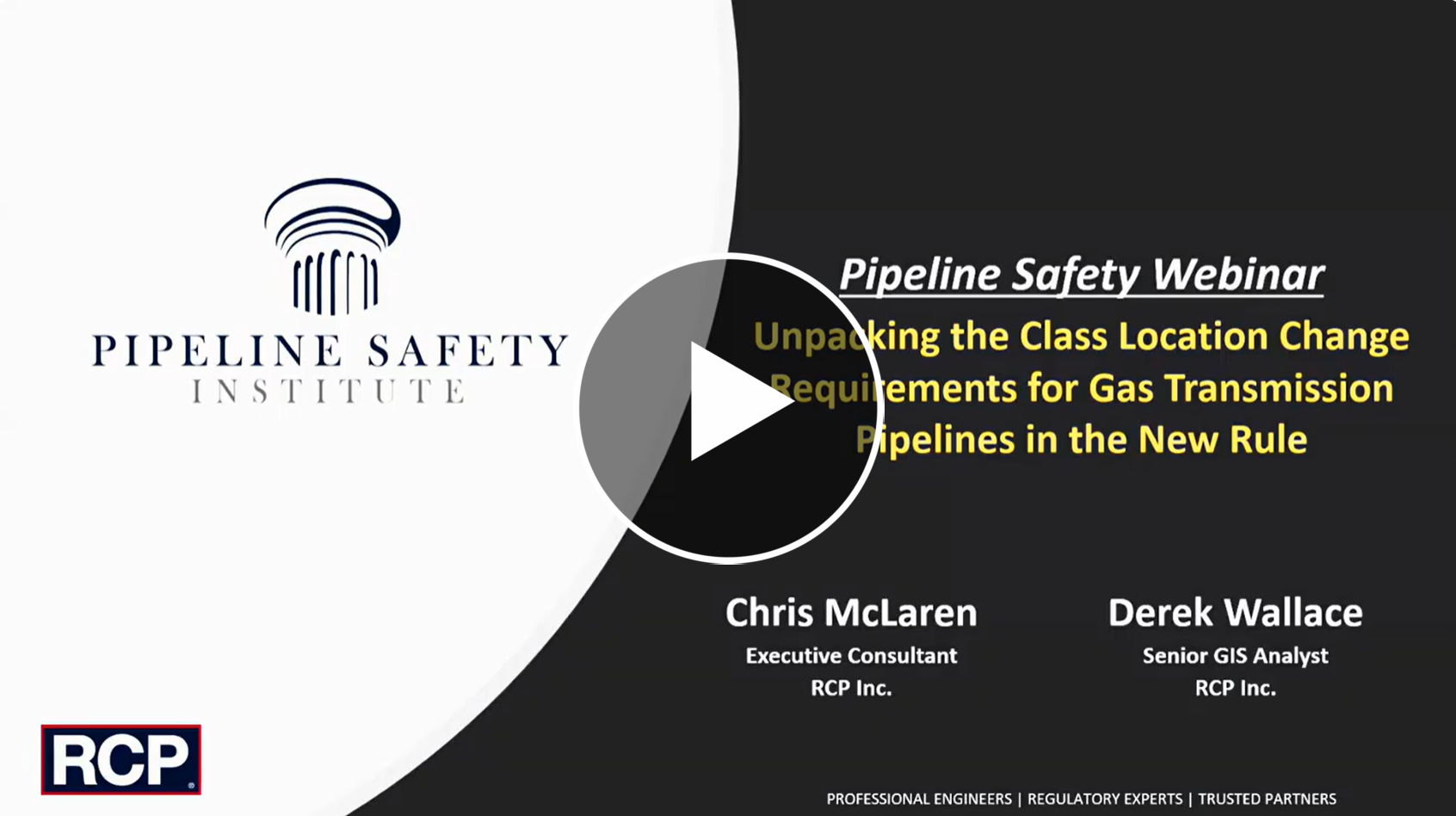
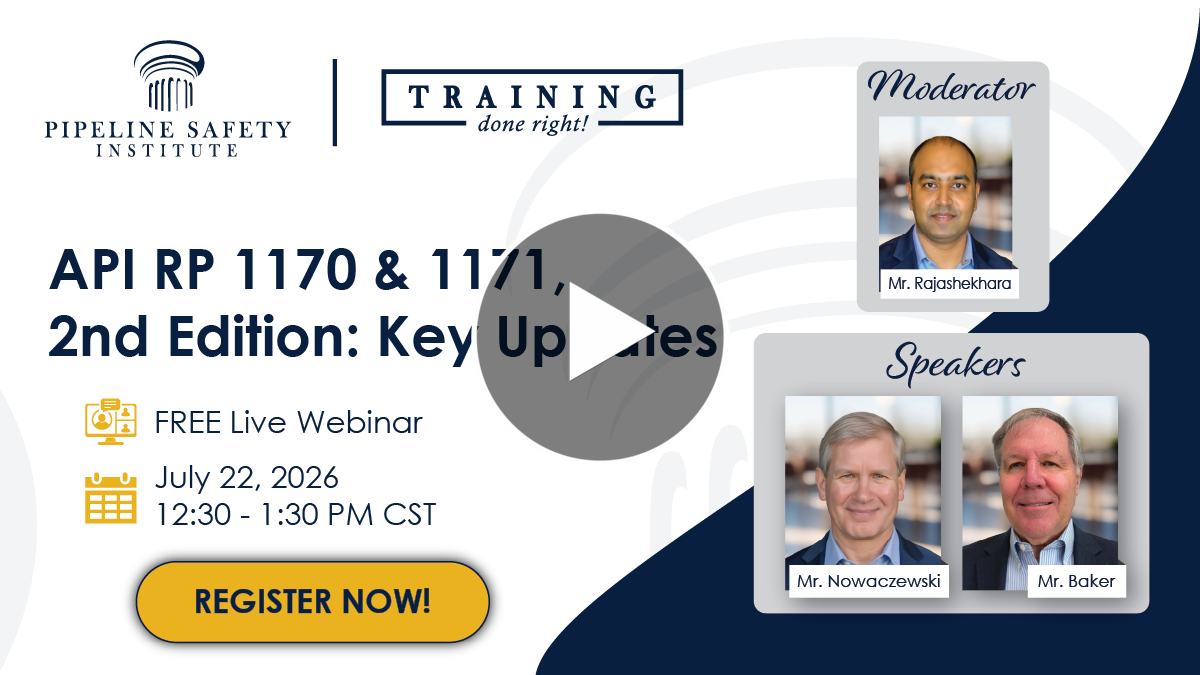
Unpacking the Key Updates in API RP 1170 & 1171, 2nd Edition
RCP and the Pipeline Safety Institute offered a free webinar exploring the 2nd Editions of API RP 1170, Design and Operation of Solution-mined Salt Caverns Used for Natural Gas Storage and API RP 1171, Functional Integrity of Natural Gas Storage in Depleted Hydrocarbon Reservoirs and Aquifer Reservoirs. Thank you to everyone who attended and participated in this informative webinar. The session recording is posted to our YouTube channel. Please watch, like, and subscribe to our channel!
New Workshop Alert!
Prepare Your Team for Pipeline Safety Audits with Confidence!
Our 3-day Pipeline Safety Audit Workshop is tailored for professionals responsible for the safe operation of hazardous liquid and natural gas pipelines. Designed for groups of 10-15 participants, this interactive training…
On-Site Training Request
We have conducted on-site training for oil and gas companies for over 25 years and can provide customized workshops for companies with groups of five or more.
We would welcome the opportunity to discuss our services with you.
Sincerely,

![]()
W. R. (Bill) Byrd, PE
President
RCP Inc.![]()

- PHMSA ADB-2012-02 Pipeline Safety: Post Accident Drug & Alcohol Testing
- PHMSA ADB 2012-03 Driscopipe® 8000 High Density Polyethylene Pipe Potential Material Degradation
- US Coast Guard PREP Guidelines Update Notice
- Misc. Changes to New York State PL Regulations
- PHMSA Leak Detection and RCV Workshops March 27 & 28 – Washington, DC
- 2012 Industry Conferences at a Glance
- Ongoing Resources
- Regulatory Watch: Key Dates & Deadlines
- Conference News
- PSI Training Schedule