PHMSA ADB-2020-01 Pipeline Safety: Meters and Regulators Inside Buildings

[Docket No. PHMSA-2020-0115]

PHMSA issued an advisory bulletin to alert owners and operators of natural gas distribution pipelines to the consequences of failures of meters and regulators inside buildings. PHMSA is also reminding operators of existing Federal regulations covering the installation and maintenance of meter and regulators inside buildings, including the integrity management regulations for distribution systems to reduce the risks associated with failures of meter and regulators inside buildings installations.

For a copy of Advisory Bulletin ADB-2020-01, contact Jessica Foley.

PHMSA ADB-2020-02 Overpressure Protection on Low-Pressure Natural Gas Distribution System

[Docket No. PHMSA-2020-0025]

PHMSA issued an advisory bulletin to remind owners and operators of natural gas distribution pipelines of the possibility of failure due to an over-pressurization on low-pressure distribution systems. PHMSA also reminds pipeline operators of their obligations to comply with the gas DIMP regulations at 49 CFR Part 192, Subpart P. 

PHMSA encourages operators to review the NTSB’s Pipeline Accident Report concerning Columbia Gas of Massachusetts’ over-pressurization event in the Merrimack Valley on September 13, 2018. It may be instructive regarding a host of potential safety problems that operators of low-pressure natural gas distribution systems may need to address. A copy of NTSB’s accident report is contained within Docket No. PHMSA–2020–0025 for this advisory bulletin.

For a copy of PHMSA’s ADAB-2020-02, contact Jessica Foley.

Mega Rule FAQs

[Docket Number PHMSA-2019-0225]

On September 15, 2020, PHMSA posted Batch 1 FAQs on the Gas Transmission Final Rule (aka Mega Rule) to assist gas transmission pipeline operators in complying with the pipeline safety regulations in 49 CFR Parts 191 and 192. The FAQs include PHMSA’s responses to public comments and address a number of issues including compliance deadlines, reporting requirements, moderate consequence areas, spike hydrostatic testing, material verification, MAOP establishment and reconfirmation, non-HCA assessments, and more.

If all of these FAQs are too overwhelming for you Really Cool People, it’s not too late to sign up for RCP’s Virtual Mega-Rule Workshop.

PHMSA Announces Nearly $8 Million in Pipeline Safety R&D Awards

PHMSA announced an award package totaling $7,810,213. The awards will fund 10 pipeline safety research and development (R&D) projects that address pipeline safety priorities including Damage/Threat Prevention, Leak Detection, Anomaly Detection/Characterization, Liquefied Natural Gas (LNG), and Improved Materials. Project awardees will contribute an additional $4,082,308 in cost-share funds.

A Merit Review Panel consisting of 28 members from PHMSA, FERC and the pipeline and LNG industries reviewed 21 project applications. PHMSA solicited proposals for a total of 13 research topics. Read the complete list of awarded projects here. For more information on PHMSA pipeline R&D projects, read here.

California Adopts New Article 7 for Risk Analysis and Best Available Technology for Minimizing Releases from Hazardous Liquid Pipelines

California’s Office of the State Fire Marshal has adopted requirements that govern the requirements for hazardous liquid pipeline construction and operation near environmentally and ecologically sensitive areas in the Coastal Zone. Hazardous liquid pipeline operators are required to conduct and submit a Risk Analysis with associated Implementation Plans to the State Fire Marshal for detecting and minimizing releases. The Office of the State Fire Marshal will determine what will be best available technology for detection and for minimizing releases from these pipelines.

Enforcement of the pipeline Risk Analysis submittals for new pipelines begins May 1, 2021. Existing Pipelines in the Coastal Zone subject to the requirement must have the risk analysis and an implementation plan to retrofit the pipeline with the best available technology by October 1, 2021, and the implementation plan completed by April 1, 2023.

Chapter 14. Hazardous Liquid Pipeline Safety, Article 7 can be found on the California Code of Regulations webpage.

Corps of Engineers NOPR to Reissue Nationwide Permits 2 Years Ahead of Schedule

[Docket No. COE-2020-0002]

On September 15, 2020, the U.S. Army Corps of Engineers (Corps) published a Notice of Proposed Rulemaking (NOPR) to replace the 2017 Nationwide Permits (NWPs) by the end of 2020. NWPs provide a streamlined process for the Corps to authorize work in streams, wetlands, lakes, and tidal waters under Section 404 of the federal Clean Water Act.

The Corps is proposing to reissue its existing NWPs and associated general conditions and definitions, with some modifications. They are also proposing to issue five new NWPs.

They are proposing to divide the current NWP 12, that authorizes utility line activities, into three separate NWPs that address the differences in how different linear projects are constructed, the substances they convey, and the different standards and best management practices that help ensure those NWPs authorize only those activities that have no more than minimal adverse environmental effects. Specifically, the Corps is proposing to modify the current utility line NWP 12 to authorize only oil and natural gas pipeline activities.

The Corps is requesting comment on all aspects of these proposed nationwide permits. Submit comments on or before November 16, 2020 on the Federal eRulemaking Portal, and include the Docket Number COE-2020-0002.

For a copy of the Corps NOPR, contact Jessica Foley.

Michigan Gas Regulation Changes

The Michigan Public Service Commission has made a number of minor changes to its regulations in Chapter 460, Technical Standards for Gas Service.  It also added a new section regarding security reporting, a new section on statistical quality sampling program for diaphragm-type meters, and incorporated a number of industry standards. 

Washington State’s Proposed New Reporting Requirements for Crude Oil Movement by Rail and Pipeline

[Chapter 173-185 WAC]

The Washington State Department of Ecology proposed new reporting requirements for pipeline and rail transport of crude oil. These new requirements include reporting the gravity, vapor pressure and the type of crude oil. The new information will be reported to the Utilities and Transportation Commission (UTC). Three Public Hearings are scheduled  through online Webinars :

  • October 7, 2020 – 1 p.m.
  • October 13, 2020 – 10 a.m.
  • October 20, 2020 – 6 p.m.

The deadline for comments is November 1, 2020.  More information on this rule making can be found on the Washington State Department of Ecology webpage.

Washington State New Reporting Requirements for Gas Pipelines

[RCW 81.88.160]

Starting March 15, 2021, gas pipeline operators will be required to file an annual report with Washington’s State Department of Ecology. The reporting requirements include information about the number and size of gas leaks, pipeline repair activities, and the scheduling of future pipeline repairs. The information reported will be included in the estimated volume of the State’s greenhouse gas emissions.

2020 International Pipeline Conference Wrap Up

Your humble newsletter editor is honored to have served as the chair of the 2020 International Pipeline Conference (and relieved that it is all over!). The conference was held virtually for the first time but still included more than 200 peer-reviewed technical papers on cutting-edge energy pipeline research from throughout the world. Recorded presentations for these papers, as well as the technical papers themselves, will be available to registrants through Oct 30, 2020. https://event.asme.org/IPC A highlights video of the conference featuring many of the presenters and key participants is available here.

Mega-Rule #1: Gas Transmission Regulation Deep Dive Virtual Workshop

RCP has been heavily involved throughout this rulemaking process and is ready to assist operators as they get prepared. Whether it’s a deep dive into MAOP records reconfirmation, conducting Engineering Critical Assessments, assessing where your Moderate Consequence Areas exist, developing Material Verification plans, reviewing existing pipeline integrity programs, developing action plans to get into compliance, or simply providing training to your team on what’s coming, RCP can help.

Summary

Join us for a virtual deep dive into the recently finalized Safety of Gas Transmission Pipelines rule. The virtual format for this is unlike anything you have experienced before. Once registered, attendees will receive links to workshop materials and will be able to review these materials at their own pace and schedule leading up to three separate live Q&A sessions with other attendees and the trainers. Attendees will have the ability to download copies of the materials, and chat and post questions in a live forum from the time they register until the live Q&A sessions with the trainers. There are practical exercises and knowledge reinforcement throughout the workshop to ensure attendees understand how to apply what they have learned. During the live Q&A sessions, trainers will work through these exercises and answer questions from the attendees.

What You Will Learn

There is a lot to unpack with this rule. This workshop will not only dive deep into the rule requirements and some of its nuances; there will also be several practical and interactive exercises for the audience to perform, ensuring they come away knowledgeable not only with “what” is required, but also “how” to conduct certain analyses that are new to the gas transmission pipeline regulations. These exercises will include how to conduct an Engineering Critical Assessment, how to calculate estimated remaining life of your pipelines, how to develop material sampling plans, how to determine TVC records and extract the required data for validated MAOP calculations, and how to plan and execute a spike test.

Workshop Materials

Each attendee will receive access to all presentation materials after registration, including the ability to download copies of the presentations for future reference or taking notes while progressing through the workshop. There are additional reference materials posted within the virtual workshop that can be downloaded, including related PHMSA Frequently Asked Questions, Federal Register Notices, and more.

Schedule

  • February 1 through April 23, 2021
    • Registration Open
    • Registrants obtain access to workshop materials and proceed through this content at their own pace
  • April 6, 2021
    • Live Kick-Off Session with Trainers
  • May 4-6, 2021
    • Live Q&A Sessions with Trainers (1pm-3pm)
    • Day 1: MAOP, Material Verification
    • Day 2: Engineering Critical Assessment, Calculating Remaining Life
    • Day 3: Integrity Outside HCAs, Changes to Integrity Programs, Spike Testing

About the Trainers

RCP trainers have a wealth of industry experience and provide participants a practical perspective on operations and maintenance activities at a level all can understand and are very effective in answering any questions.

Chris Foley, RCP
Mike Rosenfeld, RSI-Pipeline Solutions
Nathan Switzner, RSI-Pipeline Solutions
Nhan Pham, RCP
Joel Anderson, RSI-Pipeline Solutions

Mike Rosenfeld is an experienced consultant in pipeline fitness for service, pipeline integrity, pipeline design and construction, causes of pipeline failures, pipeline regulations and standards, and related matters. He has performed numerous pipeline failure investigations and root cause failure analyses; conducted research, funded by the pipeline industry, on the effects of mechanical damage, fatigue, pipeline integrity threat interactions, and methods to determine the probable grade of undocumented pipe materials; performed engineering analyses of a broad range of design, operations, or integrity matters for numerous pipeline operators; and provided expert support in litigation. He chairs the Subgroup on Design, Materials, and Construction of the ASME B31.8 Gas Transmission and Distribution Piping Committee and serves on other ASME piping standards development committees. Mr. Rosenfeld has authored or co-authored over 90 published articles or public presentations dating to 1988, is an ASME Fellow, and is a Professional Engineer registered in the State of Ohio. He previously worked with Kiefner & Associates (27 years), Battelle (6 years), and Impell Corporation (4 years). He earned a Bachelor of Science in Engineering from the University of Michigan (1979) and a Master of Engineering from Carnegie-Mellon University (1981).

Chris Foley has a deep understanding of the new gas transmission regulation, including participating on the Joint Industry Trade Association Task Group to prepare for and submit comments throughout the Gas Pipeline Advisory Committee process.  Mr. Foley owns three patents for MaxOp, which is widely considered the gold standard used across the gas and hazardous liquid pipeline industry for MAOP validation. He serves on the ANSI GPTC Z380 Gas Piping Technology Committee and the American Gas Association Engineering Committee.  Mr. Foley has almost 30 years’ experience developing and implementing engineering and regulatory compliance solutions and technology for the oil and gas industry. He earned a Bachelor of Science in Industrial Engineering with a specialty in Systems Safety Engineering from Texas A&M University.

Virtual Workshop Pricing

$1,250 for registration prior to March 25
$1,350 for registration after March 25 and prior to April 1
$1,500 for registration after April 1


For more information or to register for this course click here.
Ongoing Resources

These articles are maintained and updated as new information becomes available.

Regulatory Watch: Key Dates & Deadlines

REGULATORY SNAPSHOT Last updated November 3, 2026
38Tracked regulations
8Proposed / DFR
18Final rules

Track PHMSA rulemaking, regulatory stages, and important compliance deadlines in RCP's Regulatory Watch.

View Full Regulatory Watch →
Last Updated: October 2026

Conference News

Jan252027

Pipeline Pigging and Integrity Management Conference

▦ January 25, 2027 – January 28, 2027⌖ George R. Brown Convention Center, Houston, TX

The 39th International Pipeline Pigging & Integrity Management Conference (PPIM) will take place at the George R. Brown Convention Center in Houston. The event brings together pipeline operators, engineers, and industry professionals to explore advancements in pipeline inspection, integrity management, risk assessment, and emerging technologies.…

Exhibiting · Booth 524
RCP Team Attending
Heather RoarkHeather Roark
Jessica FoleyJessica Foley
Event Details

Last Updated: November 2026

PSI Training Schedule

Date Training Course Price Registration
Nov 17 – Nov 19, 2026 DOT Pipeline Compliance Workshop $2,150 SOLD OUT
Feb 16 – Feb 18, 2027 Pipeline Safety Audit Training $2,150 Register →
Feb 23 – Feb 25, 2027 Advanced Pipeline Risk Assessment Workshop $2,150 Register →
Mar 23 – Mar 25, 2027 DOT Pipeline Compliance Workshop $2,150 Register →

WEBINAR RECORDING!
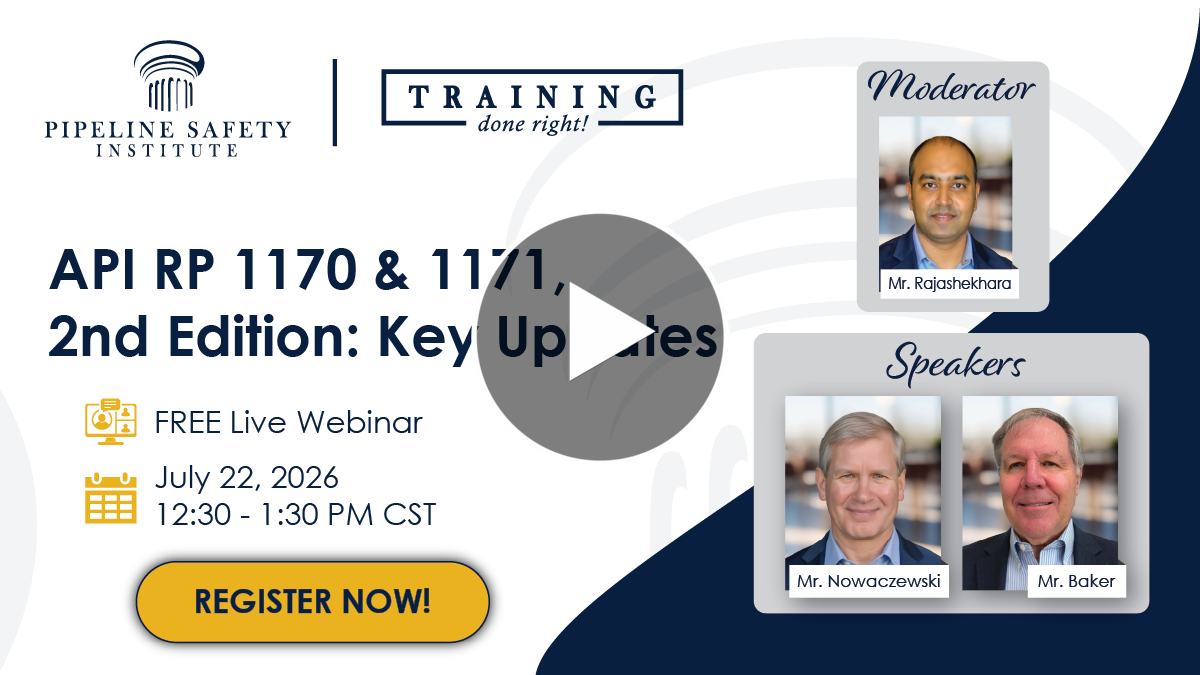
Unpacking the Key Updates in API RP 1170 & 1171, 2nd Edition

RCP and the Pipeline Safety Institute offered a free webinar exploring the 2nd Editions of API RP 1170, Design and Operation of Solution-mined Salt Caverns Used for Natural Gas Storage and API RP 1171, Functional Integrity of Natural Gas Storage in Depleted Hydrocarbon Reservoirs and Aquifer Reservoirs. Thank you to everyone who attended and participated in this informative webinar. The session recording is posted to our YouTube channel. Please watch, like, and subscribe to our channel!

WEBINAR RECORDING
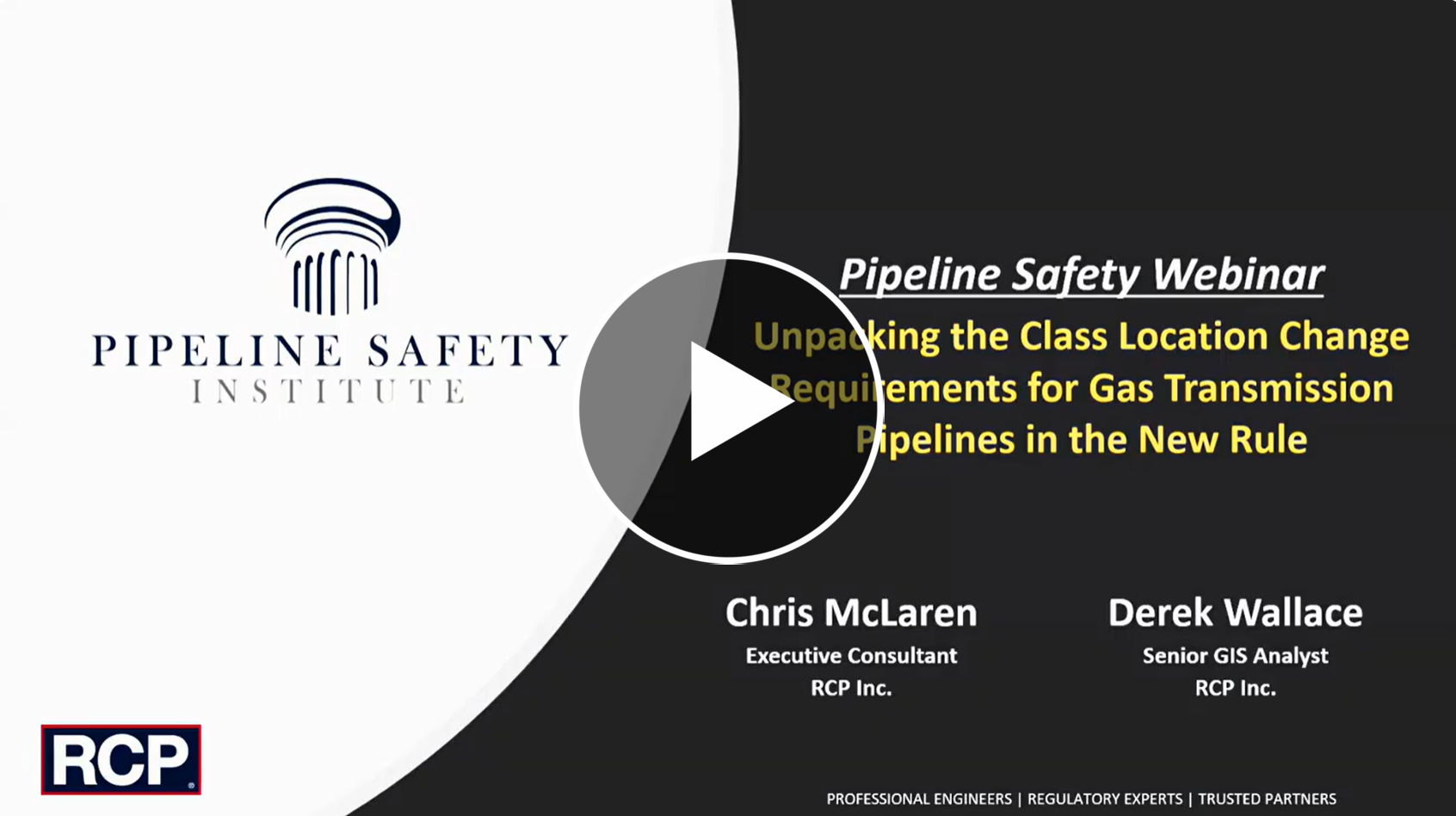
Pipeline Safety: Unpacking the Class Location Change Requirements

Thank you to everyone who attended and participated in this informative webinar. The session recording is posted to our YouTube channel. Please watch, like, and subscribe to our channel!

New Workshop Alert!

Prepare Your Team for Pipeline Safety Audits with Confidence!

Our 3-day Pipeline Safety Audit Workshop is tailored for professionals responsible for the safe operation of hazardous liquid and natural gas pipelines. Designed for groups of 10-15 participants, this interactive training…

On-Site Training Request

We have conducted on-site training for oil and gas companies for over 25 years and can provide customized workshops for companies with groups of five or more.

We would welcome the opportunity to discuss our services with you.

Sincerely,

W. R. (Bill) Byrd, PE
President
RCP Inc.