Gas Gathering / Type R (Reporting Regulated) Annual Report Training

The Pipeline Safety Institute has developed an e-Learning course designed to give gas gathering operators a comprehensive understanding of how to report asset data required for the Type R Gas Gathering Annual Report form (Form F7100.2-3), which is submitted in the PHMSA portal. This course is Ideal for gas-gathering operators that are new to the industry, or anyone who has questions regarding the recent changes to the Annual Reports, or who has not been required to submit an Annual Report in the past.

Topics Include:

  • Annual Report & Its Importance
  • Who Should & When to Submit Annual Reports
  • What is Type R Gas Gathering
  • Identifying Type R Gas Gathering
  • Type R Annual Report Filing Data Checklist
  • Type R Annual Report Filing Steps

For additional information, or to register, click here.

The Enforcement Corner

The Enforcement Corner summarizes recent PHMSA enforcement actions, indicating where PHMSA is putting its enforcement efforts and the fines they are proposing for various types of violations.

In January 2023, PHMSA issued 4 NOAs, 7 NOPVs, and 4 WLs accompanied by $788,608 in proposed fines. Significant proposed fines were attributed to the following code sections:

  • $222,504 – 49 CFR 192.493 – In-Line Inspections
  • $222,504 – 49 CFR 192.605(c)(v) – Procedure Manual
  • $151,900 – 49 CFR 195.202 – Specifications & Standards
  • $63,900 – 49 CFR 195.214(b) – Welding Procedures
  • $63,900 – 49 CFR 195.228(a) – Welding Inspections
  • $63,900 – 49 CFR 195.234(b)(1) – Nondestructive Testing                       

Please note:

  1. Pipeline operators may disagree in whole or in part with each proposed violation cited by PHMSA. 
  2. Proposed Civil Penalties (PCP) may be reduced or eliminated before an enforcement action becomes final.
  3. A Corrective Action Order (CAO) usually addresses urgent situations arising out of an accident, spill, or other significant, immediate, or imminent safety or environmental concern.
  4. A Notice of Amendment (NOA) is frequently a result of a difference of opinion regarding written procedure requirements.
  5. A Notice of Proposed Safety Order (NOPSO) addresses pipeline integrity risks that may not constitute a hazardous facility requiring immediate corrective action (see Corrective Action Order described above),but do need to be addressed over time.
  6. A Notice of Probable Violation (NOPV) is not proof that a violation actually occurred.
  7. A Proposed Compliance Order (PCO) frequently documents actions the pipeline operator already planned to do.
  8. Warning Letter (WL) is an official notice by PHMSA that an operator needs to make improvements but that no further enforcement is proposed for those findings at this time.

RCP maintains a detailed database of all PHMSA enforcement actions dating back to 2007 and is routinely asked for data analysis of various enforcement actions. For more information on how RCP can assist with enforcement action data analysis services, contact Jessica Foley.

Need to respond to a PHMSA enforcement action?
Need to know if your enforcement action is an outlier, or par for the course? 

RCP maintains a detailed database of all PHMSA enforcement actions and their resolution which enables us to compare and contrast individual enforcement actions to nationwide actions and trends.  We can help put things into context to ensure an effective reply for each citation.  For more information on how RCP can assist with enforcement action data analysis services, contact Jessica Foley.

Did you know?

DID YOU KNOW? About the gas cooking safety…

  • Natural gas is a commonly preferred source of energy for cooking products, such as ovens and stovetops, as natural gas offers many benefits including quick startup, even temperature, and reliability during outages.
  • All forms of cooking, regardless of heat source, generate air pollutants, especially at high temperatures.  The installation of exhaust systems for all indoor cooking products, no matter gas or electric, helps to eliminate these pollutants.
  • To ensure safe operation, gas kitchen appliances should be installed in accordance with local codes such as the International Fuel Gas Code or the National Fuel Gas Code.  These codes and other related appliance safety standards are developed by independent organizations that bring together experts from all areas, including government agencies.
  • Always use the appropriate pot or pan size when cooking by matching the pan to flame size.  The flame should be the same as or smaller than the bottom of the pan.
  • APGA is opposed to bans on gas appliances, as they restrict consumer choice, removing affordable choices that consumers love, such as gas cooking appliances. Read APGA’s recent statement here.
  • APGA has a resource page on our website that offers more information on cooking with gas safety/indoor air quality, view it at www.apga.org/naturalgas-cooking-safety.
  • Cooking on a natural gas stovetop is a very safe way to cook and offers many benefits. As with any cooking, it’s important to follow a few simple steps to keep your family safe. Find a safety checklist here: https://www.naturalgasgenius.com/safety/.

  •  

  •  

  •  

  •  

  •  

  •  

Q&A Section

Do you have questions? RCP’s SMEs have the answers. Information will be posted here for questions we often get from clients or discussions we have with regulators, regarding interpretations and pending regulatory deadlines.

Q: If PHMSA’s maps show a liquid HCA, such as a drinking water source, in a certain location, must liquid operators assume that information is accurate when doing their “could affect” analysis?

A: PHMSA’s liquid HCA maps are based on various datasets provided by other agencies and organizations.  While they are a good starting point when identifying HCAs, they are not definitive.  Operators are required to identify any HCAs which were missed in PHMSA’s maps.  Likewise, operators may be able to demonstrate that an HCA shown on PHMSA’s maps is not currently an HCA.  If so, they can omit that HCA from their “could affect” analysis.  RCP can help operators upgrade their HCA datasets to ensure only current HCAs are included in their “could affect” analysis. 

Upcoming Deadlines:

  • April 10, 2023, is coming soon and require all new and entirely replaced gas transmission and liquids pipelines subject to PHMSA’s new RMV rule to comply from that point forward unless alternative technologies are approved by PHMSA for a particular instance. The new RMVs will have to be operational within 14 days of placing the new line or replacement segment in service.
  • The onshore gas gathering rule was published April 8, 2022. Portions became effective May 16, 2022 – Reporting of Incidents for the new Type C & R.
  • Full identification by Type and Class location was to be completed by November 16, 2022
  • For the newly identified Type C that must have the MAOP established, the deadline for boosting system pressure to take advantage of “highest actual operating pressure” as permitted by 192.619(a)(3) is coming fast – May 16, 2023
  • And as a reminder, the “Stay of Enforcement” does not mean regulators don’t expect work toward getting compliance activities in place can be ignored.

If we can help, contact Jessica Foley.

Ongoing Resources

These articles are maintained and updated as new information becomes available.

Regulatory Watch: Key Dates & Deadlines

REGULATORY SNAPSHOT Last updated November 3, 2026
38Tracked regulations
8Proposed / DFR
18Final rules

Track PHMSA rulemaking, regulatory stages, and important compliance deadlines in RCP's Regulatory Watch.

View Full Regulatory Watch →
Last Updated: October 2026

Conference News

Jan252027

Pipeline Pigging and Integrity Management Conference

▦ January 25, 2027 – January 28, 2027⌖ George R. Brown Convention Center, Houston, TX

The 39th International Pipeline Pigging & Integrity Management Conference (PPIM) will take place at the George R. Brown Convention Center in Houston. The event brings together pipeline operators, engineers, and industry professionals to explore advancements in pipeline inspection, integrity management, risk assessment, and emerging technologies.…

Exhibiting · Booth 524
RCP Team Attending
Heather RoarkHeather Roark
Jessica FoleyJessica Foley
Event Details

Last Updated: November 2026

PSI Training Schedule

Date Training Course Price Registration
Nov 17 – Nov 19, 2026 DOT Pipeline Compliance Workshop $2,150 SOLD OUT
Feb 16 – Feb 18, 2027 Pipeline Safety Audit Training $2,150 Register →
Feb 23 – Feb 25, 2027 Advanced Pipeline Risk Assessment Workshop $2,150 Register →
Mar 23 – Mar 25, 2027 DOT Pipeline Compliance Workshop $2,150 Register →

WEBINAR RECORDING!
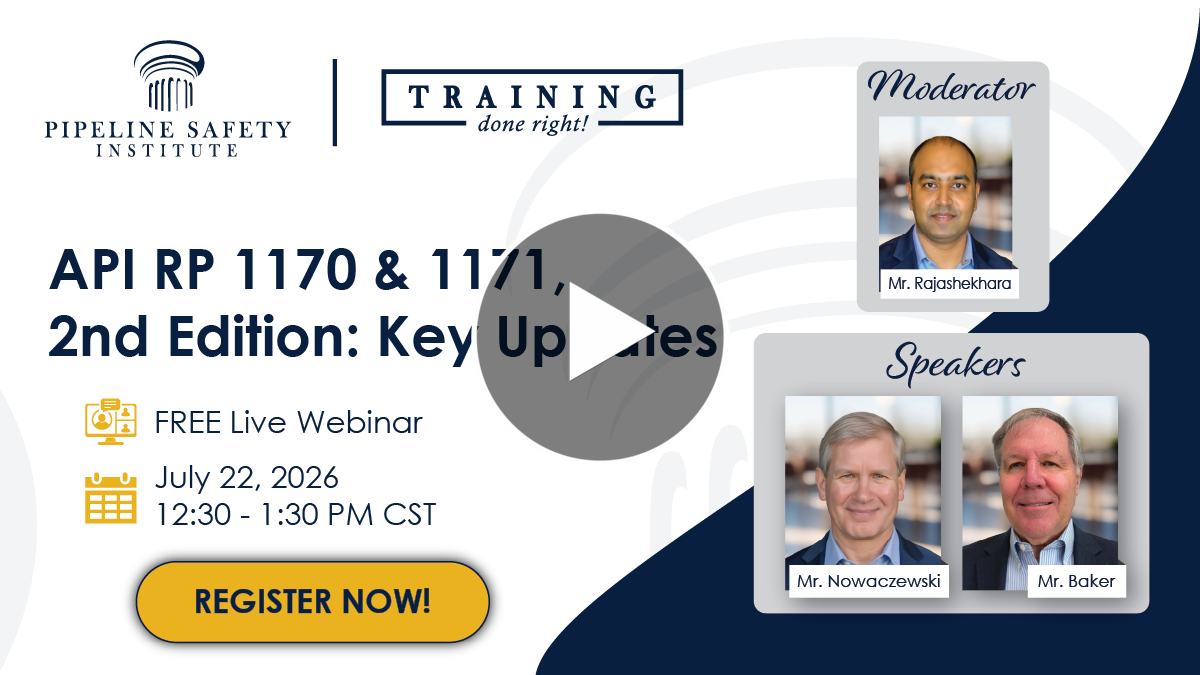
Unpacking the Key Updates in API RP 1170 & 1171, 2nd Edition

RCP and the Pipeline Safety Institute offered a free webinar exploring the 2nd Editions of API RP 1170, Design and Operation of Solution-mined Salt Caverns Used for Natural Gas Storage and API RP 1171, Functional Integrity of Natural Gas Storage in Depleted Hydrocarbon Reservoirs and Aquifer Reservoirs. Thank you to everyone who attended and participated in this informative webinar. The session recording is posted to our YouTube channel. Please watch, like, and subscribe to our channel!
WEBINAR RECORDING
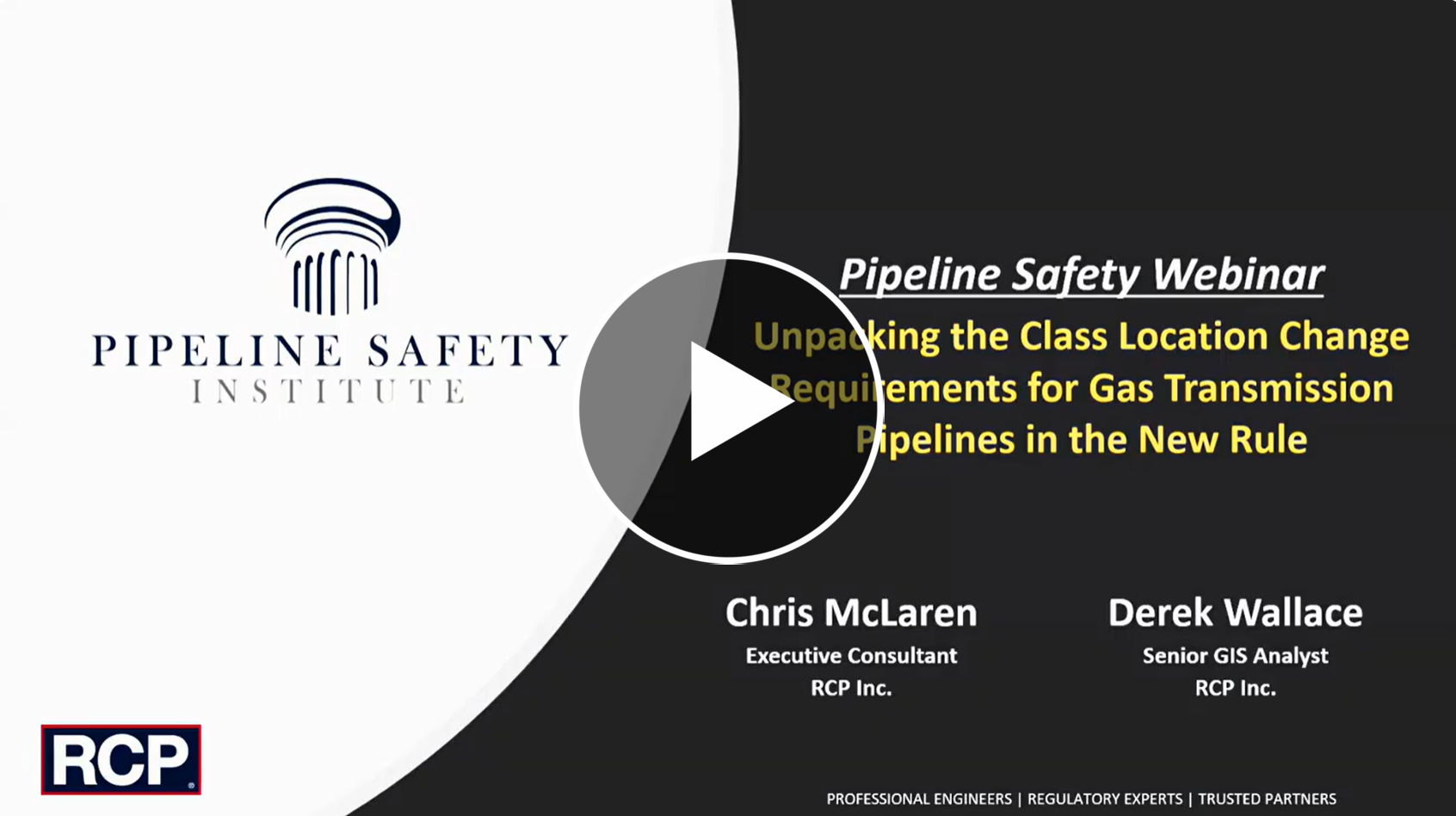
Pipeline Safety: Unpacking the Class Location Change Requirements

Thank you to everyone who attended and participated in this informative webinar. The session recording is posted to our YouTube channel. Please watch, like, and subscribe to our channel!
New Workshop Alert!

Prepare Your Team for Pipeline Safety Audits with Confidence!

Our 3-day Pipeline Safety Audit Workshop is tailored for professionals responsible for the safe operation of hazardous liquid and natural gas pipelines. Designed for groups of 10-15 participants, this interactive training…

On-Site Training Request

We have conducted on-site training for oil and gas companies for over 25 years and can provide customized workshops for companies with groups of five or more.

We would welcome the opportunity to discuss our services with you.

Sincerely,

W. R. (Bill) Byrd, PE
President
RCP Inc.