NTSB 2021-2022 Most Wanted List of Transportation Safety Improvements
[Pipeline Leak Detection]
The NTSB Board Meeting to discuss the 2021-2022 Most Wanted List proposed 10 recommendations, including one safety item to improve pipeline leak detection and mitigation. This safety item has three elements:
- Equipping gas transmission lines with ruptured detection technology;
- Installing automatic shut-off valves and remote-control valves on natural gas transmission lines; and
- Installing methane detectors in all residents with natural gas service.
The NTSB is recommending that the industry take the following actions:
- Revise the National Fuel Gas Code, National Fire Protection Association 54 to require methane detection systems for all types of residential occupancies with gas service; and
- Develop additional guidance that identifies steps gas distribution operators can take to safely respond to leaks, fires, explosions, and emergency calls.
The NTSB also notes that operators should review and update as needed:
- Incident-reporting practices;
- Policies and procedures for responding to leaks, fires, explosions, and emergency calls; and
- integrity management programs
A full list of recommended actions can be found on the NTSB website.
Pipeline Leak Detection, Leak Repair and Methane Emission Reductions Public Meeting
May 5-6, 2021
PHMSA will be holding a virtual public meeting for stakeholder groups and members of the public to share and discuss perspectives on improving gas pipeline leak detection and repair. PHMSA expects to cover subjects that include examining the sources of methane emissions from natural gas pipeline systems, current regulatory requirements for managing fugitive and vented emissions, industry leak detection and repair practices, and the use of advanced technologies and practices to reduce methane emissions from gas pipeline systems. PHMSA is holding this public meeting to gather information to aid in the preparation of a rulemaking and report to Congress on natural gas pipeline leak detection and repair mandated by Sections 113 and 114 of the Protecting our Infrastructure of Pipelines and Enhancing Safety Act of 2020. The meeting will occur virtually on May 5-6, 2021. The meeting agenda and instructions on how to attend virtually have been published on PHMSA’s public meeting registration page.
Proposed Changes to Operator Qualification and Waivers in NY State
[I.D No. PSC-14-21-00003-P]
The New York Public Service Commission is considering revisions to certain sections of 16 NYCRR Part 255 as summarized below:
Waivers would become Special Permits
- The current waiver request would become a request for a special permit. Currently, pipeline operators are required to comply with the regulations as stated or ask for a “waiver” of the requirement. The term “waiver,” however, inaccurately describes what occurs when a company is complying with the regulations but believes it can do so in a different manner than that specifically stated in the regulations. A “special permit,” whether granted temporarily or permanently, is a more accurate description of what is being granted. Any alternative approach to a regulation as written must still “meet or exceed” the existing regulation.
Operator Qualification (OQ) requirements would change in a variety of ways, such as:
- Add a definition for “span of control,” which describes pipeline operators’ ratio of fully operator qualified supervisors to non-qualified workers who are completing pipeline work.
- Change the definition of “covered task” so it would also apply to pipeline construction.
- OQ programs would have to be revised to make clear that to be “operator qualified” workers must have been evaluated for their “knowledge, skills, and abilities” (KSA’s) to complete each covered task. Further, although written tests are not required to test workers’ repair or construction knowledge, when written tests are used, they must be offered in a secure setting that precludes opportunities to cheat. A passing grade on a written test will have to include some basic requirements; for instance, a worker cannot be deemed to have passed a written exam if the worker incorrectly answered any question about how to respond to a “abnormal operating condition” (AOC).
- Operators must explain their “management of change” process for when they make changes to their own operator qualification protocols, such as when and how a task, process, or span of control changes.
- Operators would have to develop a method to keep records and allow real-time checks of which workers are operator qualified and for which tasks on any worksite. It should also be apparent when those credentials expire.
The full text of the proposed rule is posted at the following State website: http://documents.dps.ny.gov/public/MatterManagement/CaseMaster.aspx?MatterCaseNo=19-g-0736&CaseSearch=Search.
For questions, contact: John Pitucci, Public Service Commission, 3 Empire State Plaza, Albany, New York 12223-1350, (518) 486-2655, email: John.Pitucci@dps.ny.gov.
Data, views or arguments may be submitted to: Michelle Phillips, Public Service Commission, 3 Empire State Plaza, Albany, New York 12223-1350, (518) 474-6530, email: secretary@dps.ny.gov.
Public comment will be received until 60 days after April 7, 2021 (the date of publication).
Maine’s Updated Damage Prevention Regulations
[Chapter 420 – Safety Standards for Natural Gas and LNG Facility Operators]
The Maine Public Utilities Commission (MPUC) has updated it General regulation. These updates make this regulation more in alignment with the PHMSA regulations. There are several new definitions, such as Leak Progression Map, Main, Operator, Pipe Appurtenance and Critical Valve. The definition of a Service Line was changed to identify the end as being either the outlet of the meter or at the beginning of the customer’s pipe, whichever is the furthest downstream.
There are several changes to the Damage Prevention program requirements. The Operator, if notified, is now required to have an observer on site when trenchless technology, like directional drilling, is used by a third party. The Damage Prevention program will include procedures that the Operator will use to protect the gas pipelines during trenchless excavations. The updated regulation includes references to several industry standards to be used in the development of these procedures. The content of the communication to excavators will need to be updated to reflect these new procedures. For excavators that are clearing sewer lines, this communication must also include information about the hazards of cross boring gas facilities. Any excavation work requires the operator to identify the GPS coordinates of any underground facilities, including its depth.
Locator training now must include the best practices identified by the Common Ground Alliance and any local underground damage prevention regulations. Training documentation and qualification records are specifically called out for retention. One of the items Locators and persons observing excavations will have to be trained on is the collection and recording of GPS data when underground facilities (critical valves, intersections with service lines or mains and directional information) are exposed.
Reporting an incident no longer needs to be done within 1 hour. There is language now to allow for reporting as soon as practical and employees and the public are safe. Reporting the details of the incident are to be done on the MPUC Underground Facility Incident Reporting Form.
The updated regulation has stated its preference that all new meters are to be located outside of buildings but still allows for meters to be installed inside if outside is not feasible. Operators cannot install Master meters unless the downstream piping is operated and maintained by a pipeline operator. The depth of cover for pipe in Right of Ways has been decreased from 36 inches to 24 inches as measured from the top of the shallowest pipe appurtenance. This means that pipe may have to be buried deeper than the older requirement of 36 inches. This also applies to service lines. The term ‘critical valve’ was added to the definitions. These valves will have to be added to the annual valve inspection program.
There are some new requirements for leakage surveys. After a repair, a new leak survey is required. If the retest still shows leakage, additional repair work is required. After three attempts to repair, the risk model must be updated and a new repair cycle is started. A risk-based approach to determining the frequency of the leak surveys is required and new details for those surveys as input to the risk assessment.
The Control Room Management Plan as been added to the list of manuals to be submitted to the MPUC.
The MPUC has updated its enforcement procedures to be more in alignment with PHMSA’s enforcement procedures. Gone are the terms Informal Disposition of Probable Violation, Written Formal and Commission Action. They have been replaced with Field Corrective Action, Notice of Probable Violation and Formal MPUC Action. They added Reinforcement Reminder, which may be either oral or written, for MPUC employees to identify to the Operator any issues of concern. Another new section that was added is Request for Information. This new section sets out the timeframes for the Operator to respond when the MPUC makes one of these requests.
For more information about this rule or how RCP can assist you with implementation of the compliance programs required within this rule, contact Jessica Foley.
Maine’s Updated Damage Prevention Regulations
Maine has updated its “65-07 – Public Utilities Commission – General” natural gas pipelines regulations. Several of the additions and changes focused on changing the wording and requirements to align with current PHMSA regulations for natural gas. This means renumbering of the regulation and adding several new definitions to existing portions; therefore, a lot of word substitution. Outlined below are a few of the changes:
- Incident reporting changed from 1-hour limit of reporting an incident to as soon as practical, without compromising safety. Also, incidents are to be reported on the new MPUC Underground Facility Incident Reporting Form.
- New training requirement for locators and new mapping requirements.
- Damage Prevention documentation will need to be updated to include new procedures for protecting underground facilities.
- New communication requirements to third-party excavators.
- Determining the depth of cover has been changed to less cover but the depth has to be measured from the shallowest pipe appurtenance.
- Control Room Management Plans have been added to the list of documents that are to be submitted to the PUC.
- The PUC updated its enforcement procedures to align with PHMSA’s enforcement procedures.
For more information about this rule or how RCP can assist you with implementation of the compliance programs required within this rule, contact Jessica Foley.
Colorado Public Service Commission Implements New Gas Pipeline Regulations
On March 17, 2021 Regulation 11 Rules Regulating Pipeline Operators and Gas Pipeline Safety was implemented by the Public Utilities Commission. These regulations apply to all public utilities and all municipal or quasi-municipal corporations transporting natural gas or providing natural gas service, all operators of master meter systems, and all operators or pipelines transporting gas in interstate commerce as defined in 49 CFR Part 191.3. These regulations make up the Pipeline Safety Program (PSP) under a cooperative agreement with federal agencies to adopt and create rules to administer and enforce the Natural Gas Pipeline Safety Act (49 U.S.C. §§ 60101). These regulations describe the requirements for safe construction, operation, maintenance, and integrity management of the following:
- All intrastate pipeline facilities engaged in the transportation of hazardous gases, including natural gas and vaporized liquefied petroleum (LP) gas; and
- Liquefied natural gas (LNG) facilities.
These regulations also outline reporting requirements for operators of all facilities and pipeline systems. Some of these are incorporated by reference from 49 CFR Part 191 while others are in addition to the Federal requirements or part of the requirements that were not incorporated.
Lastly, this rule provides additional guidance for preventing damage to pipelines by excavation and complying with integrity regulations.
For more information about this rule or how RCP can assist you with implementation of the compliance programs required within this rule, contact Jessica Foley.
April is National Safe Digging Month
The Common Ground Alliance (CGA) is a member-driven association of individuals, organizations and sponsors in every facet of the underground utility industry. Every year, the industry celebrates National Safe Digging Month in April. During the month, campaigns and activities focus on promoting safe digging to the general public and professionals nationwide. New tools and graphics are now available for you Really Cool People. Visit the National Safe Digging Month Toolkit (commongroundalliance.com)
These articles are maintained and updated as new information becomes available.
Regulatory Watch: Key Dates & Deadlines
Track PHMSA rulemaking, regulatory stages, and important compliance deadlines in RCP's Regulatory Watch.
View Full Regulatory Watch →Conference News
Pipeline Pigging and Integrity Management Conference
The 39th International Pipeline Pigging & Integrity Management Conference (PPIM) will take place at the George R. Brown Convention Center in Houston. The event brings together pipeline operators, engineers, and industry professionals to explore advancements in pipeline inspection, integrity management, risk assessment, and emerging technologies.…
RCP Team Attending
Heather Roark
Jessica FoleyPSI Training Schedule

| Date | Training Course | Price | Registration |
|---|---|---|---|
| Nov 17 – Nov 19, 2026 | DOT Pipeline Compliance Workshop | $2,150 | SOLD OUT |
| Feb 16 – Feb 18, 2027 | Pipeline Safety Audit Training | $2,150 | Register → |
| Feb 23 – Feb 25, 2027 | Advanced Pipeline Risk Assessment Workshop | $2,150 | Register → |
| Mar 23 – Mar 25, 2027 | DOT Pipeline Compliance Workshop | $2,150 | Register → |
WEBINAR RECORDING!
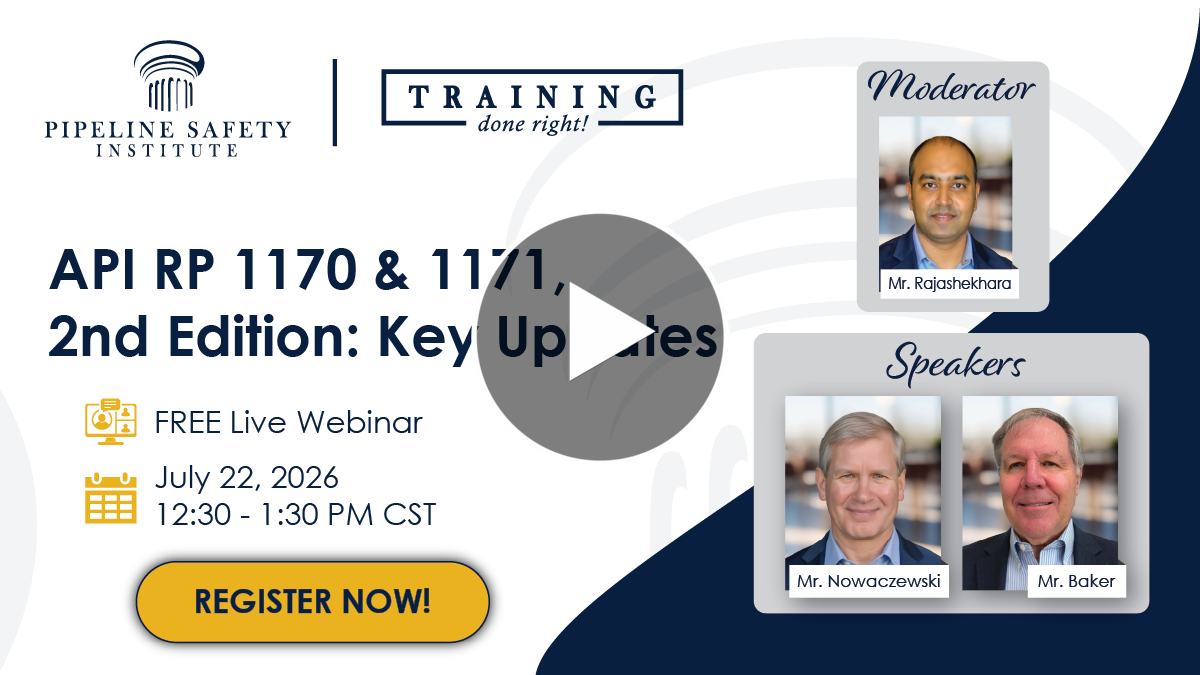
Unpacking the Key Updates in API RP 1170 & 1171, 2nd Edition
RCP and the Pipeline Safety Institute offered a free webinar exploring the 2nd Editions of API RP 1170, Design and Operation of Solution-mined Salt Caverns Used for Natural Gas Storage and API RP 1171, Functional Integrity of Natural Gas Storage in Depleted Hydrocarbon Reservoirs and Aquifer Reservoirs. Thank you to everyone who attended and participated in this informative webinar. The session recording is posted to our YouTube channel. Please watch, like, and subscribe to our channel!
New Workshop Alert!
Prepare Your Team for Pipeline Safety Audits with Confidence!
Our 3-day Pipeline Safety Audit Workshop is tailored for professionals responsible for the safe operation of hazardous liquid and natural gas pipelines. Designed for groups of 10-15 participants, this interactive training…
On-Site Training Request
We have conducted on-site training for oil and gas companies for over 25 years and can provide customized workshops for companies with groups of five or more.
We would welcome the opportunity to discuss our services with you.
Sincerely,

![]()
W. R. (Bill) Byrd, PE
President
RCP Inc.![]()