- PHMSA Notice: Limited Enforcement Discretion for Certain Type C Gas Gathering Pipelines
- Gas Pipeline Incident Property Damage Reporting Threshold Adjustment
- Unpacking the New Valve and Rupture Detection Rule
- Client Feedback
- The Enforcement Corner
- Did you know?
- Regulatory Watch: Key Dates & Deadlines
- Conference News
- PSI Training Schedule
PHMSA Notice: Limited Enforcement Discretion for Certain Type C Gas Gathering Pipelines
On July 8, 2022, PHMSA issued a notice that it intends to exercise limited enforcement actions for Type C gas gathering lines with nominal outer diameters greater than and equal to 8” and less than or equal to 12”. On November 15, 2021, PHMSA published a Final Rule Safety of Gas Gathering Pipelines: Extension of Reporting Requirements, Regulation of Large, High-Pressure Lines, and Other Related Amendments. The Final Rule requires that Type C gas gathering pipelines meet the requirements of §192.9 requirements by May 16, 2023. The July 8, 2022 Notice indicates that PHMSA does not intend to take enforcement action for Type C gas gathering pipelines, related to §192.9 compliance until May 17, 2024 for those lines with nominal outer diameters greater than and equal to 8” and less than or equal to 12”. After May 17, 2024 PHMSA states they will begin inspection of these pipelines, with an emphasis on those lines with buildings intended for human occupancy located within the pipeline’s Potential Impact Radius. PHMSA recommends that State partners also adopt this limited enforcement discretion, but there is no mandate for States to do so. PHMSA also reminded operators that this limited enforcement discretion does not apply to the other provisions of the Final Rule and those enforcement dates will remain in effect (ex. Part 191 reporting provisions for Type C & R gas gathering, classification of Type C lines by November 16, 2022, and §192.9 compliance for Type C lines with nominal outside diameters greater than 12”).
For a copy of this Notice or to find out how RCP can assist operators correctly classifying their gas gathering pipelines and assist with compliance efforts, contact Jessica Foley.
Gas Pipeline Incident Property Damage Reporting Threshold Adjustment
The 2022 gas pipeline property damage threshold has been adjusted for inflation. Effective July 1, 2022, the new threshold is $129,300 (up from $122,000 previously). This limit is incorporated into the definition of “incident” for gas pipelines, in 49 CFR 191.3.
Unpacking the New Valve and Rupture Detection Rule
August 15, 2022 (Monday): 1-2 p.m. CST
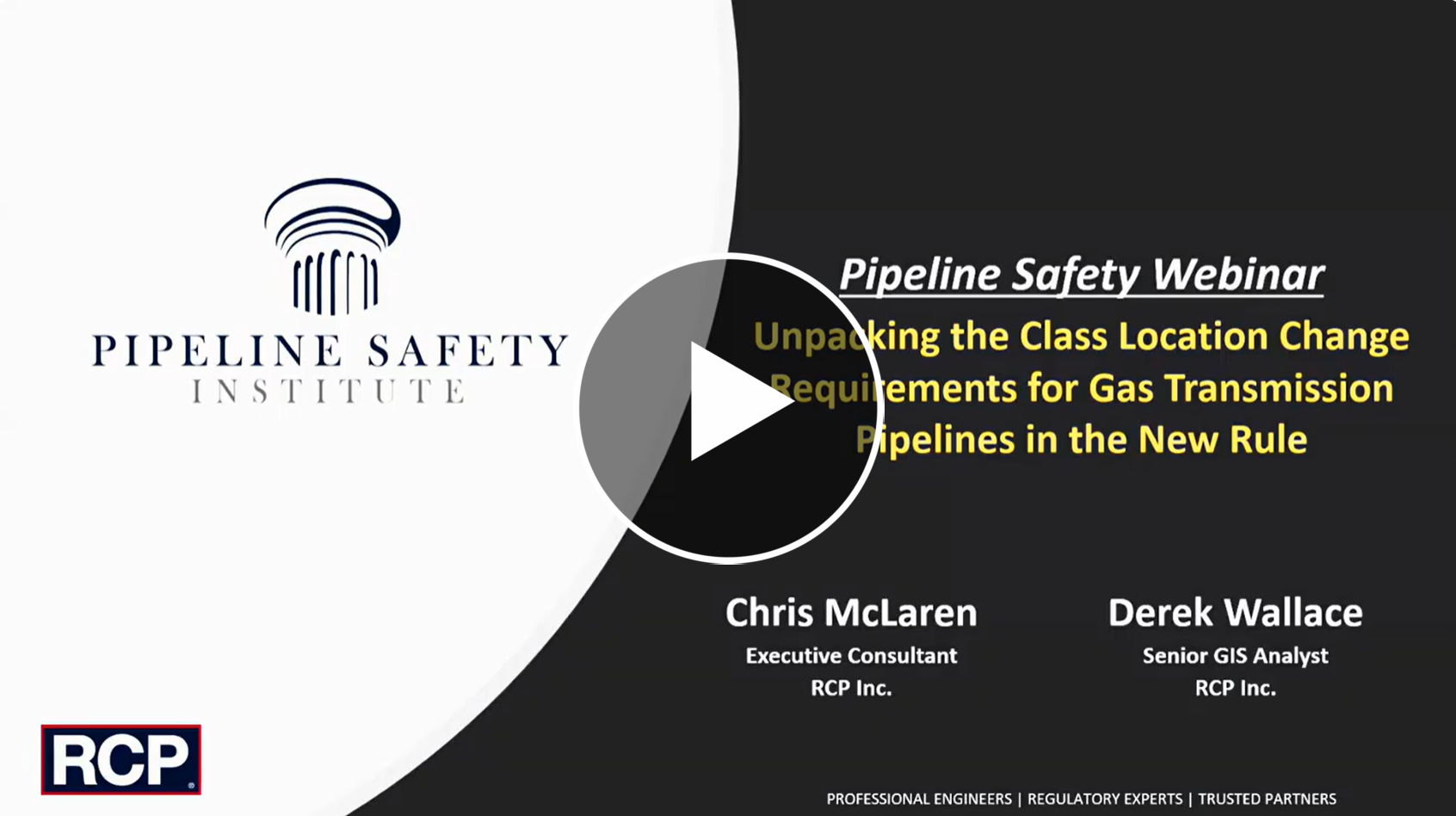
RCP will host a webinar to provide an overview of the requirements found within PHMSA’s Amendments to Parts 192 and 195 to Require Valve Installation and Minimum Rupture Detection Standards published April 8, 2022. We will discuss which lines are subject to the new rules, new definitions which have been added to the regulations, and when Rupture Mitigation Valves must be installed. There are other areas of an operator’s emergency response action and follow-up investigations impacted by the regulation as well.
To register for this free webinar, click here. If you registered previously and have not received a Teams Meeting link, please send an email to info@rcp.com.
Client Feedback
RCP has a tradition of creating and sustaining trusted partnerships with the companies we serve. This has translated into long-term relationships that are based not only on the quality and scope of the work we provide, but also on the manner in which we provide it. We routinely hear from our clients with positive feedback like this quote below:
“. . . amazing teacher! You really presented a difficult subject in a manner that was easy for everyone to understand. Even for someone like me who came into the class knowledgeable; I still took away many new concepts.” – DOT/PHMSA
The Enforcement Corner
The Enforcement Corner summarizes recent PHMSA enforcement actions, indicating where PHMSA is putting its enforcement efforts and the fines they are proposing for various types of violations.
In May 2022, PHMSA issued 4 WLs, 2 NOAs, and 4 NOPVs accompanied by $4,858,934 in proposed fines. Significant proposed fines were attributed to the following code sections:
- $94,500 – 49 CFR 195.446(a) – Control Room Management
- $846,300 – 49 CFR 195.446(c)(3) – Control Room: Internal Communications
- $45,600 – 49 CFR 195.446(e)(2) – Control Room: Alarm Management
- $5,800 – 49 CFR 192.631(c)(4) – Control Room: Backup SCADA
- $2,251,334 – 49 CFR 195.401(b)(1) – Non Integrity Management Repairs
- $46,600 – 49 CFR 195.402(e)(7) – Working with Public Officials
- $46,600 – 49 CFR 195.408(b)(4) – Communication with Public Officials
- $46,600 – 49 CFR 195.412(a) – ROW Inspections
- $46,600 – 49 CFR 195.440(i) – Public Awareness
- $46,600 – 49 CFR 195.452(l)(3) – Baseline Assessments
- $1,382,400 – 49 CFR 195.452(i)(2)(ix) – Risk Analysis
Please note:
- Pipeline operators may disagree in whole or in part with each proposed violation cited by PHMSA.
- Proposed Civil Penalties (PCP) may be reduced or eliminated before an enforcement action becomes final.
- A Corrective Action Order (CAO) usually addresses urgent situations arising out of an accident, spill, or other significant, immediate, or imminent safety or environmental concern.
- A Notice of Amendment (NOA) is frequently a result of a difference of opinion regarding written procedure requirements.
- A Notice of Proposed Safety Order (NOPSO) addresses pipeline integrity risks that may not constitute a hazardous facility requiring immediate corrective action (see Corrective Action Order described above),but do need to be addressed over time.
- A Notice of Probable Violation (NOPV) is not proof that a violation actually occurred.
- A Proposed Compliance Order (PCO) frequently documents actions the pipeline operator already planned to do.
- Warning Letter (WL) is an official notice by PHMSA that an operator needs to make improvements but that no further enforcement is proposed for those findings at this time.
RCP maintains a detailed database of all PHMSA enforcement actions dating back to 2007 and is routinely asked for data analysis of various enforcement actions. For more information on how RCP can assist with enforcement action data analysis services, contact Jessica Foley.
Need to respond to a PHMSA enforcement action?
Need to know if your enforcement action is an outlier, or par for the course?
RCP maintains a detailed database of all PHMSA enforcement actions and their resolution which enables us to compare and contrast individual enforcement actions to nationwide actions and trends. We can help put things into context to ensure an effective reply for each citation. For more information on how RCP can assist with enforcement action data analysis services, contact Jessica Foley.
Did you know?
About consumer choice – home cooks and professional chefs alike prefer the consistent, responsive flame provided by natural gas stoves. For more information, visit https://www.apga.org/advocacy

These articles are maintained and updated as new information becomes available.
Regulatory Watch: Key Dates & Deadlines
Track PHMSA rulemaking, regulatory stages, and important compliance deadlines in RCP's Regulatory Watch.
View Full Regulatory Watch →Conference News
Pipeline Pigging and Integrity Management Conference
The 39th International Pipeline Pigging & Integrity Management Conference (PPIM) will take place at the George R. Brown Convention Center in Houston. The event brings together pipeline operators, engineers, and industry professionals to explore advancements in pipeline inspection, integrity management, risk assessment, and emerging technologies.…
RCP Team Attending
Heather Roark
Jessica FoleyPSI Training Schedule

| Date | Training Course | Price | Registration |
|---|---|---|---|
| Nov 17 – Nov 19, 2026 | DOT Pipeline Compliance Workshop | $2,150 | SOLD OUT |
| Feb 16 – Feb 18, 2027 | Pipeline Safety Audit Training | $2,150 | Register → |
| Feb 23 – Feb 25, 2027 | Advanced Pipeline Risk Assessment Workshop | $2,150 | Register → |
| Mar 23 – Mar 25, 2027 | DOT Pipeline Compliance Workshop | $2,150 | Register → |
WEBINAR RECORDING!
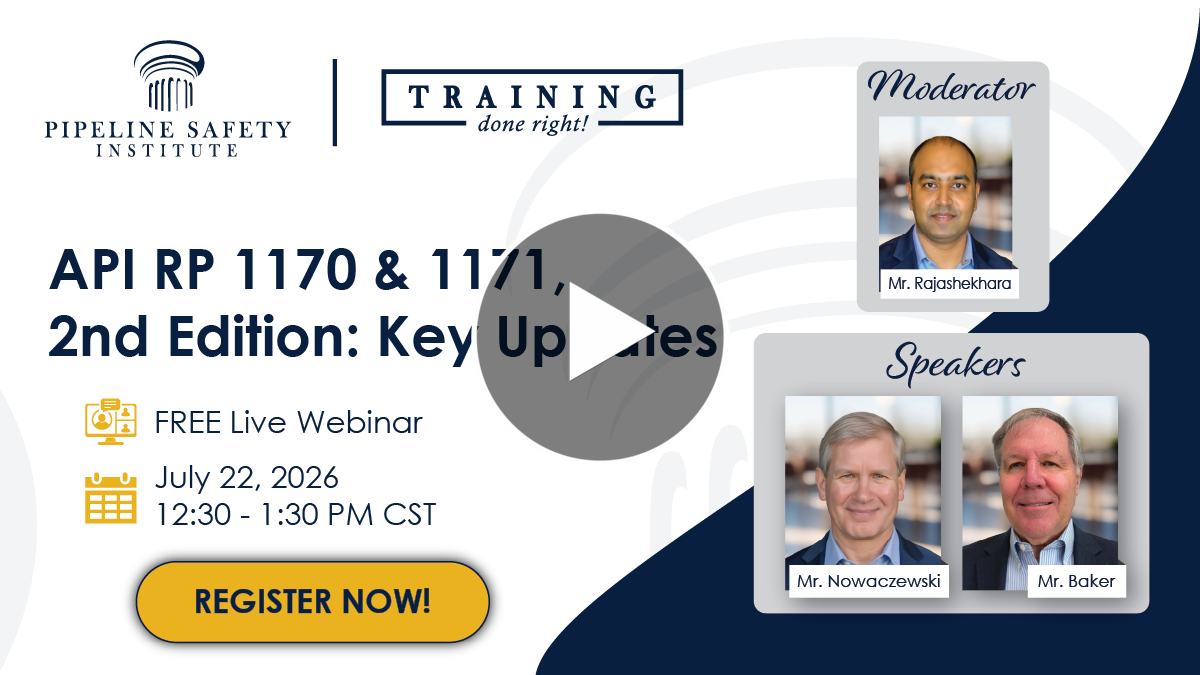
Unpacking the Key Updates in API RP 1170 & 1171, 2nd Edition
RCP and the Pipeline Safety Institute offered a free webinar exploring the 2nd Editions of API RP 1170, Design and Operation of Solution-mined Salt Caverns Used for Natural Gas Storage and API RP 1171, Functional Integrity of Natural Gas Storage in Depleted Hydrocarbon Reservoirs and Aquifer Reservoirs. Thank you to everyone who attended and participated in this informative webinar. The session recording is posted to our YouTube channel. Please watch, like, and subscribe to our channel!
New Workshop Alert!
Prepare Your Team for Pipeline Safety Audits with Confidence!
Our 3-day Pipeline Safety Audit Workshop is tailored for professionals responsible for the safe operation of hazardous liquid and natural gas pipelines. Designed for groups of 10-15 participants, this interactive training…
On-Site Training Request
We have conducted on-site training for oil and gas companies for over 25 years and can provide customized workshops for companies with groups of five or more.
We would welcome the opportunity to discuss our services with you.
Sincerely,

![]()
W. R. (Bill) Byrd, PE
President
RCP Inc.![]()