PHMSA Proposes Changes to Pipeline Annual Reporting Requirements

The Pipeline and Hazardous Materials Safety Administration (PHMSA) published a notice in the Federal Register on November 12, 2026, outlining proposed revisions to several pipeline safety reporting requirements. The changes are intended to reduce duplicate reporting, simplify annual submissions, and focus data collection on information most relevant to pipeline safety.

The notice follows an earlier public comment period and includes PHMSA’s responses to feedback from pipeline industry associations, regulators, and other stakeholders.

What’s Changing?

The proposed revisions affect several types of pipeline operators:

Gas Distribution Systems

PHMSA plans to eliminate certain diameter-based reporting requirements while maintaining a focus on higher-risk pipe materials. Operators would continue reporting specific materials, including brittle-like polyethylene (PE), and would no longer report the percentage of unaccounted-for gas on annual reports.

Gas Transmission and Gathering Systems

Proposed changes include removing requirements to report the total volume of gas transported, eliminating certain duplicate pipeline diameter reporting, and revising how integrity management and MAOP reconfirmation information is collected.

Hazardous Liquid and Carbon Dioxide Pipelines

PHMSA proposes eliminating duplicate pipeline diameter and breakout tank reporting from annual submissions, relying instead on information collected through the National Pipeline Mapping System (NPMS). Certain anomaly reporting requirements would also be removed, while condition repair reporting would remain.

Liquefied Natural Gas (LNG) Facilities

LNG reporting revisions would address facility location data, operating status, leak causes, and reporting terminology. PHMSA also proposes using annual report information to maintain LNG facility mapping data, reducing separate NPMS submission requirements.

What Does This Mean for Operators?

Although many of these changes would simplify reporting, operators should review the proposed revisions to determine how their existing data collection and reporting processes may be affected.

Some information would no longer be required on annual reports, while other data elements would be revised or collected through different reporting systems.

Importantly, these changes are still under review and do not yet replace existing reporting obligations.

Comment Deadline Approaching

PHMSA is requesting additional public comments as part of its submission to the Office of Management and Budget (OMB).

Comments must be submitted by December 14, 2026.

Pipeline operators should review the proposed changes and consider whether the revisions could affect their reporting procedures, data management practices, or regulatory compliance programs.

Source: Federal Register, November 12, 2026, Pipeline Safety: Information Collection Activities, [Docket No. PHMSA-2026-0529].

View the Federal Register Notice

PHMSA Proposes Modernized LNG Facility Regulations

The Pipeline and Hazardous Materials Safety Administration (PHMSA) announced a Notice of Proposed Rulemaking (NPRM) on October 28, 2026, to modernize liquefied natural gas (LNG) facility safety regulations under 49 CFR Part 193.

The proposal would incorporate the 2026 edition of NFPA 59A, updating standards governing the siting, design, construction, operation, and maintenance of LNG facilities.

Key Proposed Changes

The proposed rule would:

  • Incorporate NFPA 59A (2026 edition) into federal LNG safety regulations.
  • Allow modern technologies, including pipe-in-pipe systems, single-walled ASME containers, and membrane storage tanks.
  • Streamline regulatory requirements to support LNG infrastructure development.
  • Reduce compliance costs, with DOT estimating approximately $100 million in annual savings.

The proposal follows PHMSA’s May 2025 Advance Notice of Proposed Rulemaking (ANPRM), which sought industry feedback on updates to existing LNG facility requirements.

California Proposes Expanded In-Line Inspection Requirements

The California Office of the State Fire Marshal (OSFM) has proposed new in-line inspection (ILI) requirements for intrastate hazardous liquid pipelines under Title 19 of the California Code of Regulations. The proposal introduces requirements that extend beyond federal regulations under 49 CFR Part 195.

Key provisions include:

  • § 2154: Requires most intrastate hazardous liquid pipeline segments to accommodate ILI tools within a five-year compliance framework, including segments outside high consequence areas. Exemption requirements would differ from 49 CFR Part 195.
  • § 2156: Allows OSFM to determine the type of ILI tool used in the interest of public safety.
  • § 2157(b): Authorizes OSFM to require more frequent integrity assessments.
  • § 2158(c): Requires six independent validation measurements, generally before receipt of the final ILI report.
  • § 2158(d)(4): Establishes a 12-month repair requirement for metal loss of 40% or greater, regardless of anomaly dimensions.
  • § 2159(a)–(b): Establishes minimum operating pressure reductions of 20% for immediate repair conditions and 10% for certain delayed repairs, potentially limiting engineering-based pressure restrictions permitted under federal regulations.
  • § 2159(d): Allows OSFM to direct additional remedial actions to ensure pipeline safety.

The proposal also raises concerns regarding differences between OSFM and PHMSA standards incorporated by reference, as well as the extent of OSFM’s authority over operator integrity management decisions.

OSFM issued revised proposed regulations on October 1, 2026. If adopted, these requirements could significantly affect inspection schedules, repair obligations, and compliance costs for California hazardous liquid pipeline operators.

Click here to review the Title 19 requirements. For assistance, please contact Jessica Foley.

Preparing for the 2027 NPMS Submission Changes: What Pipeline and LNG Operators Need to Know

The Pipeline and Hazardous Materials Safety Administration (PHMSA) is implementing a comprehensive structural overhaul to the National Pipeline Mapping System (NPMS). Effective January 1, 2027, all pipeline and liquefied natural gas (LNG) plant data submissions must align with major new spatial accuracy and attribute field updates. Because these modifications completely rewrite the existing geospatial framework, standard reporting procedures will look significantly different for the calendar year 2026 (CY26) reporting cycle.

The End of “No Change” Notifications

The defining change of the upcoming cycle is that operators cannot submit “No Change Notifications” or utilize simple addition submission types for CY26 data. Due to extensive revisions to the underlying data architecture, every single pipeline and LNG feature must be updated to fulfill the new requirements. Revision code “N” (No Change to the Data Feature) has been disabled for the 2027 filing period, and pipeline submissions will remain restricted from using it through 2028. Consequently, omissions will be treated as deletions, requiring a systemwide rebuild and re-validation of your active assets. It is critical to note that breakout tank submission standards remain unchanged for this cycle, though breakout tank OPIDs must now include public contact information.

New Spatial and Attribute Frameworks

The updated guidelines introduce strict spatial accuracy benchmarks alongside restructured attribute requirements. Appendix A of the updated manual completely redesigns the Pipeline Attribute Table and LNG Plant Attribute Table, defining entirely new field names, properties, and permissible code values. This structural data collection mandate directly incorporates Phase 1 and Phase 3 of PHMSA’s multi-year information collection strategy. To ensure compatibility, operators must adapt their internal geographic information systems (GIS) to the new Excel attribute templates as well as the specialized ESRI shapefile and geodatabase feature class templates distributed by PHMSA.

Crucial Submission Deadlines

Compliance timelines tracking system data as-of December 31, 2026, adhere to strict calendar benchmarks. Gas transmission and LNG plant operators are required to submit their finalized geospatial datasets by March 15, 2027. Hazardous liquid operators must complete their submittals by June 15, 2027. For organizations managing combined OPIDs, PHMSA requests that submissions occur by the March 15 deadline, though the liquid portions may be deferred to June 15 if necessary.

Next Steps and System Migration

To avoid administrative or technical delays, operators should immediately begin auditing their current GIS databases against the updated schemas. All finalized submissions must be processed via the standard Operator Submission Verification and Engagement (OSAVE) digital workflow. Review the updated manuals, lookup tables, and past technical presentation recordings by visiting the official PHMSA NPMS Future Changes Page. You can also review real-time software capability updates and portal access protocols directly on the PHMSA NPMS What’s New Page.

RCP is ready to help pipeline operators prepare for and meet the new NPMS submission requirements. Contact us to learn how we can assist.

For more details, review the NPMS Attribute Standards and Revision Summary.

Explore the New RCP Website

RCP is pleased to announce the launch of our newly redesigned website at www.rcp.com.

With a fresh look and improved navigation, the new site makes it easier than ever to explore our pipeline integrity services, software solutions, and industry training opportunities.

Visitors can also stay informed with the latest pipeline safety news, regulatory updates, and enforcement activity through our Regulatory Watch, Enforcement Corner, and monthly newsletters.

Whether you’re looking for compliance support, operational software, or professional training, our new website brings everything together in one convenient location.

PHMSA Meetings & Events

The Pipeline and Hazardous Materials Safety Administration (PHMSA) regularly hosts meetings, workshops, and public discussions covering pipeline safety, regulatory developments, research, and emerging technologies.

We’ve highlighted upcoming events relevant to pipeline operators and industry professionals below.

Last Updated: November 2026
DatePHMSA DebriefDetails
Nov 17, 2026 Use of Gamification and Generative AI to provide more effective training for hazardous conditions and emergency response. View Details →
Nov 18, 2026 Advanced Leak Detection Capabilities for Compressible Hydrocarbon Products View Details →
Nov 19, 2026 Liquefied Natural Gas (LNG) Knowledge Development, Consequences of Catastrophic Failure of LNG Storage Tanks View Details →
Nov 19, 2026 Standardize the Application of Vapor Corrosion Inhibitors View Details →
Dec 2, 2026 LNG Safety Best Practices Workshop Series Presented by the National Center of Excellence for LNG Safety View Details →
Dec 2, 2026 Pipeline Safety: Meetings of the Liquid and Gas Pipeline Advisory Committees View Details →

Select View Details for event information, agendas, and registration directly through PHMSA.

Featured Service: Field Trial Program

TestApp Logo

We Supply the Gauge. You Put It to the Test.

Still using handwritten pressure test records? See what a digital approach can do for your team.

RCP is inviting pipeline and pressure testing professionals to participate in the TestApp Field Trial Program. Selected applicants will receive a Bluetooth-enabled digital pressure gauge and complimentary access to TestApp for 90 days.

TestApp simplifies pressure testing with real-time monitoring, digital data collection, and automated reporting, helping eliminate manual data entry and improve documentation.

What’s included?

  • Bluetooth-enabled digital pressure gauge for the evaluation
  • 90 days of complimentary TestApp access
  • Setup assistance and support
  • An opportunity to help shape future improvements

No Bluetooth gauge? No problem. We provide one to selected participants.

Put TestApp to the test in your own field operations.

The Enforcement Corner

Enforcement SnapshotNovember 2026
Reporting Period: October 2026
$668,200Proposed penalties
11Reported enforcement actions
7Listed violations

CAO: 0   NOA: 3   WL: 2   NOPV: 6  

Review the cited regulations, proposed penalties, and year-to-date enforcement trends in the complete report.

View Full Enforcement Report →

Did You Know?

November isn’t just about Thanksgiving! It’s also Critical Infrastructure Security and Resilience Month, recognized by the Cybersecurity and Infrastructure Security Agency (CISA).

The month highlights the importance of protecting the systems Americans depend on every day, including energy pipelines, transportation networks, water systems, and communications.

This year’s theme, “Resolve to be Resilient,” encourages organizations to identify risks, strengthen security, and prepare for unexpected disruptions.

It’s a great reminder of the important role the pipeline industry plays in keeping America’s critical infrastructure safe and reliable.

Q&A Section

Q: With the holiday season approaching, does pipeline regulatory compliance ever take a break?

A: Not exactly! While the holidays may bring some well-deserved time off, regulatory deadlines, documentation requirements, and compliance responsibilities don’t disappear.

That’s where a little preparation goes a long way. Staying organized, keeping records current, and planning ahead can help pipeline operators avoid a last-minute scramble.

Ask the Experts

Do you have a question for the experts at RCP?  Submit your question using this form. 

Name
Ongoing Resources

These articles are maintained and updated as new information becomes available.

Regulatory Watch: Key Dates & Deadlines

REGULATORY SNAPSHOT Last updated November 12, 2026
39Tracked regulations
8Proposed / DFR
18Final rules

Track PHMSA rulemaking, regulatory stages, and important compliance deadlines in RCP's Regulatory Watch.

View Full Regulatory Watch →
Last Updated: October 2026

Conference News

Jan242027

Pipeline Pigging and Integrity Management Conference

▦ January 24, 2027 – January 28, 2027⌖ George R. Brown Convention Center, Houston, TX

The 39th International Pipeline Pigging & Integrity Management Conference (PPIM) will take place at the George R. Brown Convention Center in Houston. The event brings together pipeline operators, engineers, and industry professionals to explore advancements in pipeline inspection, integrity management, risk assessment, and emerging technologies.…

Exhibiting · Booth 524
RCP Team Attending
Jessica FoleyJessica Foley
Event Details

Last Updated: November 2026

PSI Training Schedule

Date Training Course Price Registration
Nov 17 – Nov 19, 2026 DOT Pipeline Compliance Workshop $2,150 SOLD OUT
Feb 16 – Feb 18, 2027 Pipeline Safety Audit Training $2,150 Register →
Feb 23 – Feb 25, 2027 Advanced Pipeline Risk Assessment Workshop $2,150 Register →
Mar 23 – Mar 25, 2027 DOT Pipeline Compliance Workshop $2,150 Register →

WEBINAR RECORDING!
Unpacking the Key Updates in API RP 1170 & 1171, 2nd Edition

RCP and the Pipeline Safety Institute offered a free webinar exploring the 2nd Editions of API RP 1170, Design and Operation of Solution-mined Salt Caverns Used for Natural Gas Storage and API RP 1171, Functional Integrity of Natural Gas Storage in Depleted Hydrocarbon Reservoirs and Aquifer Reservoirs. Thank you to everyone who attended and participated in this informative webinar. The session recording is posted to our YouTube channel. Please watch, like, and subscribe to our channel!

WEBINAR RECORDING
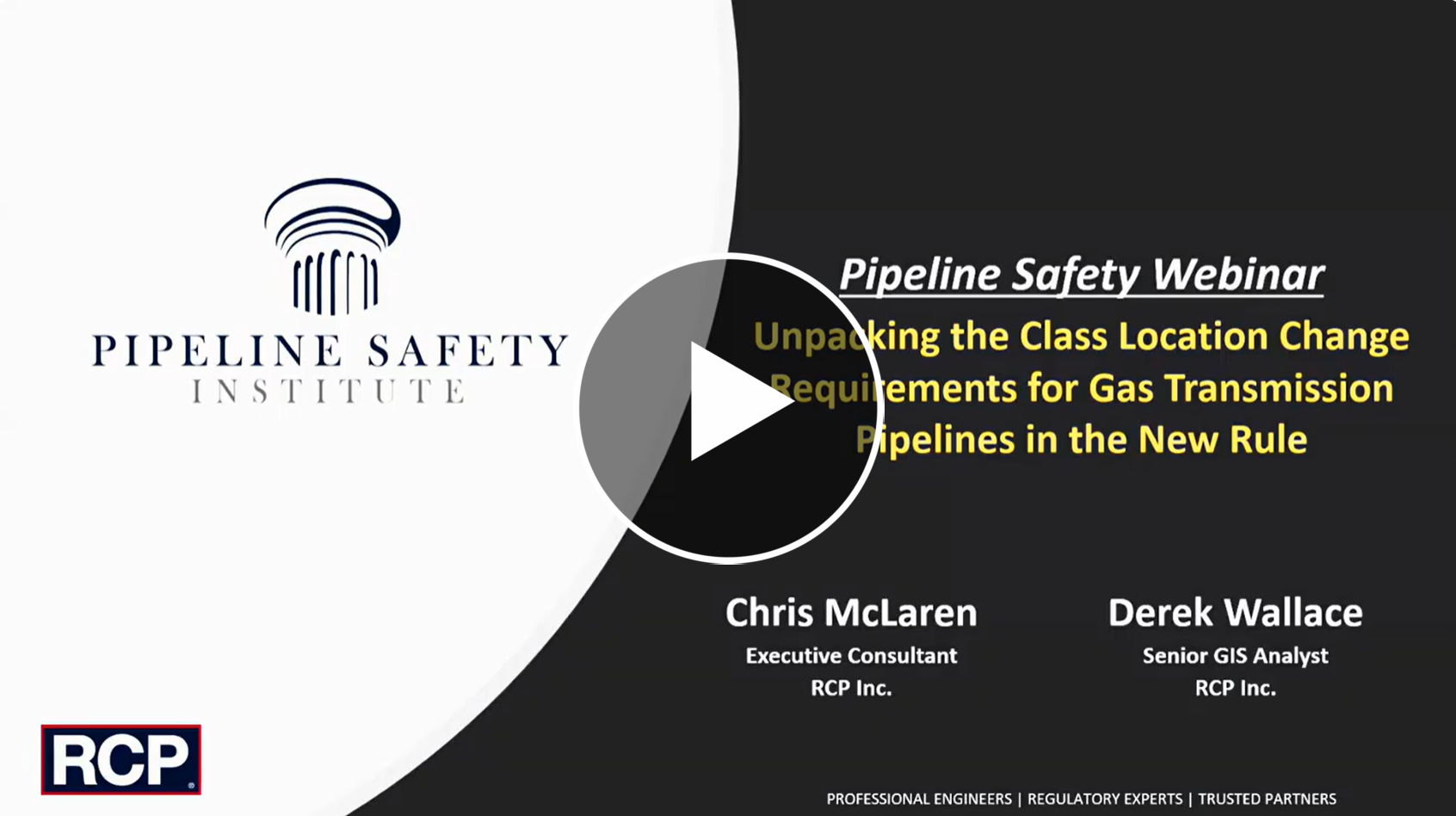
Pipeline Safety: Unpacking the Class Location Change Requirements

Thank you to everyone who attended and participated in this informative webinar. The session recording is posted to our YouTube channel. Please watch, like, and subscribe to our channel!
New Workshop Alert!

Prepare Your Team for Pipeline Safety Audits with Confidence!

Our 3-day Pipeline Safety Audit Workshop is tailored for professionals responsible for the safe operation of hazardous liquid and natural gas pipelines. Designed for groups of 10-15 participants, this interactive training…

On-Site Training Request

We have conducted on-site training for oil and gas companies for over 25 years and can provide customized workshops for companies with groups of five or more.

We would welcome the opportunity to discuss our services with you.

Sincerely,

W. R. (Bill) Byrd, PE
President
RCP Inc.