DOT Pipeline Compliance Workshop – July 30-31, 2003 – Houston

RCP will conduct a 2 day workshop on DOT Pipeline Regulations on July 30th and 31st in Houston. Day 1 of this workshop will present an overview of all the current DOT regulations for pipeline operators. Day 2 will review recent regulatory initiatives such as pipeline integrity management, high consequence area (HCA) analysis, community education and liaison programs, operator qualification inspection protocols, and significant state regulatory proposals. Day 2 will also include a review of the new Pipeline Safety Improvement Act of 2002, which includes several important self-implementing requirements that will affect pipeline operators. This workshop is suitable for personnel who need a general introduction to DOT pipeline regulatory requirements, or who need an update on recent and proposed DOT Pipeline regulatory initiatives. We have conducted this type of seminar several times, and have received excellent feedback each time. We expect this workshop to fill up rapidly. Early registration and group discounts are available. Additional information is available on our website here.

Anomaly Repair Requirements

We thought our readers would be interested in the following “Frequently Asked Question” from the OPS integrity management website:

FAQ 7.21 Must anomalies identified during pig runs not considered “baseline” or “reassessments” under the rule be repaired in accordance with the rule’s repair criteria?

ANSWER: Yes. The integrity management rule requires a program that integrates all information regarding the integrity of the pipeline. Thus, all pig runs conducted after the effective date of the rule are considered activities covered by the rule. Anomalies discovered in segments that could affect high consequence areas after the effective date of the rule must be repaired in accordance with the criteria and schedules for repair conditions specified in 195.452(h). This includes anomalies identified by any pig run conducted after the effective date of the rule, even if the pig run is not considered a “baseline assessment” or “re-assessment”.

Editor’s note: The effective date of the rule for large liquid operators was March 31, 2001 (but President Bush instituted a 60 day delay on the effective date of all new regulations when he took office, which shifted the effective date to May 29, 2001) . The effective date for small liquid operators was February 15, 2002. Any anomaly detected after those dates would have to be investigated and repaired as described in the operator’s integrity management plan – even if the pig run / etc. was not performed as an official part of the integrity assessment program. Note also that this only applies to segments of pipe that fall under the operator’s integrity management program (“in or could affect an HCA”).

Hazardous Liquid Pipeline Operator Annual Report Form – Notice and request for comments

In accordance with the Paperwork Reduction Act of 1995, the RSPA Office of Pipeline Safety (OPS) published a Notice of Proposed Rulemaking (NPRM) on July 26, 2002, announcing RSPA’s/OPS’s intention to collect pipeline characteristics information via a hazardous liquid pipeline operator annual report form. RSPA/OPS received comments on the proposed form and changed the form accordingly. RSPA/OPS discussed the changes with the Technical Hazardous Liquids Pipeline Safety Standards Committee (THLPSSC) on March 25, 2003. RSPA/OPS has posted the proposed form in the docket so that the THLPSSC can review it.

RSPA/OPS will hold a public meeting (see docket RSPA-97-2426) on May 28, 2003, to discuss potential improvements to the current standard for data submission to the National Pipeline Mapping System. The meeting will include a discussion about whether, at a future date, some information sought by the proposed hazardous liquid annual report form may alternatively be obtained through the National Pipeline Mapping System.

ADDRESSES: You may submit written comments by mail or delivery to the Dockets Facility, U.S. Department of Transportation, Room PL-401, 400 Seventh Street, SW., Washington, DC 20590-0001. The Dockets facility is open from 10 a.m. to 5 p.m., Monday through Friday, except Federal holidays. Comments should identify the docket number of this notice, RSPA-01-9832. You should submit the original and one copy. If you wish to receive confirmation of receipt of your comments, you must include a stamped, self-addressed postcard.

You may also submit or review comments electronically by accessing the Docket Management System’s home page at dms.dot.gov. Click on “Help & Information” for instructions on how to file a document electronically. All written comments should identify the docket and notice numbers stated in the heading of this notice.

Anyone is able to search the electronic form of all comments received into any of our dockets by the name of the individual submitting the comment (or signing the comment, if submitted on behalf of an association, business, labor union, etc.). You may review DOT’s complete Privacy Act Statement in the Federal Register published on April 11, 2000 (volume 65, number 70; pages 19477-78), or you may visit dms.dot.gov.

FOR FURTHER INFORMATION CONTACT: Roger Little, by telephone, at 202-366-4569; by fax at 202-366-4566; by mail at U.S. Department of Transportation, RSPA, 400 Seventh Street, SW., Room 7128, Washington, DC, 20590; or by e-mail at roger.little@rspa.dot.gov.

Direct Assessment Market Report 2003

Direct Assessment Technology Partners (DATP) and Technical Toolboxes, Inc (TTI) have completed a comprehensive market study to assist companies interested in the growing Direct Assessment market within the Pipeline Industry. Access to this information can be had through the member’s only section at www.datp.net.

For more information either visit www.datp.net or contact Gary R. White at gwhite@datp.net.

Procedures for Transportation Workplace Drug and Alcohol Testing Programs: Interim final rule

The Department of Transportation (DOT) is amending a provision of its drug and alcohol testing procedures to change the instructions to medical review officers (MROs) with respect to reporting specimens as dilute or substituted. The change is based on the Department’s experience since the adoption of its current rule and new scientific information on the subject. This rule is effective May 28, 2003. Comments on the interim final rule should be submitted by August 26, 2003. Late-filed comments will be considered to the extent practicable. The full interim final rule revisions can be downloaded from RCP’s website here through the DOT Gateway.

FOR FURTHER INFORMATION CONTACT: Robert C. Ashby, Deputy Assistant General Counsel for Regulation and Enforcement, 400 7th Street, SW., Room 10424, Washington, DC, 20590, 202-366-9310 (voice), 202-366-9313 (fax), or bob.ashby@ost.dot.gov (e-mail) or Ken Edgell, Acting Director, Office of Drug and Alcohol Policy and Compliance (ODAPC), 400 7th Street, SW., Room 10403, Washington, DC 20590, 202-366-3784 (voice), 202-366-3897 (fax), or kenneth.edgell@ost.dot.gov (e-mail).

RP 1162 – Public Awareness Programs for Pipeline Operators – Comment Period

The final draft of RP 1162, Public Awareness Programs for Pipeline Operators, is now available for review and comment. This is the official ANSI comment period, and comments must be submitted electronically to the API ballot system. The ballot and document is available at ballots.api.org/. The Ballot ID is 196. To provide comments, enter the Ballot ID 196, but leave the Login ID blank. All public comments must be considered, and their disposition documented to ANSI. You may access other related documents using the following link: committees.api.org/pipeline/standards/index.html. Note that this is a new web address.

The deadline for comments is Wednesday July 9, 2003. If you have questions, contact Louise Scott at scottl@api.org.

IMP Inspection Schedule

According to recent presentations by DOT / OPS, OPS should complete their initial IMP inspections of 14 large pipeline operators by June, 2003. They will then have a “reset” meeting (also in June), where the results of these audits will be reviewed and enforcement actions will be decided. We can expect to see a lot of Notices of Amendment (NOAs) as a result. OPS intends to inspect all the other large pipeline operators from June 2003 to early 2004. OPS is also piloting their inspection process for small operators, using a different set of audit protocols. They are trying to match the depth of the inspection to the risk of the operator. A large pipeline operator can expect to have an audit that lasts 8 working days, divided among 2 OPS trips that are separated by 1 to 2 weeks.

Editor’s note: We haven’t heard any information concerning how the small operator audits are varying from the large operators – either in duration or scope. If you know something, we’d like to hear it!

HCA Definition – Latest Proposal

The DOT has proposed revisions to the Gas Pipeline High Consequence Area (HCA) definition, to take into consideration the directional flow of gas along a pipeline route in the event of a major pipeline rupture (think Carlsbad, NM). The HCA definition has evolved significantly since the “official” HCA definition was published on August 6, 2002. The DOT’s latest thoughts are in a document which can be downloaded from RCP’s website here through the Pipeline Integrity Management Gateway. Industry is anxiously awaiting the final version of the HCA definition so that HCA surveys can begin, which are fundamental to gas pipeline integrity management program development.

NPMS Deadline Reminder

The deadline to submit information to the National Pipeline Mapping System is June 17, 2003. The submission standards and guidelines are available at www.npms.rspa.dot.gov/default.htm. According to this site, 98% of the liquid mileage and 72% of the gas mileage in the US has been submitted. We have worked with several operators on their submittals, and would be glad to assist your operations as necessary.

OQ2 compromise – NOT

The industry / agency working group that was attempting to resolve issues related to the latest Operator Qualification inspection protocols (known as OQ2) has failed to reach an acceptable consensus. The DOT is now planning to address issues concerning training and re-evaluation intervals in a new rulemaking, which is anticipated this summer. The TSI website contains links to most of the relevant websites concerning this issue: www.tsi.dot.gov/divisions/pipeline/pub_mtg_apr_03.htm. Note that the Southern Gas Association is surveying industry for their interest in a special workshop on the OQ2 protocols (as they currently exist). Go to www.sgalink.org/forum/messageview.cfm?catid=17&threadid;=99 for more information. If you need a copy of the latest OQ inspection protocols, they are available at primis.rspa.dot.gov/oq/index.htm. Click on the PROTOCOLS tab on the left side of the screen.

Ongoing Resources

These articles are maintained and updated as new information becomes available.

Regulatory Watch: Key Dates & Deadlines

REGULATORY SNAPSHOT Last updated November 3, 2026
38Tracked regulations
8Proposed / DFR
18Final rules

Track PHMSA rulemaking, regulatory stages, and important compliance deadlines in RCP's Regulatory Watch.

View Full Regulatory Watch →
Last Updated: October 2026

Conference News

Jan252027

Pipeline Pigging and Integrity Management Conference

▦ January 25, 2027 – January 28, 2027⌖ George R. Brown Convention Center, Houston, TX

The 39th International Pipeline Pigging & Integrity Management Conference (PPIM) will take place at the George R. Brown Convention Center in Houston. The event brings together pipeline operators, engineers, and industry professionals to explore advancements in pipeline inspection, integrity management, risk assessment, and emerging technologies.…

Exhibiting · Booth 524
RCP Team Attending
Heather RoarkHeather Roark
Jessica FoleyJessica Foley
Event Details

Last Updated: November 2026

PSI Training Schedule

Date Training Course Price Registration
Nov 17 – Nov 19, 2026 DOT Pipeline Compliance Workshop $2,150 SOLD OUT
Feb 16 – Feb 18, 2027 Pipeline Safety Audit Training $2,150 Register →
Feb 23 – Feb 25, 2027 Advanced Pipeline Risk Assessment Workshop $2,150 Register →
Mar 23 – Mar 25, 2027 DOT Pipeline Compliance Workshop $2,150 Register →

WEBINAR RECORDING!
Unpacking the Key Updates in API RP 1170 & 1171, 2nd Edition

RCP and the Pipeline Safety Institute offered a free webinar exploring the 2nd Editions of API RP 1170, Design and Operation of Solution-mined Salt Caverns Used for Natural Gas Storage and API RP 1171, Functional Integrity of Natural Gas Storage in Depleted Hydrocarbon Reservoirs and Aquifer Reservoirs. Thank you to everyone who attended and participated in this informative webinar. The session recording is posted to our YouTube channel. Please watch, like, and subscribe to our channel!

WEBINAR RECORDING
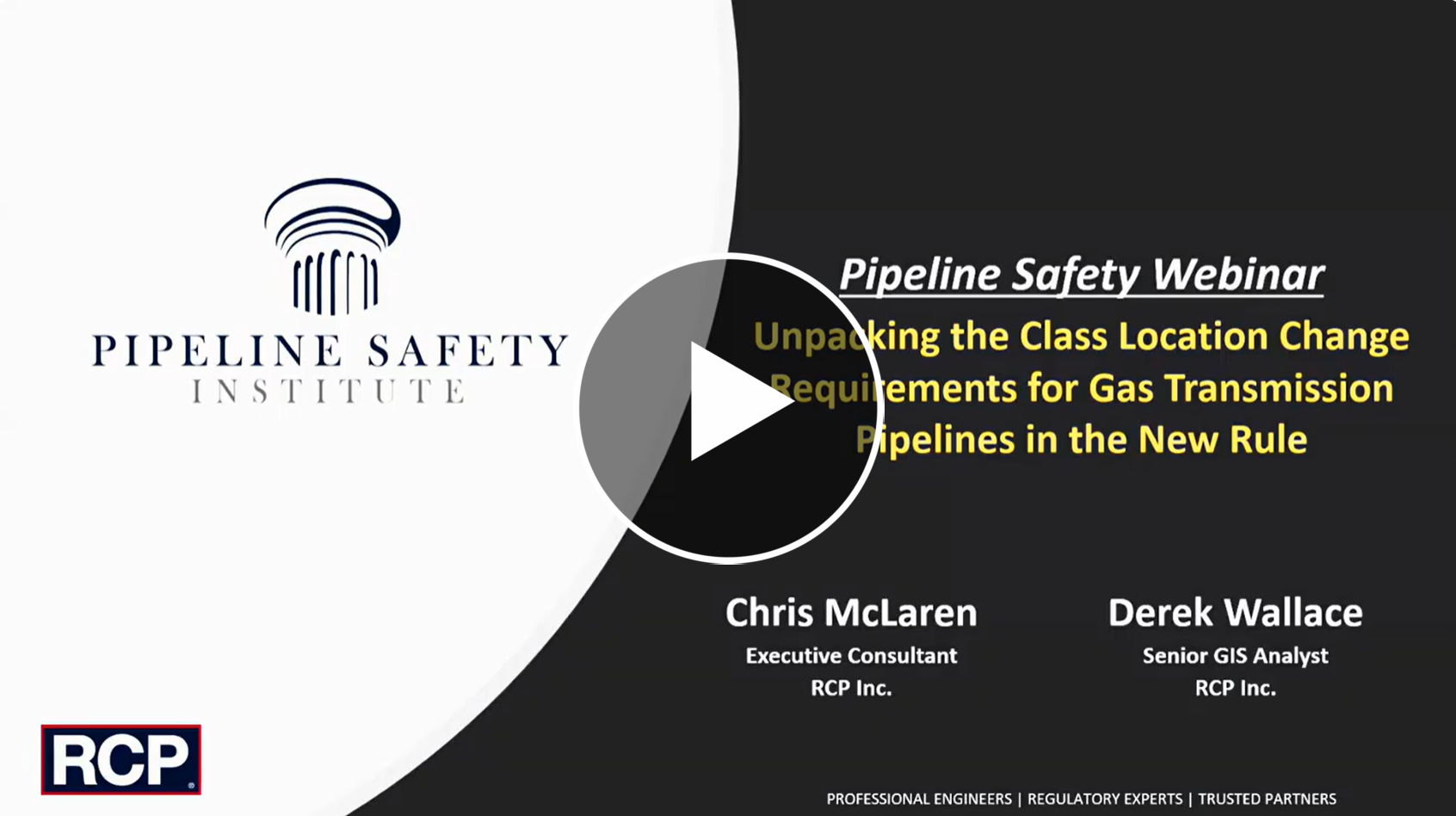
Pipeline Safety: Unpacking the Class Location Change Requirements

Thank you to everyone who attended and participated in this informative webinar. The session recording is posted to our YouTube channel. Please watch, like, and subscribe to our channel!
New Workshop Alert!

Prepare Your Team for Pipeline Safety Audits with Confidence!

Our 3-day Pipeline Safety Audit Workshop is tailored for professionals responsible for the safe operation of hazardous liquid and natural gas pipelines. Designed for groups of 10-15 participants, this interactive training…

On-Site Training Request

We have conducted on-site training for oil and gas companies for over 25 years and can provide customized workshops for companies with groups of five or more.

We would welcome the opportunity to discuss our services with you.

Sincerely,

W. R. (Bill) Byrd, PE
President
RCP Inc.