API Revising RP 1123 re: Public Awareness Programs
API has begun making revisions to Recommended Practice 1123: Development of Public Awareness Programs by Pipeline Operators. The revised RP will address natural gas pipelines as well as oil pipelines, and will establish baseline public awareness program expectations. The revised RP is being developed under API’s ANSI standard-making authority. The final version may be incorporated into future Federal or State regulations. API is encouraging members of the public, industry, and regulatory agencies to be involved in the revision process, and has developed a website at http://www.api.org/pipelinepublicawareness/ to facilitate this process. Comments or questions about the RP and the revision process can be directed to Louise Scott at scottl@api.org
Establishment of the DOT Electronic Transmission and Storage of Drug Testing Information Advisory Committee
The Secretary of Transportation is establishing the Department of Transportation (DOT) Electronic Transmission and Storage of Drug Testing Information Advisory Committee. The committee will be composed of approximately 20 members appointed by the Secretary from interested parties within the public. The purpose of the committee is to recommend to the Department the type and level of electronic security that should be used for the transmission and storage of drug testing information generated as part of the DOT drug and alcohol testing program regulated by 40 CFR Part 40. Additionally, the Committee may examine and provide advice to the DOT related to the format and methodology used in transmitting this type of information as well as the levels and procedures to use in implementing electronic signature technology within the context of the drug and alcohol program. Based on the charter of the Committee, it is envisioned that the Committee will meet approximately three times within the next year. Meeting times and places will be published in the Federal Register.
Currently, there are approximately 8.3 million transportation workers in safety-sensitive positions requiring drug testing. All results of drug tests, including negative, positive, adulterated, substituted, and invalid are reported by laboratories directly to physicians (i.e., MROs), who subsequently send final test results to employers. In the majority of cases, laboratory results and MRO verification results are sent by U.S. mail or courier, generating substantial paper work requirements. To alleviate some of the paper work burden, when 49 CFR Part 40 was revised on December 19, 2000, the use of faxed and electronic reporting of some of the drug testing results was authorized, provided that the laboratory and MRO ensured that the information is transmitted in such a manner as to prevent unauthorized access or release while it is transmitted or stored. However, no particular standards or guidelines were provided to ensure that laboratories and MROs used adequate, but secure, methods to transmit and store this sensitive information. The Committee will examine the current state of the art for electronic security and identify those methods which will adequately ensure security, but at the same time provide reasonable cost in its implementation.
FOR FURTHER INFORMATION CONTACT: Don Shatinsky, Office of Drug and Alcohol Policy and Compliance (ODAPC), Office of the Secretary, Department of Transportation, (202) 366-3784, fax (202) 366-3897 or Roberta Fede, Committee Management Officer, Executive Secretariat, Department of Transportation, (202) 366-9764.
Washington State Opens Contingency Planning Rule
The Department of Ecology (Ecology) is proposing to amend the rules governing oil spill contingency plans. Chapter 173-181 Washington Administrative Code (WAC), Facility Contingency Plan and Response Contractor Standards, and Chapter 317-10 WAC, Vessel Contingency Plan and Response Contractor Standards, took effect in 1991. These regulations help ensure that everyone involved in transporting oil is ready and equipped to respond immediately if a ship, barge, refinery, pipeline or other oil handling facility spills oil into Washington’s waters.
The rule is being amended to improve the state of readiness in Washington for large and small oil spills, to simplify the requirements for spill response contractors and plan-holders wherever possible and, in some areas, to make the rules more consistent with federal laws and standards. The proposed rule amendment will combine the two existing rules into one, covering both vessels and oil-handling facilities.
For more information and the opportunity to comment on this rule amendment visit http://www.ecy.wa.gov/programs/spills/spills.html and scroll down to Preparedness and Contingency Plans.
FERC Notice of Workshop; Better Stakeholder Involvement: How To Make It Work
The Office of Energy Projects is initiating the second phase of its Better Stakeholder Involvement Series. These workshops will explore ways to help make the pre-filing stakeholder involvement work. This first workshop will be held in Atlanta, Georgia on Thursday, April 4, 2002 from 9:15 a.m. to 12:30 p.m. at the Atlanta Capitol Plaza, 450 Capitol Avenue, SW, Atlanta, Georgia 30312, phone: 404-591-2000, fax: 404-591-1999. FERC plans to conduct future workshops around the country throughout the upcoming year.
FERC is inviting interstate natural gas companies; Federal, state and local agencies; landowners and other non-governmental organizations with a continuing interest in developing successful strategies for involving people in the pre-filing process. The purpose of these workshops is to discuss how stakeholders are implementing the ideas outlined in the staff report. The merits of any pending or planned pipeline projects will not be discussed.
If you plan to attend or have suggestions for the agenda, please respond by March 29, 2002 via facsimile to Roberta Coulter at 202/219-2722, or via email to: gasoutreach@ferc.gov. Please include in the response the names, addresses, and telephone numbers of all attendees from your organization.
National Emission Standards for Hazardous Air Pollutants: Organic Liquids Distribution (Non-Gasoline)
The EPA has proposed a national emission standard for hazardous air pollutants (NESHAP) for organic liquids distribution (OLD) (non-gasoline) operations, which are carried out at storage terminals, refineries, crude oil pipeline stations, and various manufacturing facilities. These proposed standards would implement section 112(d) of the Clean Air Act (CAA) by requiring all organic liquids distribution operations at plant sites that are major sources to meet hazardous air pollutant (HAP) emission standards reflecting the application of the maximum achievable control technology (MACT).
The EPA estimates that approximately 70,200 megagrams per year (Mg/yr) (77,300 tons per year (tpy)) of HAP are emitted from facilities in this source category. Although a large number of organic HAP are emitted nationwide from these operations, benzene, ethylbenzene, toluene, vinyl chloride, and xylenes are among the most prevalent. These HAP have been shown to have a variety of carcinogenic and noncancer adverse health effects.
The EPA estimates that these proposed standards would result in the reduction of HAP emissions from major sources in the organic liquids distribution source category by 28 percent. The emissions reductions achieved by these proposed standards, when combined with the emissions reductions achieved by other similar standards, would provide protection to the public and achieve a primary goal of the CAA.
Organic liquids distribution activities are carried out at many different types of facilities. Most of these facilities can be grouped under three general categories: Stand-alone (usually for-hire) storage terminals dedicated to distribution activities; organic liquids distribution operations collocated with a petroleum refinery, chemical manufacturing, or other manufacturing plant site; and crude oil pipeline pumping or breakout stations (containing crude oil tankage). The estimates that in 1997, the baseline year for the proposed standards, there were approximately the following numbers of major source organic liquids distribution facilities: 480 collocated organic liquids distribution operations, 135 stand-alone terminals, and 35 crude oil pipeline stations, for a total of about 650 existing major source organic liquids distribution plant sites.
Submit comments on or before June 3, 2002 (docket No. A-98-13) to: Air and Radiation Docket and Information Center (6102), Attention Docket Number A-98-13, U.S. EPA, 1200 Pennsylvania Avenue, NW, Washington, DC 20460. In person or by courier, deliver comments (in duplicate if possible) to: Air and Radiation Docket and Information Center (6102), Attention Docket Number A-98-13, U.S. EPA, 401 M Street, SW, Washington DC 20460. The EPA requests that a separate copy also be sent to Ms. Martha Smith, Waste and Chemical Processes Group, Emission Standards Division (MD-13), U.S. EPA, Research Triangle Park, NC 27711; phone (919) 541-2421, e-mail smith.martha@epa.go.
If anyone contacts the EPA requesting to speak at a public hearing by April 22, 2002, a public hearing will be held on May 2, 2002, at 10 a.m. in the EPA’s Office of Administration Auditorium, Research Triangle Park, North Carolina, or at an alternate site nearby.
The proposed NESHAP can be downloaded from RCP’s website at http://www.dotpipeline.org/downloads/apr2002/40 CFR 63 National Emission Standards Organic.pdf
These articles are maintained and updated as new information becomes available.
Regulatory Watch: Key Dates & Deadlines
Track PHMSA rulemaking, regulatory stages, and important compliance deadlines in RCP's Regulatory Watch.
View Full Regulatory Watch →Conference News
Pipeline Pigging and Integrity Management Conference
The 39th International Pipeline Pigging & Integrity Management Conference (PPIM) will take place at the George R. Brown Convention Center in Houston. The event brings together pipeline operators, engineers, and industry professionals to explore advancements in pipeline inspection, integrity management, risk assessment, and emerging technologies.…
RCP Team Attending
Heather Roark
Jessica FoleyPSI Training Schedule

| Date | Training Course | Price | Registration |
|---|---|---|---|
| Nov 17 – Nov 19, 2026 | DOT Pipeline Compliance Workshop | $2,150 | SOLD OUT |
| Feb 16 – Feb 18, 2027 | Pipeline Safety Audit Training | $2,150 | Register → |
| Feb 23 – Feb 25, 2027 | Advanced Pipeline Risk Assessment Workshop | $2,150 | Register → |
| Mar 23 – Mar 25, 2027 | DOT Pipeline Compliance Workshop | $2,150 | Register → |
WEBINAR RECORDING!
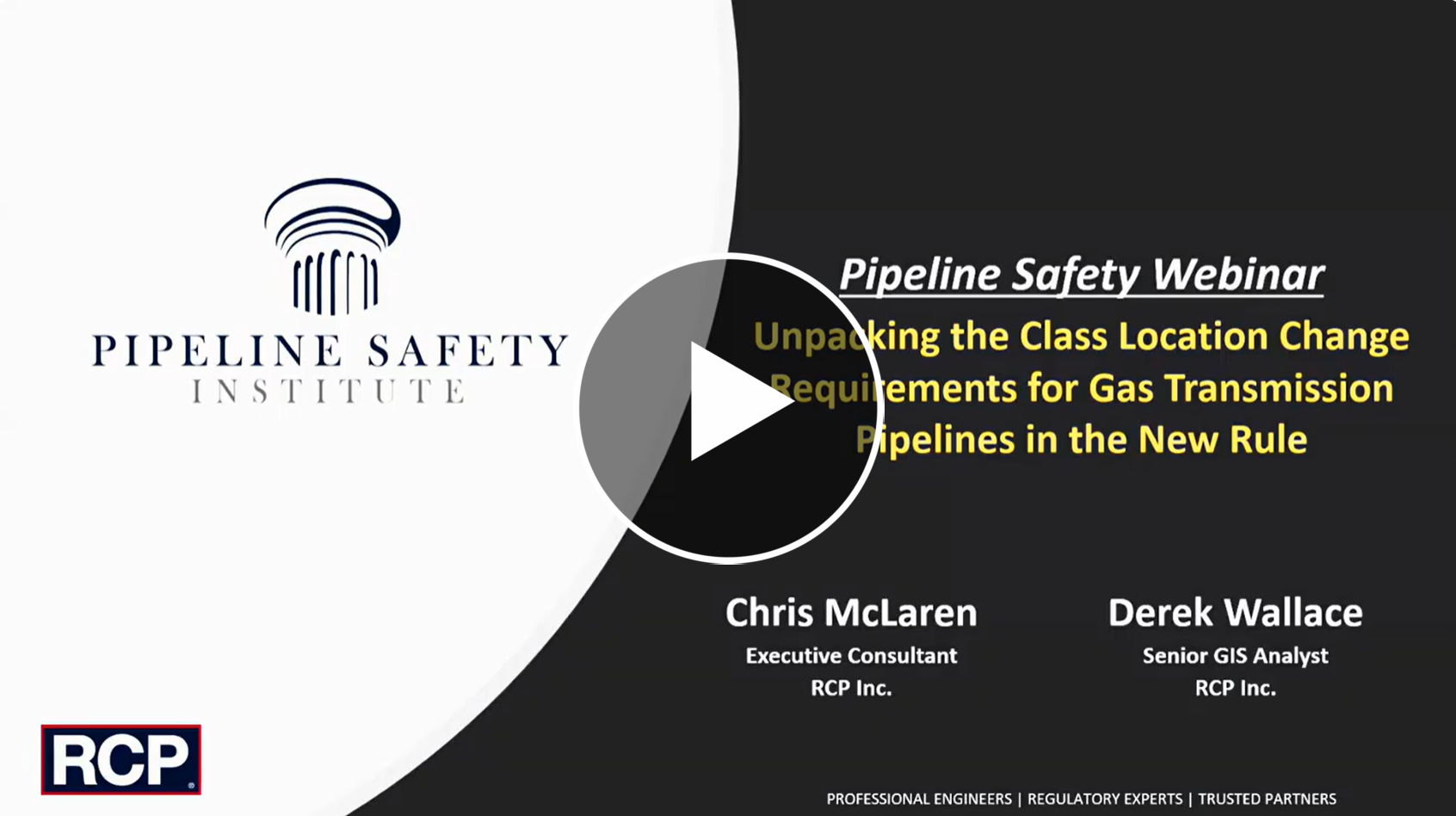
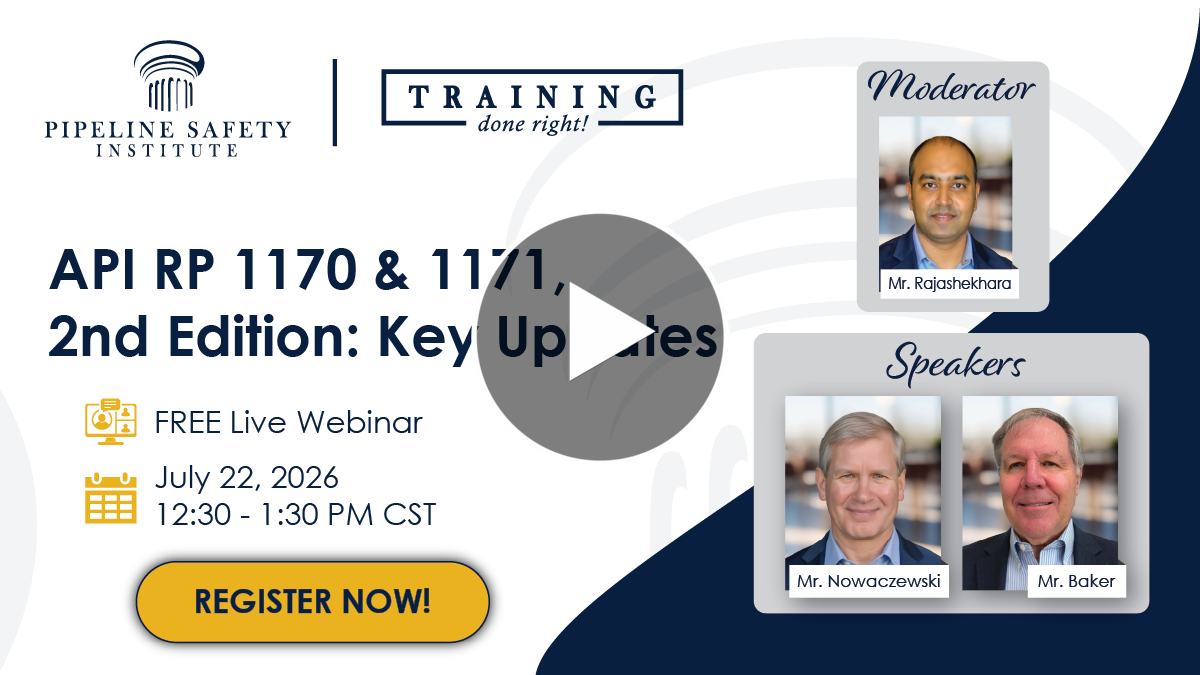
Unpacking the Key Updates in API RP 1170 & 1171, 2nd Edition
RCP and the Pipeline Safety Institute offered a free webinar exploring the 2nd Editions of API RP 1170, Design and Operation of Solution-mined Salt Caverns Used for Natural Gas Storage and API RP 1171, Functional Integrity of Natural Gas Storage in Depleted Hydrocarbon Reservoirs and Aquifer Reservoirs. Thank you to everyone who attended and participated in this informative webinar. The session recording is posted to our YouTube channel. Please watch, like, and subscribe to our channel!
New Workshop Alert!
Prepare Your Team for Pipeline Safety Audits with Confidence!
Our 3-day Pipeline Safety Audit Workshop is tailored for professionals responsible for the safe operation of hazardous liquid and natural gas pipelines. Designed for groups of 10-15 participants, this interactive training…
On-Site Training Request
We have conducted on-site training for oil and gas companies for over 25 years and can provide customized workshops for companies with groups of five or more.
We would welcome the opportunity to discuss our services with you.
Sincerely,
![]()
W. R. (Bill) Byrd, PE
President
RCP Inc.![]()