Underground Gas Storage User Fees
[Docket No. PHMSA-2016-0092]
PHMSA issued a notice to Underground Gas Storage operators on how it plans to assess annual user fees. PHMSA will use working-gas capacity as the basis for the user-fee rate structure. PHMSA will use the working-gas capacity values from the most recent Form EIA-191 Monthly Underground Natural Gas Storage Report. PHMSA will sum the working-gas capacity for all fields operated by the holder of a PHMSA-issued operator identification number. The operator working-gas capacity values will be divided into 10 tiers. The lowest values will be in tier 1 and the highest values in tier 10. The minimum and maximum working-gas capacities for each tier will be selected to place an equal number of operators in each tier. Each tier will have a user-fee assessment to be paid by each operator in the tier. The tiers and assessment per tier to collect $8,000,000 would be:
| Tier | Assessment per Operator | Working-Gas Capacity (Mcf) Range |
| 1 | $11,799 | Less than 930,000 |
| 2 | 23,599 | More than 930,000 and less than 3,000,000 |
| 3 | 29,499 | More than 3,000,000 and less than 5,800,000 |
| 4 | 35,398 | More than 5,800,000 and less than 11,000,000 |
| 5 | 47,198 | 11,000,000 or more and less than 13,700,000 |
| 6 | 58,997 | More than 13,700,000 and less than 21,000,000 |
| 7 | 70,796 | More than 21,000,000 and less than 32,100,000 |
| 8 | 76,696 | More than 32,100,000 and less than 48,000,000 |
| 9 | 88,496 | More than 47,000,000 and less than 91,500,000 |
| 10 | 147,493 | 147,493 |
PHMSA placed a spreadsheet in the docket showing the EIA company names in each tier, as well as the methodology used to determine the assessment per tier and tier ranges.
For more information or to get a copy of this notice, contact Jessica Foley.
Comments Filed: Proposed Safety of Gas Transmission and Gathering Pipelines
Three industry associations have filed joint comments to PHMSA regarding the proposed rulemaking for the Safety of Gas Transmission and Gathering Pipelines. AGA, API and INGAA filed comments, including proposed redlines for the topics that were covered at the first Gas Pipeline Advisory Committee meeting. These topics include:
- Transmission Integrity Management reassessment intervals
- Continuing surveillance after weather events
- Management of change
- Corrosion preventative and mitigative measures
- Integrity management clarifications
A copy of these comments can be found here. For assistance with preparations of this proposed rulemaking, please contact Jessica Foley.
Construction of Pipelines Using Domestic Steel
[Docket No. 170309252-7252-01]
The Department of Commerce (DOC) is seeking information on the construction and maintenance of American pipelines. This information will help the Department develop a plan for the domestic sourcing of materials for the construction, retrofitting, repair, and expansion of pipelines inside the U.S. as directed by the January 24, 2017 Presidential Memorandum regarding “Construction of American Pipelines” (Presidential Memorandum). The Secretary of Commerce, in consultation with relevant agencies, is required to deliver this plan to the President by July 23, 2017. In response to this directive, the DOC is conducting industry outreach to better understand:
- Current pipeline construction technology and requirements;
- Potential advances in pipeline technology;
- Domestic and foreign supply chain for pipeline materials; and,–All other information respondents consider pertinent to the development of the domestic sourcing plan.
Responses to this Notice will inform the Secretary’s plan for the domestic sourcing of materials used in pipelines within the boundaries of the U.S. Comments can be submitted via the Federal e-Rulemaking Portal. Include DOC–2017–0002 when submitting comments. Note that the original deadline for comments was April 7, 2017.
For a copy of the DOC’s Notice regarding Construction of Pipelines Using Domestic Steel, contact Jessica Foley.
PHMSA Deactivation of Threats Advisory Bulletin (ADB-2017-01)
Docket No. PHMSA-2016-0131
PHMSA has issued an advisory bulletin ADB-2017-01 to inform owners and operators of gas transmission pipelines that PHMSA has issued guidance on threat identification and the minimum criteria for deactivation of threats as well as guidance regarding documenting rationale of analyses, justifications, determinations, and decisions related to threat identification.
According to ASME B31.8S–2004, Section 2.2, an operator must consider nine individual threat categories as part of an IM program. As stated by ASME B31.8S–2004, Section 5.10, an IM program should provide criteria for eliminating a threat from consideration during a risk assessment; however, 49 CFR part 192—Subpart O does not include provisions for the permanent elimination of threats. An operator, therefore, must continually consider all threats in the evaluation of their IM program through periodic reviews and assessments, as required by section 192.937.
Some operators inappropriately label threats as inactive after they are eliminated from consideration during prior reviews and assessments, ignoring the continuous supply of new information provided during routine O&M activities. Others have opted to eliminate threats from consideration based on a lack of data, including missing, incomplete, or unsubstantiated data. Using insufficient data to eliminate a threat is not technically justified and is contrary to the guidance in ASME B31.8S–2004, Appendices A1–A9.
PHMSA acknowledges that the threats identified in ASME B31.8S–2004 may be considered active or inactive, but are never permanently eliminated. ASME B31.8S–2004, Appendix A, identifies the information an operator must collect and analyze for threats, which must demonstrate an individual threat is not acting on the pipe before an operator can properly declare the threat inactive for each assessment period. A threat must be considered active if any data required by Appendix A is missing, as lack of data indicating the existence of a threat is not an acceptable justification for considering the threat inactive.
Documents to support the determination of an inactive threat status must be maintained, as per the requirements of § 192.947(d). An operator does not need to assess a threat for the current assessment cycle if that threat is properly deemed inactive. When conditions warrant a review or new information becomes available during the required § 192.937 evaluation, operators are required to examine each applicable threat to determine it is active or inactive.
The advisory bulletin gives detailed guidance for each of the nine threat categories to help operators determine the active or inactive status. The advisory states that 4 of the 9 threats may be considered inactive if the facts warrant: internal corrosion; manufacturing; construction; and equipment threats. The remaining 5 threats (i.e., external corrosion; stress corrosion cracking; third party damage; incorrect operations; and weather related and outside forces), must always be considered active.
For a copy of ADB-2017-01 Deactivation of Threats, contact Jessica Foley.
PHMSA Advisory Bulletin: Guidance on Training and Qualifications for the Integrity Management Program (ADB-2017-02)
[Docket No. PHMSA-2016-0067]
PHMSA issued a new Advisory Bulletin (ADB-2017-02) for operators of natural gas transmission pipelines, outlining their expectations for qualifications of personnel who perform or supervise integrity management activities. PHMSA inspectors will use this Advisory Bulletin to clarify the intent of existing regulatory language when evaluating operator IM program personnel training and qualification effectiveness. Specifically, PHMSA advises that operators have the necessary qualifications and training for those personnel that:
- Have a role in executing the integrity management program,
- Have supervisory authority over integrity management activities, and
- Carry out integrity assessments and evaluate assessment results.
- Implement preventative and mitigative activities.
Qualification criteria must include minimum requirements for experience or training in order to verify individuals have the knowledge and skills necessary to perform integrity management-related tasks; and the operator must determine whether qualifications are current. Documentation of qualification must be maintained. The rule requires operators to verify that the personnel who execute activities within the integrity management program are qualified in accordance with the quality assurance process required by §192.911(l). Qualification requirements must be established for all tasks necessary to carry out integrity assessments and evaluate assessment results, including:
- Performing the integrity assessment;
- Evaluating the results of the integrity assessment;
- Integrating any other available information or data gathered in accordance with §192.917(b) that is applicable to the covered segment being assessed; and
- Deciding on actions to be taken based on these assessments.
For a copy of this Advisory Bulletin or to inquire how RCP can assist with these requirements, contact Jessica Foley.
Fundamentals of Pipeline Operations Workshop
May 17 – 18, 2017
Join us May 17-18, 2017 in Houston at our corporate office and dedicated training facility for this new workshop on the fundamentals of pipeline operations. This 2-day course is designed to give a comprehensive overview of gas and liquid energy transmission pipelines and how they are operated and maintained. It is appropriate for both technical and non-technical personnel who are new to the energy transmission pipeline industry, as well as those who need a broader understanding of pipeline operations and management in general. The course walks through the practical things that a typical pipeline company’s operations organization does on a regular basis to operate and maintain the pipeline system as a whole. Course topics include:
- Components of a pipeline system (types of pipe, coatings, tanks, valves, pumps, compressors, pressure vessels, pig traps, meters, instrumentation, control systems / SCADA)
- Operations activities (starting / stopping, batching, managing receipts and deliveries, measurement, monitoring, pressure control, leak detection)
- Inspection and Maintenance (valves, ROWs, tanks, pumps, compressors, instrumentation, pigging, cathodic protection)
- Repair (in-service repair techniques, welding, OOS repairs / replacements)
- Integrity Management (ILI, Pressure Tests, Direct Assessment), including assessment processes, analysis, follow-ups
- Emergency Response (planning, organization/ ICS, drills, response)
- Public Awareness / Damage Prevention / One Calls
Each attendee will receive the presentation as well as applicable handouts in a hardcopy notebook.
The course involves many hands-on demonstrations and examples using RCP’s in-house Pipeline Flow Loop*. To promote an optimal learning environment, class size will be limited. To register for our workshop, click here .
*RCP’s in-house Pipeline Flow Loop is an engineering marvel (!). It is a working 2” diameter pipeline system incorporating many of the components of a transmission pipeline system including state-of-the-art SCADA control system and instrumentation for flow, pressure, temperature, and volume, as well as automated valves, pig traps, variable speed pump, and more. It also incorporates clear pipe segments so that students can see a pig in operation, see phase separation as it occurs, and understand the importance of elevation change. It occupies 2 walls outside our training room. Students can monitor and control the pipeline from the training room (“control room”), and then step into the hall to see the pipeline in action.
April is National Safe Digging Month
The Common Ground Alliance (CGA) is a member-driven association of individuals, organizations and sponsors in every facet of the underground utility industry. CGA is committed to saving lives and preventing damage to underground infrastructure by promoting effective damage prevention practices. Damage prevention starts with one phone call, and since 2007 the phone number for that call has been 811. CGA has created several easy-to-use tools to help promote National Safe Digging Month (NSDM) and dialing 811. Visit the 811 Toolkit page on CGA’s website to download a suite of NSDM media materials, social media messages and infographics, advertising materials and more.
These articles are maintained and updated as new information becomes available.
Regulatory Watch: Key Dates & Deadlines
Track PHMSA rulemaking, regulatory stages, and important compliance deadlines in RCP's Regulatory Watch.
View Full Regulatory Watch →Conference News
Pipeline Pigging and Integrity Management Conference
The 39th International Pipeline Pigging & Integrity Management Conference (PPIM) will take place at the George R. Brown Convention Center in Houston. The event brings together pipeline operators, engineers, and industry professionals to explore advancements in pipeline inspection, integrity management, risk assessment, and emerging technologies.…
RCP Team Attending
Heather Roark
Jessica FoleyPSI Training Schedule

| Date | Training Course | Price | Registration |
|---|---|---|---|
| Nov 17 – Nov 19, 2026 | DOT Pipeline Compliance Workshop | $2,150 | SOLD OUT |
| Feb 16 – Feb 18, 2027 | Pipeline Safety Audit Training | $2,150 | Register → |
| Feb 23 – Feb 25, 2027 | Advanced Pipeline Risk Assessment Workshop | $2,150 | Register → |
| Mar 23 – Mar 25, 2027 | DOT Pipeline Compliance Workshop | $2,150 | Register → |
WEBINAR RECORDING!
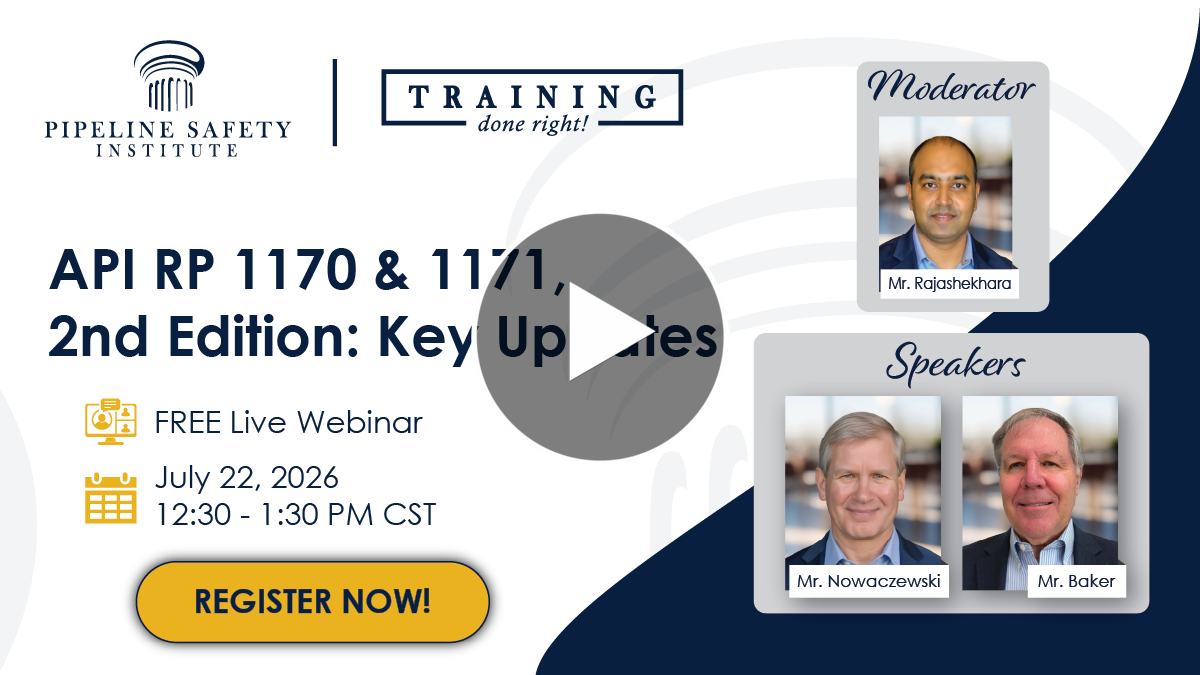
Unpacking the Key Updates in API RP 1170 & 1171, 2nd Edition
RCP and the Pipeline Safety Institute offered a free webinar exploring the 2nd Editions of API RP 1170, Design and Operation of Solution-mined Salt Caverns Used for Natural Gas Storage and API RP 1171, Functional Integrity of Natural Gas Storage in Depleted Hydrocarbon Reservoirs and Aquifer Reservoirs. Thank you to everyone who attended and participated in this informative webinar. The session recording is posted to our YouTube channel. Please watch, like, and subscribe to our channel!
New Workshop Alert!
Prepare Your Team for Pipeline Safety Audits with Confidence!
Our 3-day Pipeline Safety Audit Workshop is tailored for professionals responsible for the safe operation of hazardous liquid and natural gas pipelines. Designed for groups of 10-15 participants, this interactive training…
On-Site Training Request
We have conducted on-site training for oil and gas companies for over 25 years and can provide customized workshops for companies with groups of five or more.
We would welcome the opportunity to discuss our services with you.
Sincerely,

![]()
W. R. (Bill) Byrd, PE
President
RCP Inc.![]()