Final Rule: Safety of Gas Transmission Pipelines, MAOP Reconfirmation, Expansion of Assessment Requirements and Other Related Amendments

[Docket No. PHMSA–2011–0023; Amdt. Nos. 191–26; 192–125] RIN 2137–AE72

The long-awaited first of three gas transmission and gathering pipeline rulemakings was published in the Federal Register on October 1, 2019.  This rulemaking addresses several congressional mandates dating back to the 2011 reauthorization legislation, and addresses several NTSB recommendations following the PG&E San Bruno accident.  The effective date of the rule is July 1, 2020, with several requirements that extend out as much as 15 years to complete.  This is a significant rulemaking with a lot to digest, but we have tried to provide a brief summary of the highlights below.  For more information about how RCP can assist pipeline operators with integrating these new rules into your existing operations and integrity programs, contact Jessica Foley.

  • New Definitions for Moderate Consequence Area (MCA) and Engineering Critical Assessment (ECA)
  • Expansion of pipeline integrity management requirements beyond High Consequence Areas.
    • Applicable to onshore gas transmission lines with MAOP > 30%SMYS and located in a class 3 or 4 location, or within an MCA. An MCA is an onshore area that is within the potential impact circle, containing either:
      • 5 or more buildings intended for human occupancy, or
      • any portion of the paved surface of an interstate, freeway, expressway, or principal arterial roadway with 4 or more lanes.
    • Operators must assess the integrity of these segments by July 3, 2034 and periodically assess these segments every 10 years after the last assessment. 
  • Methods for material verification
    • New section §192.607 lists the requirements for physical material properties (e.g., diameter, wall thickness, seam type, grade) for pipelines that do not have traceable, verifiable, and complete (TVC) records.
    • Allows for destructive and non-destructive means to obtain material properties.
    • Allows operators the choice of capturing these records through:
      • in situ examinations during excavation activities as opportunities present themselves (e.g., anomaly direct exams, repairs, replacements and relocations),
      • through a more prescriptive approach for sampling multiple segments of pipe sharing similar physical properties, or 
      • by submitting a written request to PHMSA for using an alternative method and proceeding forward if no objection letter is received from PHMSA within 90 days.
    • Records established must be maintained for the life of the pipeline and be TVC.
  • MAOP reconfirmation
    • Reconfirmation of gas transmission MAOP for either of the following pipelines:
      • pipelines without TVC records necessary to establish MAOP, located within an HCA or a class 3 or 4 area.
      • “grandfathered” pipe with an MAOP > 30% SMYS located within an HCA, or a class 3 or 4 area, or an MCA capable of inspection by in-line inspection.
    • Operator have until July 3, 2028 to reconfirm MAOPs  for 50% of their affected mileage and until July 2, 2035 to reconfirm MAOP for 100% of their affected mileage.
    • Operators have six options to reconfirm MAOPs:
      • Subpart J pressure test with material verification at test head cutout locations,
      • Pressure reduction from highest sustained pressure from previous 5 years, divided by 1.25 or higher class location factor,
      • Engineering Critical Assessment,
      • Pipe replacement,
      • Pressure Reduction for Pipe with PIR < 150’, from highest sustained pressure from previous 5 years, divided by 1.1, or
      • Submit written request to PHMSA for use of alternative method and proceed forward if no objection letter is received from PHMSA within 90-days.
  • Engineering Critical Assessment for MAOP Reconfirmation
    • §192.632 describes the prescriptive and data intensive processes required for an operator to follow if they chose to perform an ECA to reconfirm MAOP under §192.624.
  • Analysis of Predicted Failure Pressure
    • §192.712 describes the process that an operator must take to determine the predicted failure pressure of a specific anomaly or defect as well as the remaining life of the pipeline segment at the location of the anomaly or defect.
  • Recordkeeping Requirements for Gas Transmission Pipelines
    • Operator will be required to maintain records for:
      • Current class location,
      • Pipe design and material properties,
      • Component pressure rating (greater than 2 inches),
      • Welder qualification must be retained for a minimum of 5 years, and
      • Plastic pipe joining qualifications at the time of pipeline installation must be retained for a minimum of 5 years.
  • Spike Testing
    • §192.506 describes the process required for operators who choose to perform a spike test to assess time dependent threats (stress corrosion cracking, selective seam weld corrosion, manufacturing defects, cracks and crack-like defects).
  • Reporting MAOP exceedances
    • Usage of the safety-related condition report form to report MAOP exceedances within 5 days of the exceedance occurrence.
  • 6-month grace period for 7-year gas transmission integrity reassessment intervals with written notice to the Secretary, with sufficient justification of the need for the extension.
  • Consider Seismicity as a risk factor in integrity management
  • Safety Requirements for In-line inspection launchers and receivers

PHMSA anticipates completing a second rulemaking to address the topics in the NPRM regarding repair criteria in HCAs, the new repair criteria for non-HCAs, pipeline inspection following extreme events, pipeline corrosion control updates, management of change process, clarification of certain other IM requirements, and strengthening IM assessment requirements. A third rulemaking is expected to address new requirements for gas gathering lines.  Stay tuned for those to be published in the federal register, possibly within the next year.

Mega Rule and Spike Testing

November 12, 2019

Sheri Baucom will host a webinar on November 12th, to detail how TestOp® can assist with spike tests.

  • Spike testing is now codified in the new regulations for gas pipelines, as part of Phase 1 of the “Mega Rule.” 
  • This presentation will outline the spike test requirements, as well as how to utilize TestOp® when designing and executing spike tests.
  • Several examples as well as do’s and don’ts will also be covered.

Click here to register for our Mega Rule and Spike Test webinar.

Pipeline Safety: Safety of Hazardous Liquid Pipelines

[Docket No. PHMSA–2010–0229; Amdt. No. 195–102] RIN 2137–AE66

The new hazardous liquids rule was published in the Federal Register on October 1, 2019.  It was originally published in the Federal Register in February 2017 but was quickly pulled back following issuance of two Executive Orders on regulatory reform.  This rulemaking addresses several congressional mandates, and NTSB and GAO recommendations.  The effective date of the rule is July 1, 2020, with several requirements that extend out as much as 20 years to complete.  This is also a significant rulemaking with a lot to digest, but we have tried to provide a brief summary of the highlights below.  For more information about how RCP can assist pipeline operators with integrating these new rules into your existing operations and integrity programs, contact Jessica Foley.

  • Additional reporting for gravity and exempt rural gathering pipelines
    • PHMSA expanded the annual reporting and accident requirements to cover both gravity lines and rural gathering lines that are not considered regulated gathering pipelines.
  • Leak Detection
    • Leak detection will be required on all new pipelines, and by October 1, 2024 for pipelines constructed prior to October 1, 2019. Regulated rural gathering and offshore gathering pipelines have been exempted from this leak detection requirement.
  • Post abnormal weather event assessments
    • A pipeline facility that could be damaged or adversely affected by an abnormal weather event (e.g., flooding, tropical storms, landslide, earthquake) must be assessed within 72 hours after cessation of the event.  The assessment will check for abnormal damages due to the natural force events. If pipeline integrity was impacted, additional integrity reviews and efforts may be warranted to ensure pipeline integrity is stable.
  • Pipeline integrity assessment for Non-HCA pipelines
    • For onshore pipelines located outside of an HCA that can pass an in-line inspection device, integrity assessments must be conducted (ILI, pressure test, etc.).  The initial assessment must be completed by October 1, 2029, with periodic reassessments completed every 10 years after the last assessment.  Operators will have 180 days from the assessment to determine if there are any conditions that warrant remedial actions.
  • HCA pipelines capability to pass internal inspection devices
    • All HCA pipe must be modified to accommodate an internal inspection device by July 2, 2040. New pipelines must be constructed to accommodate internal inspection devices. The amount of the HCA miles capable of being inspected with internal inspection devices will be required to be reported annually. Newly identified HCAs will have 5 years to be made piggable.
  • Data Integration
    • PHMSA outlines several types of data sets that will need to be integrated within an operator’s integrity management program (ex. MOP, coating, casing locations, integrity assessment data, CIS, depth of cover, interference surveys, etc.).

Understanding MAOP Reconfirmation Requirements Webinar

November 21, 2019

RCP will walk through the requirements of the new MAOP reconfirmation regulations, what it means for companies with good MAOP records, and what it means for companies without material records.

RCP’s subject matter expert will also discuss the benefits of using MaxOp®.

Click here to register for our Understanding MAOP Reconfirmation Requirements webinar.

Pipeline Safety Emergency Order Procedures

[Docket No. PHMSA-2016-0091; Amdt. No. 190-21] RIN 2137-AF26

The “Enhanced Emergency Order Procedures” final rule adopts, with modifications, the provisions of a 2016 interim final rule that established temporary emergency order procedures in accordance with a provision of the Protecting our Infrastructure of Pipelines and Enhancing Safety Act of 2016 (PIPES Act). An emergency order may impose emergency restrictions, prohibitions, or other safety measures on owners and operators of gas or hazardous liquids pipeline facilities.

These regulations establish procedures that PHMSA would follow for the issuance of emergency orders.  These orders may address an unsafe condition or practice, or a combination of unsafe conditions or practices, that constitute or cause an imminent hazard to public health and safety or the environment. The regulations describe the duration and scope of such orders and provide a mechanism by which pipeline owners and operators subject to, and aggrieved by, emergency orders can seek administrative or judicial review. 

This final rule is effective December 2, 2019.

For a copy of the Enhanced Emergency Order Procedures final rule, contact Jessica Foley.

What can TaskOp™ do for you? Webinar

february 17, 2020

New Regulations have you Stressed Out…Don’t Panic…TaskOp™ has your back

This webinar will demonstrate how TaskOp™ can be used to track all of the complex activities associated with the new gas transmission and hazardous liquid regulations.

  • Manage inventory of all segments with non-TVC records through the lifespan of MAOP reconfirmation and material verification efforts.
  • This is done with easy-to-use dashboards to:
    • Track reconfirmation mileage progress.
    • Track all your scheduled projects to get your newly regulated pipelines in step with regulations.
    • Manage workloads across your compliance team.
  • Track implementation progress of new regulatory requirements, including procedure updates, material verification digs, data analysis, assignments of responsibility.
  • Utilize the calendar for upcoming agency audits and internal field training / audits:
    • Keep up to date with what is coming up and be better prepared for any type of audit.
    • Keeps track of all your audit details, findings, follow up records, etc.
    • Manage your audit findings by assigning them to personnel, track their progress, and keep track of documentation.
  • After everything is in order, you can manage your new workflow tasks for all the newly regulated pipelines within TaskOp™.
    • Track inspections, maintenance, and other tasks related to your pipelines.
    • Keep everything traceable, verifiable, and complete all in one system.

Click here to register for our What can TaskOp™ do for you? webinar.

TaskOp now has the ability to track inventory and work with barcodes. 
We’re taking TaskOp to the next level with barcoding. Let TaskOp track your warehouse inventory of spare valves, meters, parts, etc. and track when they are pulled for projects in the field. Know when you need to reorder items, where items are used and track invoices for accounting purposes.  Barcode scanning allows users to quickly scan a barcode to find the part. If you are just starting a warehouse, or barcoding assets, TaskOp can generate those barcodes to print and stick to your inventory – the data required to find records quickly, via scanning the barcode, will already be in TaskOp.

As an added bonus, use barcodes to quickly pull up the latest field tasks without having to search the system.  If your assets have barcodes on them and that information is in the asset data in the system, you can scan the barcode and the latest active tasks for that asset will appear in a report,  greatly reducing the time needed to find those tasks that a field technician will be doing.

Visit www.rcp.com or contact Jessica Foley for more information.

Texas Railroad Commission 16 TAC 8 Regulatory Updates

On October 1st the Railroad Commission of Texas (TRRC) approved for publication a variety of regulatory changes to 16 TAC 8. The primary changes are to bring TRRC regulations in alignment with PHMSA requirements. A couple of reporting changes include: operators no longer have to submit to the TRRC certain PMHSA reports, but instead retain copies and only submit to the TRRC if requested to do so. There are proposals to shorten the time for reporting an accident/incident to one hour instead of the current two hours.

For the follow-up 30-day reports, the content has been expanded to include certain specific items but also to report all the items required by PHMSA. Construction Commencement reports have new requirements. The definitions for Priority 1, 2 and 3 segments are changed for DIMP risk analysis results. A prohibition for using cast iron, wrought iron and bare steel pipe in distribution systems is included in the proposal as well as a deadline of December 31, 2021 for the replacement of all known cast iron distribution pipe.

DOT Pipeline Compliance Virtual Workshop

Nov 15-17, 2021

Join us virtually, November 15-17, 2021  for an informative and interactive online workshop on DOT Pipeline Compliance topics. This Workshop will give a brief overview of the new rules, in addition to our standard overview of the DOT pipeline regulations in 49 CFR 191, 192, 194, 195, 196, and 199. It also describes pipeline operations and engineering concepts. It is appropriate for people who are new to pipeline regulations, who could use a refresher, or anyone who needs to know the latest developments in these areas. This workshop will be a combined format, addressing both gas and liquid pipeline topics in parallel. This will eliminate some redundancy of materials, and will allow more time for in-depth discussions for each topic.

Topics to be addressed in the workshop include:

  • An overview of DOT/OPS pipeline compliance requirements
  • State and Federal agency roles for pipeline safety
  • PHMSA Jurisdiction
  • PHMSA Inspections and Enforcement Processes
  • Engineering Concepts and Stress/Strain Relationships; %SMYS
  • Design Requirements
  • Construction Requirements
  • Corrosion Control Concepts and Requirements
  • Operations and Maintenance Requirements
  • Emergency Response Requirements (including spill response planning requirements for liquid pipelines)
  • Damage Prevention Programs
  • Operator Qualification Programs
  • Drug and Alcohol Programs
  • Public Awareness Programs
  • Integrity Management (gas and liquid) Programs
  • Control Room Management Programs

We will also discuss the PIPES Act of 2021; recent Advisory Bulletins from PHMSA; and new, pending and proposed rulemakings.

Each attendee will receive an electronic copy of the presentation as well as applicable handouts, and applicable regulations and voluminous reference materials including rulemakings, letters of interpretation, and other guidance documents.

To register for our workshop, click here.

Request a Demo

MaxOp® – MAOP Reconfirmation Services

RCP is the market leader in providing MAOP Reconfirmation Services, including over 100,000 miles of gas and liquid pipeline analysis and support. Whether you are just getting started, need help finishing, or not sure what to do next, RCP has a wealth of experienced professional engineers and support staff to assist in your MAOP validation efforts.

  • Turnkey: document review & imaging, data extraction, gap analysis, MAOP reporting
  • Traceable, Verifiable, and Complete (TVC): connects MAOP data to source document image files and identifies exact 192/195 code sections driving MAOP results
  • Document Grading: grade documents to determine TVC compliance
  • Audit: Provides a precise audit trail and calculation for each individual component or piece of pipe in a system
  • Written Procedures: Develop and/or improve company MAOP standards and procedures
  • Quality Assurance: review existing validation efforts, compare calculations using MaxOp*
  • Reporting: Import data to MaxOp*, export Section Q & R report, gap reports, and calculations
  • Remediation: develop risk and cost based strategies to prioritize, schedule, and mitigate MAOP gaps using pressure tests, pressure reductions, Engineering Critical Assessments, pipe replacement, or other engineering tools

For more information about RCP’s MAOP validation services or the MaxOp* calculator tool, please contact Jessica Foley.

* MaxOp is a registered trademark of RCP, Inc., in the United States. RCP holds 3 patents (#8,548,756; #8,548,757; and #8,548,758) for our industry-leading MaxOp* software and MaxOp is a registered trademark of RCP, Inc., in the United States.


TaskOp™ – Asset Management Tracking System

RCP provides a state-of-the-art, web-based Compliance Management System, TaskOp™, that is simple to use and keeps you on track with your tasks. TaskOp™ is a modular system, capable of handling implementations from basic work orders through complex, asset-driven compliance and training management solutions. TaskOp™ is fully customizable for any type of facility or regulatory requirement.

TaskOp™ helps your organization’s compliance requirements flow more efficiently in order to:

  • Delegate compliance duties effectively
  • Remind personnel of tasks through existing e-mail system
  • Track task completion with documentation
  • Alert management when tasks are not completed on time or need follow-up action
  • Smoothly interface with GIS applications
  • Ensure that all training and qualifications are completed prior to expiration

TaskOp™ is completely scalable, so RCP can manage a small division’s regulatory compliance and easily expand to handle the entire corporation’s regulatory management needs. This comprehensive system can neatly manage virtually any and all of your regulatory management requirements including: air, wastewater, hazardous waste, CFR 192/195 and safety requirements.

RCP will assist with initial implementation of TaskOp™ and provide on-going compliance management support. Because RCP incorporates web-based technology, there is no need to rely on IT while getting started. During use, if key personnel leave or other corporate changes take place, TaskOp™ can adapt and scale to keep up. Tracking compliance tasks will help maintain regulatory compliance, meet performance objectives and manage operational risk.


TestOp® – Pipeline Pressure Test Services

RCP’s personnel have established themselves as industry experts, with over 1,000 on-site pressure test validations and 200+ years of combined experience in designing, implementing and validating pressure tests for pipeline operators.

PRESSURE TEST STANDARDS AND PLANS
  • Develop pressure test standards and procedures
  • Review, update and consolidate company’s existing pressure test standards and procedures
  • Create standardized test plan templates
DESIGN AND CERTIFICATION OF PRESSURE TESTS
  • Assist in the design of pressure test projects
  • Develop or review test plans for upcoming tests
  • Provide on-site inspection, and certify pressure tests on-site or remotely
TRAINING AND RECORDS REVIEW
  • Conduct general or customized pressure test training
  • Review prior test records in preparation for an audit
  • Review pressure test records in preparation for purchase of an asset

RCP uses its proprietary pressure test certification tool, TestOp®, to plan, certify and document pressure tests. For more information or to schedule a free TestOp® demonstration fill out the form below.

Request a Demo

Ongoing Resources

These articles are maintained and updated as new information becomes available.

Regulatory Watch: Key Dates & Deadlines

REGULATORY SNAPSHOT Last updated November 3, 2026
38Tracked regulations
8Proposed / DFR
18Final rules

Track PHMSA rulemaking, regulatory stages, and important compliance deadlines in RCP's Regulatory Watch.

View Full Regulatory Watch →
Last Updated: October 2026

Conference News

Jan252027

Pipeline Pigging and Integrity Management Conference

▦ January 25, 2027 – January 28, 2027⌖ George R. Brown Convention Center, Houston, TX

The 39th International Pipeline Pigging & Integrity Management Conference (PPIM) will take place at the George R. Brown Convention Center in Houston. The event brings together pipeline operators, engineers, and industry professionals to explore advancements in pipeline inspection, integrity management, risk assessment, and emerging technologies.…

Exhibiting · Booth 524
RCP Team Attending
Heather RoarkHeather Roark
Jessica FoleyJessica Foley
Event Details

Last Updated: November 2026

PSI Training Schedule

Date Training Course Price Registration
Nov 17 – Nov 19, 2026 DOT Pipeline Compliance Workshop $2,150 SOLD OUT
Feb 16 – Feb 18, 2027 Pipeline Safety Audit Training $2,150 Register →
Feb 23 – Feb 25, 2027 Advanced Pipeline Risk Assessment Workshop $2,150 Register →
Mar 23 – Mar 25, 2027 DOT Pipeline Compliance Workshop $2,150 Register →

WEBINAR RECORDING!
Unpacking the Key Updates in API RP 1170 & 1171, 2nd Edition

RCP and the Pipeline Safety Institute offered a free webinar exploring the 2nd Editions of API RP 1170, Design and Operation of Solution-mined Salt Caverns Used for Natural Gas Storage and API RP 1171, Functional Integrity of Natural Gas Storage in Depleted Hydrocarbon Reservoirs and Aquifer Reservoirs. Thank you to everyone who attended and participated in this informative webinar. The session recording is posted to our YouTube channel. Please watch, like, and subscribe to our channel!

WEBINAR RECORDING
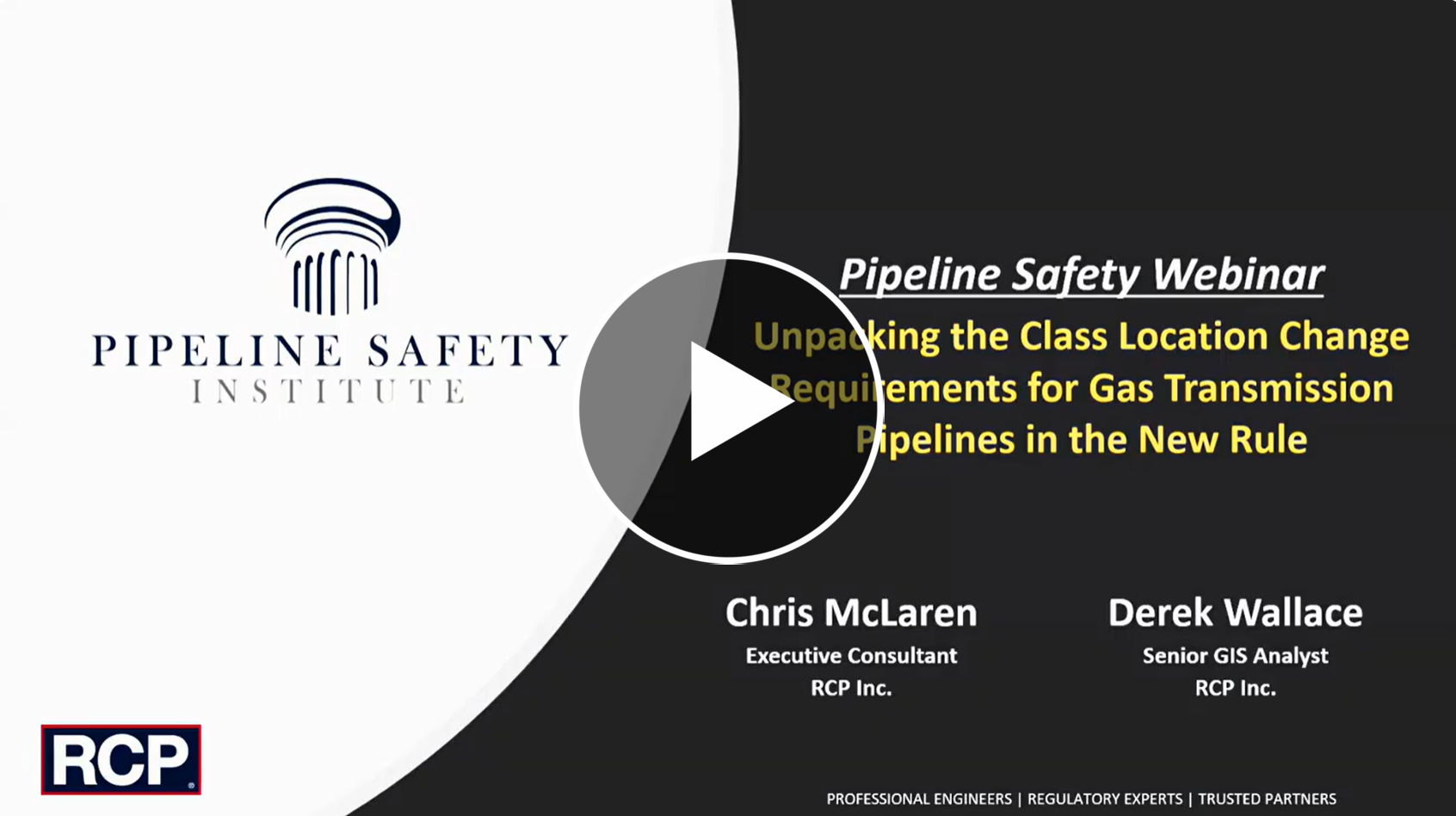
Pipeline Safety: Unpacking the Class Location Change Requirements

Thank you to everyone who attended and participated in this informative webinar. The session recording is posted to our YouTube channel. Please watch, like, and subscribe to our channel!
New Workshop Alert!

Prepare Your Team for Pipeline Safety Audits with Confidence!

Our 3-day Pipeline Safety Audit Workshop is tailored for professionals responsible for the safe operation of hazardous liquid and natural gas pipelines. Designed for groups of 10-15 participants, this interactive training…

On-Site Training Request

We have conducted on-site training for oil and gas companies for over 25 years and can provide customized workshops for companies with groups of five or more.

We would welcome the opportunity to discuss our services with you.

Sincerely,

W. R. (Bill) Byrd, PE
President
RCP Inc.