PRCI Established Emerging Fuels Institute
Through the recently established Emerging Fuels Institute (EFI), Pipeline Research Council International (PRCI) is working to resolve the technical gaps that exist as the industry transitions to low carbon energy solutions using the existing pipeline asset infrastructure. As many governments are planning or have begun mandating transitions to renewable energy sources to achieve their stated goals of stabilizing the climate, low carbon footprint fuels are a foundational component for a sustainable energy society.
The scope of the EFI addresses ammonia, biofuels, carbon capture and sequestration (CCS), hydrogen, and renewable natural gas (RNG). The EFI’s current priorities are following market focus in the storage and transportation of hydrogen and RNG. Project emphasis areas include:
- Integrity of pipeline system steel and non-steel components
- Compressor stations and facilities
- Pressure control and over pressure safety devices
- Design requirements for electrical classification and fire safety
- Downhole reservoir and cavern storage
An important output of the EFI will be to develop a guide to safely convert and operate pipeline systems to allow for the transport and storage of the next generation of fuels.
Collaboration with industry stakeholders is critical to ensure the optimization of the overall transition effort. To ensure a comprehensive and continued awareness of ongoing work within the industry, a key task of the EFI is partnering with global research associations to share respective roadmaps so that work is efficiently and comprehensively incorporated into EFI deliverables. These peer research associations currently include the Australian Pipeline and Gas Association (APGA), the European Pipeline Research Group (EPRG), the European Gas Research Group (GERG), the Future Fuels Collaborative Research Center (FFCRC), and the Gas Technology Institute (GTI).
As the opportunities around emerging fuels continues to advance, it is important that PRCI works closely with our government, industry, and standards, developing organizations to ensure that the leading research defines how the energy pipeline industry is making progress to transport and store the next generation of fuels. There are a number of efforts progressing globally and to be able to achieve the timelines that policy makers have set, it is imperative that we work closely together. The EFI coordinates its efforts with governmental agencies such as the Canada Energy Regulator (CER), the U.S. Department of Energy (DOE), and the U.S. Pipeline and Hazardous Materials Safety Administration (PHMSA). Industry associations that the EFI coordinates with include the Association of Oil Pipe Lines (AOPL), the American Petroleum Institute (API), and the Interstate Natural Gas Association of America (INGAA). Similarly, the EFI coordinates with technical societies such as Canadian Standards Association (CSA) and the American Society of Mechanical Engineers (ASME).
Cliff Johnson, president of PRCI, stated that “the current pipeline infrastructure will play a key role in the energy transition. PRCI and its members are working to ensure the safety and integrity of the pipeline system for today and tomorrow.” PRCI looks forward to continuing to work closely with their members to ensure the safety and resiliency of the global pipeline infrastructure to transport and store energy.
For more information about the EFI and membership, please contact Jeff Whitworth at jwhitworth@prci.org.
Free Webinar: Unpacking the New Gas Gathering Rule
In this free webinar, the Pipeline Safety Institute will unpack the new gas gathering final rule that becomes effective on May 16, 2022. PHMSA estimates approximately 425,000 miles of previously exempt gas gathering lines will now be regulated as either Type C or Type R regulated gas gathering pipelines.
The webinar will include useful information on how to determine whether a pipeline is classified as a Type A, B, C or R gas gathering line and will walk through what sections of Parts 191 and 192 apply to these newly regulated pipelines. Attendees will come away with a thorough understanding of the new requirements and what they would need to do to prepare for implementation.
To register for this free webinar, click here. The webinar schedule is as follow:
February 17, 2022 (Thursday): 1-2 p.m. CST
Underwater Inspection Procedures & Inspection Interval Risk Model Updates
As a reminder, now that hurricane season has ended, this is a good time to evaluate how these storms may have impacted your shallow water pipelines and if their risk profiles have changed. The number and proximity of hurricanes are typically the largest inputs for the risk profiles. In addition to the latest storm data tabulated by the National Hurricane Center, RCP’s proprietary Underwater Inspection Interval Risk Model analyzes key operator information as well as National Oceanic and Atmospheric Administration charts and state game and fisheries department maps for additional hazards and associated risks.
For more information on RCP’s Underwater Inspection Procedure or Inspection Interval Risk Model, contact Jessica Foley.
Oklahoma Corporation Commission OCC Domains Have Expired
Update your bookmarks and address books! As the Oklahoma Corporation Commission continues on the path to digital transformation and agency modernization, the prior website domains (occeweb.com and occ.state.ok.us) and older email formats including f.last@occemail.com have expired and will no longer work. Please update your bookmarks to oklahoma.gov/occ (website launched November 2020). And, check that your address books are updated with employees’ email domain: first.last@occ.ok.gov.
ASME 2021 Global Pipeline Award
ASME (American Society of Mechanical Engineers) Pipeline Systems Division presented the 2021 Global Pipeline Award (GPA) at the Rio Pipeline Conference Digital Event, November 9 – 11, 2021. This award recognizes outstanding innovations and technological advances by various organizations in the field of pipeline transportation. A project, product, device, system, service, approach or other can receive the award.
The 2021 GPA was presented to TC Energy for Plausible Profile (Psqr) Model for Metal-loss Corrosion Assessment. From Shahani Kariyawasam, TC Energy – “Annual budgets are rising as we drive towards Zero and decarbonize the energy industry. But we also have great opportunity – in the data revolution, modern computational power, and new technologies! Understanding these challenges, opportunities, and the high sensitivity of integrity actions to decision models, we pivoted to a revolutionary way of improving pipeline integrity decisions – that was not possible 30 years ago. This led to the Plausible Profiles model, which challenges traditional assumptions and removes unnecessary actions that do not reduce risk – leading to transformational value. Right work not more work brings safety and sustainability!”
The 2021 GPA Finalists:
Eddyfi Technologies Spyne
Enbridge OMEGA (Optimized Management of Engineering and Geographic Assets)
Rosen A Unique Rota to Ultra-Deep-Water In-Line Inspection
Trapil T3 for Trapil Theft Tracker
Previous winners include pipeline operators Enbridge, PetroChina, and Petrobras, as well as contractors and research organizations such as Technip, DNV, Rosen, TD Williamson, and Penspen / Northumbria University.
For information, visit www.asme.org.
MaxOp Training
RCP is now offering a one-day workshop on how to use MaxOp software. This training session can be scheduled onsite or at RCP’s corporate office in Houston, Texas. MaxOp is the most comprehensive MAOP tool on the market. RCP’s MaxOp tool can link documentation to MAOP algorithm variables, dynamically segment data, run MAOP calculations, identify potential discrepancies between the established and calculated MAOP values, and export calculated data sets and customizable reports back to their own native data sets. The tool will accept common pipeline database formats, including Excel, PODS, APDM and others. For more information, contact Jessica Foley.
Client Feedback
RCP has a tradition of creating and sustaining trusted partnerships with the companies we serve. This has translated into long-term relationships that are based not only on the quality and scope of the work we provide, but also on the manner in which we provide it. We routinely hear from our clients with positive feedback like this quote below:
“Thanks everyone for all the help in making the training so smooth. I have received extremely positive feedback from my team regarding both the content and the format, and you gave us a lot to think about with regards to potential gaps within our programs.”
December Featured Services
Pipeline Acquisition Due Diligence & Program Support
RCP has provided expert support for various pipeline acquisitions. RCP can provide due diligence audits and jurisdictional determinations to help ensure that potential compliance issues have been addressed before the sale is final.
A past project included due diligence on crude assets in West Texas and New Mexico of over 2,000 miles of regulated transmission pipeline, gathering systems, and environmental assessments for 38 sites such as breakout, pump, and tank battery stations. The types of services we provide include the following:
- Environmental Site Assessments (Phase I and Phase II) – An Environmental Site Assessment (ESA) is an evaluation of a property and all structures on the property to determine the likelihood of a recognized environmental condition.
- Pipeline Risk / Liability Assessments – RCP will evaluate the pipeline’s operating and maintenance history, its environment, and other factors to identify any unusual risks or liabilities. This can include, for example, problems identified during previous in-line inspections which have never been corrected.
- Regulatory Compliance Review – RCP can conduct a comprehensive permit and authorizations audit for all state and federal agencies (air, water, waste, etc.). For pipelines, this includes a review of the existing O&M Manuals, Operator Qualification Program, and Integrity Management Program to evaluate compliance with existing regulations.
- Compliance Program Development – RCP can assist you with the integration of these assets into your existing regulatory compliance programs. This may include consolidating programs or in some cases creating new manuals and programs for the new pipeline system.
If you would like information on RCP’s Pipeline Acquisition Support Services, contact Jessica Foley.
DOT COVID-19 Drug & Alcohol Testing Statement of Enforcement
On November 29, 2021, the Office of Drug and Alcohol Policy and Compliance updated its Statement of Enforcement Discretion for Substance Abuse Professionals and Service Agents guidance document. The guidance is now effective until June 30, 2022. To view the updated guidance, click here.
The Enforcement Corner
The Enforcement Corner summarizes recent PHMSA enforcement actions, indicating where PHMSA is putting its enforcement efforts and the fines they are proposing for various types of violations.
In November 2021, PHMSA issued 5 NOAs, 12 NOPVs, and 6 WLs accompanied by $1,323,347 in proposed fines. Significant proposed fines were attributed to the following code sections:
- $6,900 – 49 CFR 195.452(h)(4)(iii)(E) – 180-day Conditions
- $27,900 – 49 CFR 195.403(c) – Emergency Response Training
- $46,600 – 49 CFR 195.452(b)(1) – IM Program in HCAs
- $80,000 – 49 CFR 195.452(l)(ii) – IM Program in HCAs
- $67,700 – 49 CFR 195.452(f) – IM Program in HCAs
- $61,100 – 49 CFR 195. 452(b)(5) – IM Program in HCAs
- $209,700 – 49 CFR 195.406(b) – Maximum Operating Pressure
- $19,300 – 49 CFR 195.573(e) – Monitoring External Corrosion
- $115,500 – 49 CFR 195.573(a)(1) – Monitoring External Corrosion
- $40,000 – 49 CFR 195.573(c) – Monitoring External Corrosion
- $36,200 – 49 CFR 195.52(b) – NRC Reporting
- $218,647 – 49 CFR 195. 402(c)(11) – O&M Procedures
- $276,400 – 49 CFR 195. 402(c)(13) – O&M Procedures
- $61,100 – 49 CFR 195.402(a) – O&M Procedures
- $38,000 – 49 CFR 192.805(b) – Operator Qualification Plan
- $19,000 – 49 CFR 195.440(c) – Public Awareness
Please note:
- Pipeline operators may disagree in whole or in part with each proposed violation cited by PHMSA.
- Proposed Civil Penalties (PCP) may be reduced or eliminated before an enforcement action becomes final.
- A Corrective Action Order (CAO) usually addresses urgent situations arising out of an accident, spill, or other significant, immediate, or imminent safety or environmental concern.
- A Notice of Amendment (NOA) is frequently a result of a difference of opinion regarding written procedure requirements.
- A Notice of Proposed Safety Order (NOPSO) addresses pipeline integrity risks that may not constitute a hazardous facility requiring immediate corrective action (see Corrective Action Order described above),but do need to be addressed over time.
- A Notice of Probable Violation (NOPV) is not proof that a violation actually occurred.
- A Proposed Compliance Order (PCO) frequently documents actions the pipeline operator already planned to do.
- Warning Letter (WL) is an official notice by PHMSA that an operator needs to make improvements but that no further enforcement is proposed for those findings at this time.
RCP maintains a detailed database of all PHMSA enforcement actions dating back to 2007 and is routinely asked for data analysis of various enforcement actions. For more information on how RCP can assist with enforcement action data analysis services, contact Jessica Foley.
Need to respond to a PHMSA enforcement action?
Need to know if your enforcement action is an outlier, or par for the course?
RCP maintains a detailed database of all PHMSA enforcement actions and their resolution which enables us to compare and contrast individual enforcement actions to nationwide actions and trends. We can help put things into context to ensure an effective reply for each citation. For more information on how RCP can assist with enforcement action data analysis services, contact Jessica Foley.
These articles are maintained and updated as new information becomes available.
Regulatory Watch: Key Dates & Deadlines
Track PHMSA rulemaking, regulatory stages, and important compliance deadlines in RCP's Regulatory Watch.
View Full Regulatory Watch →Conference News
Pipeline Pigging and Integrity Management Conference
The 39th International Pipeline Pigging & Integrity Management Conference (PPIM) will take place at the George R. Brown Convention Center in Houston. The event brings together pipeline operators, engineers, and industry professionals to explore advancements in pipeline inspection, integrity management, risk assessment, and emerging technologies.…
RCP Team Attending
Heather Roark
Jessica FoleyPSI Training Schedule

| Date | Training Course | Price | Registration |
|---|---|---|---|
| Nov 17 – Nov 19, 2026 | DOT Pipeline Compliance Workshop | $2,150 | SOLD OUT |
| Feb 16 – Feb 18, 2027 | Pipeline Safety Audit Training | $2,150 | Register → |
| Feb 23 – Feb 25, 2027 | Advanced Pipeline Risk Assessment Workshop | $2,150 | Register → |
| Mar 23 – Mar 25, 2027 | DOT Pipeline Compliance Workshop | $2,150 | Register → |
WEBINAR RECORDING!
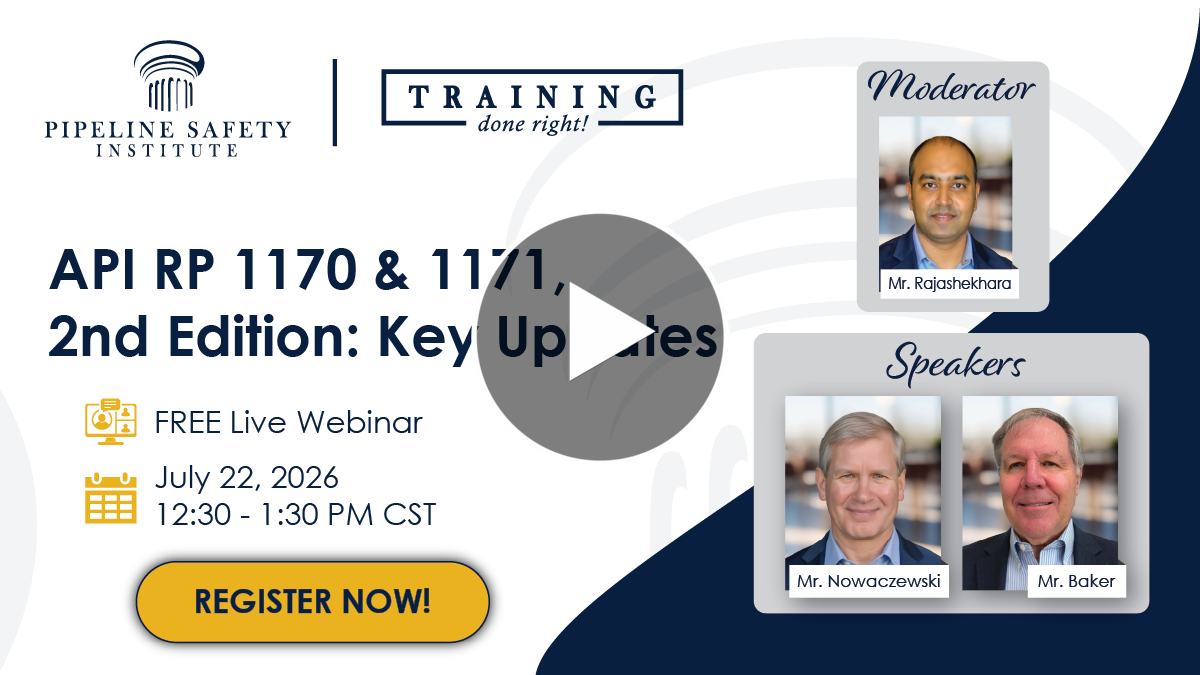
Unpacking the Key Updates in API RP 1170 & 1171, 2nd Edition
RCP and the Pipeline Safety Institute offered a free webinar exploring the 2nd Editions of API RP 1170, Design and Operation of Solution-mined Salt Caverns Used for Natural Gas Storage and API RP 1171, Functional Integrity of Natural Gas Storage in Depleted Hydrocarbon Reservoirs and Aquifer Reservoirs. Thank you to everyone who attended and participated in this informative webinar. The session recording is posted to our YouTube channel. Please watch, like, and subscribe to our channel!
New Workshop Alert!
Prepare Your Team for Pipeline Safety Audits with Confidence!
Our 3-day Pipeline Safety Audit Workshop is tailored for professionals responsible for the safe operation of hazardous liquid and natural gas pipelines. Designed for groups of 10-15 participants, this interactive training…
On-Site Training Request
We have conducted on-site training for oil and gas companies for over 25 years and can provide customized workshops for companies with groups of five or more.
Season’s Greetings from RCP!
RCP would like to thank our valued clients for a wonderful year. We appreciate the opportunities you have given us to serve as your Professional Engineers, Regulatory Experts, and Trusted Partners. We look forward to working with you on even more projects in the years ahead. Best wishes for the holiday season and the New Year, from your friends at RCP.
Sincerely,

![]()
W. R. (Bill) Byrd, PE
President
RCP Inc.