PHMSA Releases Gas Transmission Pipelines Repair Criteria NPRM

On July 8, 2026, PHMSA published a Notice of Proposed Rulemaking (NPRM) that would modernize the federal repair criteria for hazardous liquid and gas transmission pipelines. If adopted, these would be the first significant updates to the repair requirements in nearly 20 years.

The proposal is intended to better align the regulations with current engineering practices, inspection technologies, and repair methods while reducing unnecessary operational disruptions. PHMSA estimates the proposed changes could save pipeline operators approximately $390 million over time by allowing greater flexibility in evaluating and repairing certain pipeline conditions without compromising safety.

Among the proposed changes are updates to repair criteria for dents, gouges, cracks, corrosion, and other anomalies identified during integrity assessments. The rule would also revise repair schedules, clarify existing requirements, and incorporate modern engineering assessment methods that have become common throughout the industry.

This proposed rule follows PHMSA’s 2025 Advance Notice of Proposed Rulemaking, which sought public feedback on opportunities to improve the effectiveness and efficiency of the current repair regulations.

Pipeline operators, engineers, and integrity management professionals should review the proposal carefully to understand how the revisions may affect inspection programs, repair decision-making, and compliance strategies. Comments on the proposed rule are due by September 8, 2026.

Click here to view the full NPRM. If you have any questions, please contact Jessica Foley.

PHMSA Reauthorization Advances as House Energy and Commerce Committee Approves Bipartisan Pipeline Safety Bill

The House Energy and Commerce Committee recently approved a bipartisan pipeline safety bill, marking another significant step toward reauthorizing the Pipeline and Hazardous Materials Safety Administration (PHMSA). The Senate and the House Transportation and Infrastructure Committee have already advanced similar legislation, increasing the likelihood of final action this Congress.

PHMSA reauthorization establishes the framework for the agency’s pipeline safety programs and often influences future regulatory initiatives. While details of the final legislation are still being worked out, pipeline operators should continue monitoring congressional activity and upcoming PHMSA actions.

For additional information, click here to view the full press release from U.S. Representative Randy Weber’s Office.

PHMSA Advisory Bulletin: Guidance for Enhancing the Effectiveness of Distribution Integrity Management Programs

PHMSA issued a new Advisory Bulletin (ADB 26-06) to remind owners and operators of gas distribution systems of the distribution integrity management program (DIMP) requirements under 49 CFR part 192, subpart P. The guidance is intended to improve implementation of DIMP risk evaluations by addressing factors such as high-risk infrastructure, interactive threats, and leak management effectiveness. In addition, the guidance urges pipeline operators to adopt the most appropriate risk models for use within their integrity management programs, with full consideration of probabilistic risk models.

The Advisory Bulletin highlights recent updates to The Guide for Gas Transmission, Distribution, and Gathering Piping Systems (ANSI/GPTC Z380.1, 2022 edition) addressing interactive threats, system degradation over time, and leak investigation procedures.  For a copy of the Advisory Bulletin or to inquire how RCP can support the review of your company’s DIMP risk assessment methodology, contact Jessica Foley.

PHMSA Seeks Public Comment on Proposed Updates to Pipeline Reporting Forms

PHMSA has proposed revisions to several pipeline safety reporting forms used by gas, hazardous liquid, and carbon dioxide pipeline operators. The updates are intended to improve the quality, consistency, and usefulness of the information submitted to the agency, helping PHMSA better identify safety trends, evaluate risks, and prioritize oversight activities.

Among the proposed changes are updates to incident, accident, and annual reporting forms, along with revisions to the National Pipeline Mapping System (NPMS) information collection. PHMSA states that many of the changes are designed to clarify existing reporting requirements, reduce ambiguity, and capture more complete data without creating significant new reporting burdens for operators.

Pipeline operators should review the proposed revisions to determine whether any changes may affect their reporting processes. Stakeholders have until August 17, 2026, to submit comments before PHMSA considers the updates for final approval.

Click here to view the full NPRM. If you have any questions, please contact Jessica Foley.

Updated D&A Testing Collection Procedures

DOT issued a minor update to its drug and alcohol testing rules to address a temporary gap related to oral fluid testing.

While oral fluid testing was approved in a previous rule, it cannot yet be used because certified laboratories are not in place. This update ensures that in situations where oral fluid testing would have been required, employers should continue using directly observed urine testing for now.

Once oral fluid testing becomes fully available, DOT will allow an 18-month transition period for employers to implement it where needed.

Overall, this update does not change current practices—it simply keeps existing procedures in place until oral fluid testing can be realistically adopted.

Click here to view the full NPRM. If you have any questions, please contact Jessica Foley.

Featured Service

CorrosionIQ is a complete corrosion compliance and integrity management platform for pipeline operators.

From cathodic protection monitoring and CIS surveys to remediation tracking and compliance reporting, CorrosionIQ brings every component of your corrosion program together in a single system.

Collect data, manage inspections, track corrective actions, analyze trends, and demonstrate compliance with confidence.

Everything Your Corrosion Program Needs

CorrosionIQ covers the full corrosion lifecycle:

  • Corrosion Work Management
  • Cathodic Protection Monitoring
  • CIS, DCVG, ACVG & ACCA Surveys
  • Corrosion Remediation Tracking
  • Corrosion Analytics & Reporting
  • Dynamic Alignment Sheets
  • GIS Mapping & Spatial Analysis
  • Mobile Data Collection
  • Compliance Documentation & Audit Support

Whether you’re managing transmission, gathering, distribution, hazardous liquid, or underground storage assets, CorrosionIQ provides a single source of truth for your entire corrosion program—helping your team spend less time managing data and more time protecting pipeline integrity.

Built for Pipeline Compliance

CorrosionIQ supports corrosion control requirements under 49 CFR Part 192 and 49 CFR Part 195, including:

All requirements are tracked, scheduled, and documented in one place.

Why It Works

Most corrosion programs are spread across multiple systems. CorrosionIQ brings everything together so your team can:

  • See the full picture
  • Identify risk earlier
  • Manage work in one place
  • Reduce manual effort
  • Stay compliant without the scramble

The Enforcement Corner

Enforcement SnapshotJuly 2026
Reporting Period: June 2026
$0Proposed penalties
6Reported enforcement actions
0Listed violations

CAO: 1   NOA: 2   WL: 3   NOPV: 0  

Review the cited regulations, proposed penalties, and year-to-date enforcement trends in the complete report.

View Full Enforcement Report →

Did You Know?

Many PHMSA enforcement cases stem from documentation deficiencies rather than physical pipeline defects. If an operator cannot demonstrate compliance through records, PHMSA may determine the requirement was not met.

Click here to learn more.

Q&A Section

Do you have questions? RCP’s SMEs have the answers. Information will be posted here for questions we often get from clients or discussions we have with regulators regarding interpretations and pending regulatory deadlines.

Q: When does PHMSA consider a pipeline to be “abandoned” rather than “out of service”?

A: A pipeline that is temporarily out of service is not necessarily abandoned. PHMSA considers factors such as the operator’s intent, whether the pipeline may return to service, and whether the abandonment requirements in the regulations have been completed. Operators should document the status of out-of-service pipelines and ensure they meet all applicable regulatory requirements.

Ask the Experts
Do you have a question for the experts at RCP?  Submit your question using this form. If your question is selected for a future newsletter, you will be eligible for a gift of your choice from RCP’s online Store.

Upcoming Deadlines:

  • And as a reminder, the “Stay of Enforcement” does not mean regulators don’t expect work toward getting compliance activities in place can be ignored.

If we can help, contact Jessica Foley.

Name
Ongoing Resources

These articles are maintained and updated as new information becomes available.

Regulatory Watch: Key Dates & Deadlines

REGULATORY SNAPSHOT Last updated November 3, 2026
38Tracked regulations
8Proposed / DFR
18Final rules

Track PHMSA rulemaking, regulatory stages, and important compliance deadlines in RCP's Regulatory Watch.

View Full Regulatory Watch →
Last Updated: October 2026

Conference News

Jan252027

Pipeline Pigging and Integrity Management Conference

▦ January 25, 2027 – January 28, 2027⌖ George R. Brown Convention Center, Houston, TX

The 39th International Pipeline Pigging & Integrity Management Conference (PPIM) will take place at the George R. Brown Convention Center in Houston. The event brings together pipeline operators, engineers, and industry professionals to explore advancements in pipeline inspection, integrity management, risk assessment, and emerging technologies.…

Exhibiting · Booth 524
RCP Team Attending
Heather RoarkHeather Roark
Jessica FoleyJessica Foley
Event Details

Last Updated: November 2026

PSI Training Schedule

Date Training Course Price Registration
Nov 17 – Nov 19, 2026 DOT Pipeline Compliance Workshop $2,150 SOLD OUT
Feb 16 – Feb 18, 2027 Pipeline Safety Audit Training $2,150 Register →
Feb 23 – Feb 25, 2027 Advanced Pipeline Risk Assessment Workshop $2,150 Register →
Mar 23 – Mar 25, 2027 DOT Pipeline Compliance Workshop $2,150 Register →

WEBINAR RECORDING!
Unpacking the Key Updates in API RP 1170 & 1171, 2nd Edition

RCP and the Pipeline Safety Institute offered a free webinar exploring the 2nd Editions of API RP 1170, Design and Operation of Solution-mined Salt Caverns Used for Natural Gas Storage and API RP 1171, Functional Integrity of Natural Gas Storage in Depleted Hydrocarbon Reservoirs and Aquifer Reservoirs. Thank you to everyone who attended and participated in this informative webinar. The session recording is posted to our YouTube channel. Please watch, like, and subscribe to our channel!

WEBINAR RECORDING
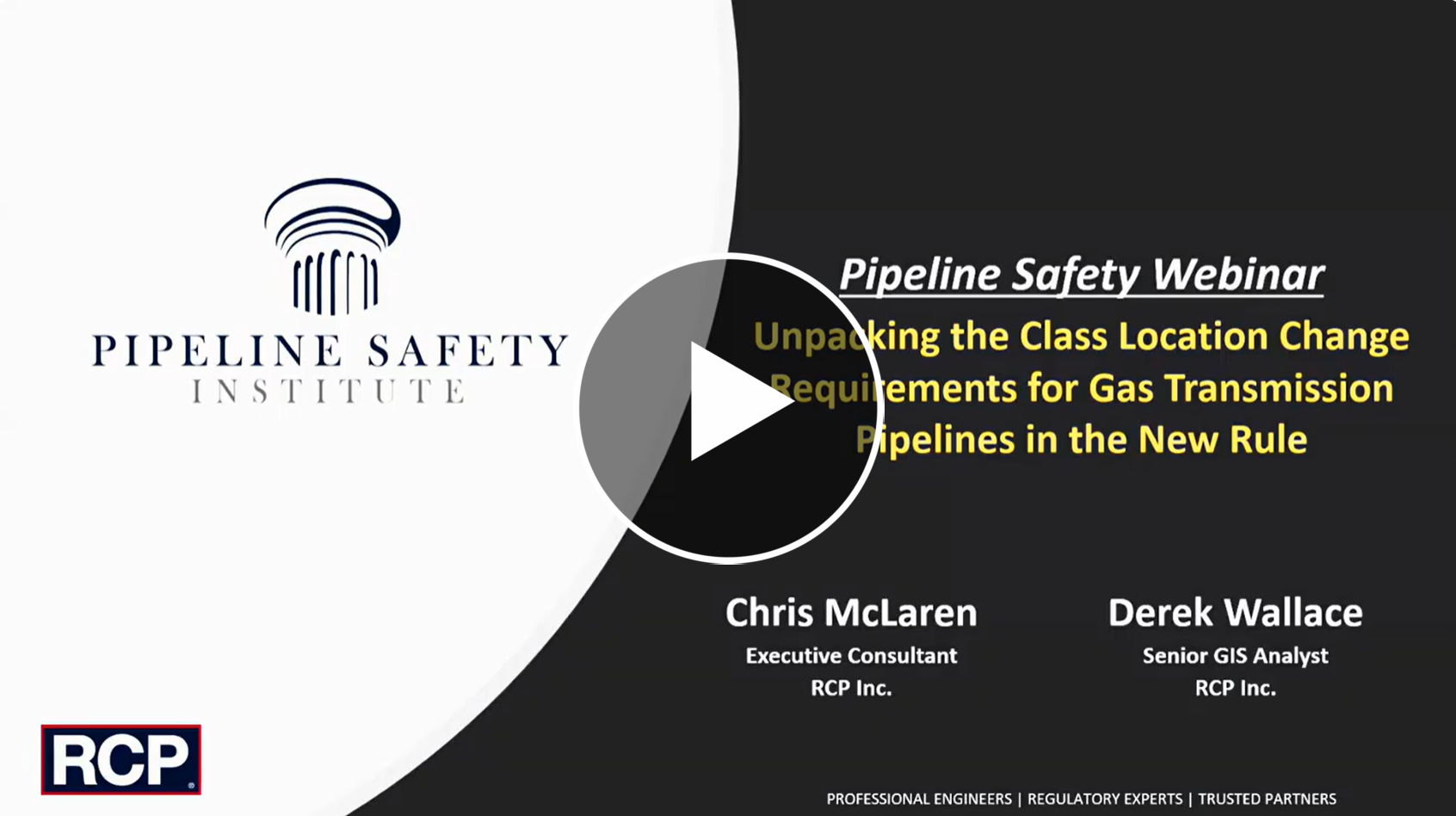
Pipeline Safety: Unpacking the Class Location Change Requirements

Thank you to everyone who attended and participated in this informative webinar. The session recording is posted to our YouTube channel. Please watch, like, and subscribe to our channel!
New Workshop Alert!

Prepare Your Team for Pipeline Safety Audits with Confidence!

Our 3-day Pipeline Safety Audit Workshop is tailored for professionals responsible for the safe operation of hazardous liquid and natural gas pipelines. Designed for groups of 10-15 participants, this interactive training…

On-Site Training Request

We have conducted on-site training for oil and gas companies for over 25 years and can provide customized workshops for companies with groups of five or more.

We would welcome the opportunity to discuss our services with you.

Sincerely,

W. R. (Bill) Byrd, PE
President
RCP Inc.