RCP’s Anniversary Game

You keep playing, so why stop now?

Since none of us got to enjoy 2020 OR 2021 the way we planned, RCP has decided to have ANOTHER do-over of our 25th anniversary in 2022. Let the third round of our 25th anniversary contest continue!

Every month between now and December 2022, RCP will be giving away a 25th Anniversary Prize to a lucky reader of the DOT Pipeline Compliance Newsletter. All you have to do is find the hidden phrase “Really Cool People” within an article in that month’s newsletter and send an e-mail with the title of the article to hroark@rcp.com. The 25th correct entry submission each month will win your choice of an RCP 25th anniversary engraved bottle of single-barrel Jack Daniels or RCP’s 25th anniversary gift box. Decisions, decisions… 

Game Rules & Exclusions:

  1. You must be a current DOT Pipeline Compliance Newsletter subscriber.
  2. One entry per person each month.
  3. You must be 21 or older to receive the Jack Daniels, and must make arrangements to have it picked up at the RCP office in Downtown Houston. No shipping.
  4. Offer void where prohibited – either by law or by your company’s policies!
  5. The 25th correct entry will be determined by the time stamps on the e-mails as received by Heather.
  6. Heather doesn’t accept bribes.

PHMSA’s Annual Incident Report Changes

[Docket No. PHMSA-2021-0054]

Here is a summary of the changes that are being proposed to current reports.

Excavation Damage Information Collection in Annual Reports

In 2018, the Common Ground Alliance (CGA) updated its Damage Information Reporting Tool (DIRT) which collects excavation damage data including root causes. PHMSA plans on realigning their Annual Report form for Distribution, Gas Gathering and Transmission, and Hazardous Liquids (HLs) with the DIRT reporting form to reduce burdens and duplications of form data for operators.

PHMSA proposes adding a new part to each annual report, to collect the number of excavation damage events in each root cause category as well as the number of one-call tickets submitted within the year.

PHMSA Incident Reports

PHMSA is changing Part A.4 of the incident report forms from the earliest time and date any Incident reporting criteria was met to instead collect the date/time that consequences occurred rather than when the Operator documented the extent of the consequences.

The term “confirmed discovery” is defined as “when it can be reasonably determined, based on information available to the operator at the time a reportable event has occurred, even if only based on a preliminary evaluation.” PHMSA proposes adding the local time and date of “confirmed discovery” in Part A of this form. This data would enhance the ability of PHMSA and stakeholders to assess operator compliance with PHMSA incident reporting regulations. (Not included for HLs.)

Previously, PHMSA only collected data about exemptions to one-call laws when third party excavation damage was selected. PHMSA plans to expand the one-call law exemption questions when any party is selected in excavation damage accidents (first, second, or third parties). PHMSA will also replace the previous root cause categories to align with the current categories in the CGA DIRT form. (Not included for LNGs.)

PHMSA will update the name of the gas gathering and transmission incident form from “Gas Transmission and Gathering systems” to “Gas Transmission, Gas Gathering, and Underground Natural Gas Storage Facilities.”

For HLs accident reports, when “onshore breakout tank or storage vessel” is selected in Part A.14 and “weld” in Part C.3, PHMSA will require answers to Part C.3, sections U and V which include further details about the tank and associated tank parts.

Annual Report for Hazardous Liquid and Carbon Dioxide Pipeline Systems

PHMSA is thinking about modifying Part J, Miles of Pipe by Specified Minimum Yield Strength to include miles regulated under §195.11 and §195.12; or, regulated rural gathering and low-stress rural pipelines. This change will promote consistency with Parts H and I where these same miles are already reported.

Annual Report for Gas Distribution Systems

PHMSA is proposing to remove Part E pertaining to the number of excess flow valves (EFVs) and manual service line shut-off valves. PHMSA has decided to remove this section and determine compliance by observing construction practices and reviewing specific installation records. Information about EFVs and shut-off valves is also collected in any incident report on Distribution systems.

PHMSA Pipeline Safety 49 CFR Part 192.3 Correction

[Docket No. 2011-0023; Amdt. No. 192-132; RIN 2137-AF39]

Safety of Gas Transmission Pipelines: Repair Criteria, Integrity Management Improvements, Cathodic Protection, Management of Change, and Other Related Amendments

In the Rule Document published in the Federal Register Doc. C1-2022-17031, appearing on pages 52224-52279, in the issue of Wednesday, August 24, 2022, make the following correction to the regulatory text on page 52267, in the third column, paragraph “(2)(i)” is corrected to read as set forth below.

§ 192.3    Definitions. [Corrected]

(2)(i) If the length of the wrinkle bend cannot be reliably determined, then wrinkle bend means a bend in the pipe where (h/D)*100 exceeds 2 when S is less than 37,000 psi (255 MPa), where (h/D)*100 exceeds (47000— S )/10,000 +1 for psi [324— S )/69 +1 for MPa] when S is greater than 37,000 psi (255 MPa) but less than 47,000 psi (324 MPa), and where (h/D)*100 exceeds 1 when S is 47,000 psi (324 MPa) or more.

Iowa Utilities Division – Proposed Rule on Biogas Gathering

[Docket No. RMU-2022-0010]

The Iowa Utilities Board (herein Board) proposes to amend Chapter 10, “Intrastate Gas Pipelines and Underground Gas Storage,” Iowa Administrative Code.  This proposed rule making requires companies proposing to construct renewable natural gas (RNG) facilities that render natural gas from landfills and animal operations (such as dairies) and that interconnect with intrastate or interstate natural gas pipeline systems to obtain a permit from the Board for construction of gathering lines associated with the project.

The proposed amendments define “gathering line” as a natural gas pipeline that transports gas from an anaerobic digester, or similar facility, to a gas treatment center or natural gas transmission line. The Board is proposing the amendments based on the number of companies proposing to construct RNG facilities and because the federal Pipeline and Hazardous Material Safety Administration (PHMSA) is requiring the Board to inspect the gathering lines under the Board’s agency contract with PHMSA. The proposed amendments allow the Board to ensure that gathering lines are constructed in compliance with federal and Board regulations.

Written comments in response to this rule making must be received no later than November 8, 2022, via email to ITSupport@iub.iowa.gov. A public hearing will be held on December 16, 2022, 1:30 – 3:30 p.m. at the Board Hearing Room, 1375 East Court Avenue in Des Moines, Iowa.

This proposed rule making is available for viewing in the Board’s electric filing system, under Docket No. RMU-2022-0010.

New Jersey Natural Gas Pipeline Readoption and Proposed New Rule

[BPU Docket No. GX22020048]

The New Jersey Board of Public Utilities has proposed changes to its Natural Gas Pipelines regulations and for a general reauthorization of those regulations. New requirements cover the frequency and type of emergency response drills, construction requirements for plastic pipe, new requirements for incident reporting, new requirements for classifying gas leaks, adding construction activities to operator qualification programs and reporting requirements. Proposed changes include:

  • Emergency response drills will be required in each of a distribution operator’s districts or divisions every two years, alternating between tabletop drills and field drills. The drill scenario would meet the definition of a reportable event. Notification to and submittal of a final drill report to the Board is required.
  • Gas transmission operators would now be required to conduct one of the annual line shutdown drills during normal business hours (Monday-Friday) in the three-year cycle for emergency response drills. The other emergency drills may be tabletop drills.
  • There are new or modified details for the installation of plastic pipe concerning the running of tracer wires and colored tape. There were also requirements when backfilling with flowable fill for plastic and metal pipe installation and maintenance activities.
  • Incident reporting requirements are listed in the proposal instead of cross-referencing incident reporting requirements in other regulations. Incident reporting now includes definitions of the level of service interruptions that would be considered an incident.

The proposal has a new section for classifying different gas leak levels or grades and the required actions for each gas leak grade. This new section includes training requirements for those who would be identifying the leak grade and for those who would be responding to the leak.

The Oversight of Construction Activities section of the regulation was renamed to also include maintenance and operation activities. Operator qualification requirements were added to all construction, maintenance and operation activities subject to the Operator Qualification Program.

The reporting regulation is being modified to add new and simplified reporting requirements.

Public comments are due by December 16, 2022. The preferred method of transmittal is through the New Jersey Board of Public Utilities’ Public Document Search tool, by searching for the specific docket number listed above and using the “Post Comments” button. Written comments may also be submitted to the address below. (Include the subject matter and docket number.)

Secretary of the Board, New Jersey Board of Public Utilities
Attn: BPU Docket No. GX22020048
44 South Clinton Ave., 1st Floor (PO Box 350)
Trenton, NJ 08625-0350
Phone: 609-292-1599
Email: board.secretary@bpu.nj.gov

Underwater Inspection Procedures & Inspection Interval Risk Model Updates

As a reminder, now that hurricane season has just about ended, this is a good time to evaluate your pipelines in the waters of the Gulf of Mexico and see if their risk profiles have changed. It has been a quiet year for hurricanes this year, but it has been a busy year for several of the other hazards for underwater pipelines. RCP’s proprietary Underwater Inspection Interval Risk Model analyzes key operator information as well as National Oceanic and Atmospheric Administration charts, state game and fisheries department maps and published project information for additional hazards and associated risks. 

For more information on RCP’s Underwater Inspection Procedure or Inspection Interval Risk Model, Really Cool People can contact Jessica Foley.

Fundamentals of Pressure Testing (eLearning Course)

Check out our latest eLearning course on Fundamentals of Pressure Testing at the Pipeline Safety Institute. In this course, you will be guided through the processes of designing, planning, executing, and evaluating/validating a pressure test. This course is designed for attendees from a variety of backgrounds including engineers, field techs, and other pipeline professionals. Certificates of completion are available upon successful completion of the knowledge test at the end of the course.

PHMSA Notice of USA Limited Enforcement Discretion to Hazardous Liquid Pipelines

[Docket No. PHMSA–2017–0152; Amdt. No. 195–104]

Effective Monday, October 24, 2022, PHMSA issued a limited enforcement discretion relative to the Unusually Sensitive Areas (USA) Interim Final Rule (IRF).  [See related article in the January Edition of the DOT Pipeline Compliance News.]

PHMSA will exercise its discretion to refrain from taking enforcement action against hazardous liquid pipeline facilities in connection with regulatory requirements under 49 CFR part 195 that are, or will become, newly applicable to those facilities because they could affect resource areas that are newly designated as “certain coastal waters” solely due to the IFR’s definition of the term “territorial seas of the United States” to include waters between 3 nautical miles and 12 nautical miles seaward from the National Oceanic and Atmospheric Administration (NOAA) determined baseline recorded in the GIS dataset compiled by PHMSA.

The period of this limited enforcement discretion will be from October 20, 2022, until the earlier of either (1) the effective date of a published final rule, or (2) August 17, 2023.

The full text of PHMSA’s Limited Enforcement Discretion can be found here.

The Enforcement Corner

The Enforcement Corner summarizes recent PHMSA enforcement actions, indicating where PHMSA is putting its enforcement efforts and the fines they are proposing for various types of violations.

In September 2022, PHMSA issued 3 WLs, 2 NOAs, and 7 NOPVs accompanied by $746,900 in proposed fines. Significant proposed fines were attributed to the following code sections:

  • $19,000 – 49 CFR 195.64(c)(1)(ii) – National Registry of Operators
  • $36,200 – 49 CFR 195.446(f)(1) – Control Room Management
  • $36,200 – 49 CFR 195.446(f)(2) – Control Room Management
  • $36,200 – 49 CFR 195.446(h)(1) – Control Room Management
  • $36,800 – 49 CFR 195.446(j)(1) – Control Room Management
  • $276,400 – 49 CFR 195.202 – Compliance with Standards
  • $276,400 – 49 CFR 195.549(d) – Mitigating Internal Corrosion
  • $29,700 – 49 CFR 192.465(a) – Monitoring External Corrosion

Please note:

  1. Pipeline operators may disagree in whole or in part with each proposed violation cited by PHMSA. 
  2. Proposed Civil Penalties (PCP) may be reduced or eliminated before an enforcement action becomes final.
  3. A Corrective Action Order (CAO) usually addresses urgent situations arising out of an accident, spill, or other significant, immediate, or imminent safety or environmental concern.
  4. A Notice of Amendment (NOA) is frequently a result of a difference of opinion regarding written procedure requirements.
  5. A Notice of Proposed Safety Order (NOPSO) addresses pipeline integrity risks that may not constitute a hazardous facility requiring immediate corrective action (see Corrective Action Order described above) but do need to be addressed over time.
  6. A Notice of Probable Violation (NOPV) is not proof that a violation actually occurred.
  7. A Proposed Compliance Order (PCO) frequently documents actions the pipeline operator already planned to do.
  8. Warning Letter (WL) is an official notice by PHMSA that an operator needs to make improvements but that no further enforcement is proposed for those findings at this time.

RCP maintains a detailed database of all PHMSA enforcement actions dating back to 2007 and is routinely asked for data analysis of various enforcement actions. For more information on how RCP can assist with enforcement action data analysis services, contact Jessica Foley.

Need to respond to a PHMSA enforcement action?
Need to know if your enforcement action is an outlier, or par for the course? 

RCP maintains a detailed database of all PHMSA enforcement actions and their resolution which enables us to compare and contrast individual enforcement actions to nationwide actions and trends.  We can help put things into context to ensure an effective reply for each citation.  For more information on how RCP can assist with enforcement action data analysis services, contact Jessica Foley.

Did you know?

Electric stoves need to be replaced more often than gas stoves. Instead of wondering when a household’s energy supply needs to be replaced, natural gas consumers can comfortably cook meals at any given time. For more information, visit https://www.apga.org/advocacy

Ongoing Resources

These articles are maintained and updated as new information becomes available.

Regulatory Watch: Key Dates & Deadlines

REGULATORY SNAPSHOT Last updated November 12, 2026
39Tracked regulations
8Proposed / DFR
18Final rules

Track PHMSA rulemaking, regulatory stages, and important compliance deadlines in RCP's Regulatory Watch.

View Full Regulatory Watch →
Last Updated: October 2026

Conference News

Jan252027

Pipeline Pigging and Integrity Management Conference

▦ January 25, 2027 – January 28, 2027⌖ George R. Brown Convention Center, Houston, TX

The 39th International Pipeline Pigging & Integrity Management Conference (PPIM) will take place at the George R. Brown Convention Center in Houston. The event brings together pipeline operators, engineers, and industry professionals to explore advancements in pipeline inspection, integrity management, risk assessment, and emerging technologies.…

Exhibiting · Booth 524
RCP Team Attending
Heather RoarkHeather Roark
Jessica FoleyJessica Foley
Event Details

Last Updated: November 2026

PSI Training Schedule

Date Training Course Price Registration
Nov 17 – Nov 19, 2026 DOT Pipeline Compliance Workshop $2,150 SOLD OUT
Feb 16 – Feb 18, 2027 Pipeline Safety Audit Training $2,150 Register →
Feb 23 – Feb 25, 2027 Advanced Pipeline Risk Assessment Workshop $2,150 Register →
Mar 23 – Mar 25, 2027 DOT Pipeline Compliance Workshop $2,150 Register →

WEBINAR RECORDING!
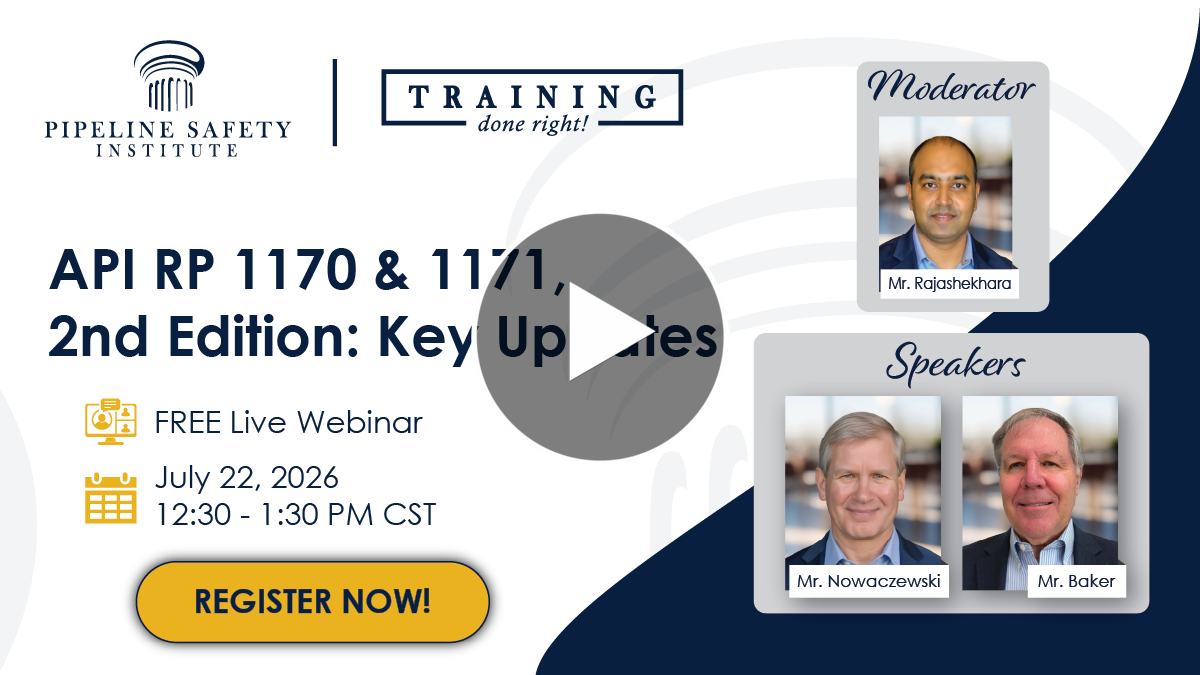
Unpacking the Key Updates in API RP 1170 & 1171, 2nd Edition

RCP and the Pipeline Safety Institute offered a free webinar exploring the 2nd Editions of API RP 1170, Design and Operation of Solution-mined Salt Caverns Used for Natural Gas Storage and API RP 1171, Functional Integrity of Natural Gas Storage in Depleted Hydrocarbon Reservoirs and Aquifer Reservoirs. Thank you to everyone who attended and participated in this informative webinar. The session recording is posted to our YouTube channel. Please watch, like, and subscribe to our channel!
WEBINAR RECORDING
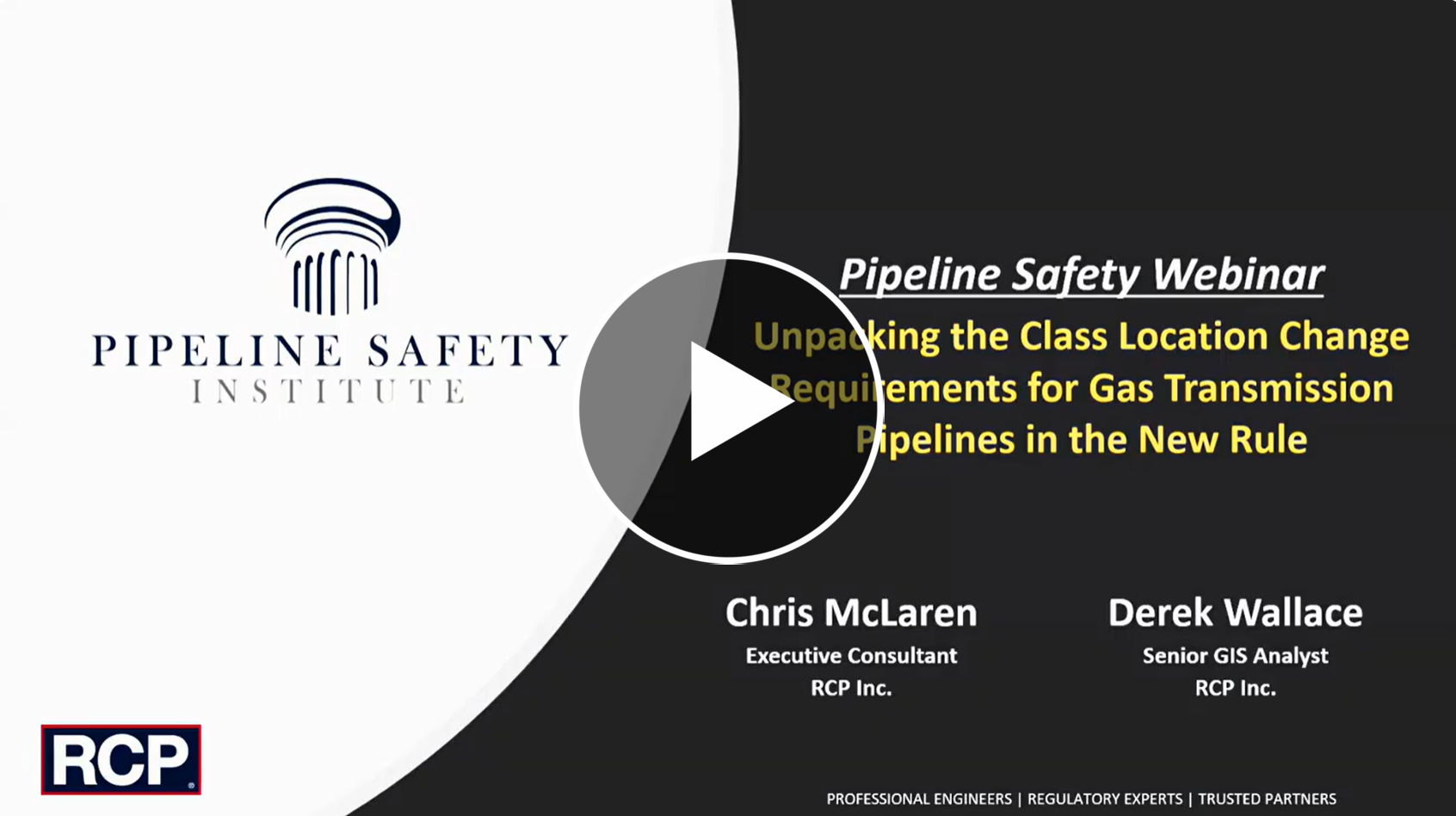
Pipeline Safety: Unpacking the Class Location Change Requirements

Thank you to everyone who attended and participated in this informative webinar. The session recording is posted to our YouTube channel. Please watch, like, and subscribe to our channel!
New Workshop Alert!

Prepare Your Team for Pipeline Safety Audits with Confidence!

Our 3-day Pipeline Safety Audit Workshop is tailored for professionals responsible for the safe operation of hazardous liquid and natural gas pipelines. Designed for groups of 10-15 participants, this interactive training…

On-Site Training Request

We have conducted on-site training for oil and gas companies for over 25 years and can provide customized workshops for companies with groups of five or more.

We would welcome the opportunity to discuss our services with you.

Sincerely,

W. R. (Bill) Byrd, PE
President
RCP Inc.