July 2025 Issue
In This Issue
- PHMSA Published 28 Separate Rulemaking Actions Affecting the Pipeline Safety Regulations
- PHMSA Form Updates
- PHMSA Rescinds ADB-2021-01
- ANPRM: Pipeline Safety: Repair Criteria for Hazardous Liquid and Gas Transmission Pipelines
- Upcoming Training: DOT Pipeline Compliance Workshop (Gas Pipelines Only)
- Featured Service
- The Enforcement Corner
- Q&A Section
- Did You Know?
- PSI Training Schedule
PHMSA Published 28 Separate Rulemaking Actions Affecting the Pipeline Safety Regulations
To further the Administration’s deregulatory policies, PHMSA has published in today’s Federal Register twenty-eight (28) separate rulemaking actions affecting the pipeline safety regulations (PSR; Parts 190-199). Click here to access the documents.
These actions are summarized below:
- Pipeline Safety: Rationalize Special Permit Conditions
Notice of proposed Rulemaking (NPRM)
49 CFR Part 190
PHMSA proposes to amend its procedures governing special permits authorizing waiver of its pipeline safety regulations to ensure that special permit conditions must be connected directly to the provisions of the pipeline safety regulations being waived.
- Pipeline Safety: Rationalize Calculation of Regulatory Filing and Compliance Deadlines
Direct Final Rule (DFR)
49 CFR Part 190
PHMSA will amend its pipeline safety regulations to introduce a clarification that filing and compliance deadlines falling on weekends and Federal holidays will be adjusted automatically to the following business day.
- Pipeline Safety: Adjust Annual Report Filing Timelines
DFR
49 CFR Parts 191
PHMSA will amend its annual reporting to change the deadline for submission of annual reports from March to June for gas pipelines.
- Pipeline Safety: Property Damage Definition for Incident Reporting on Gas Pipelines and Accidents on Hazardous Liquid Pipelines
DFR
49 CFR Part 191 and Part 195
PHMSA will finalize a previous proposal to clarify, for the purposes of defining an incident on a gas pipeline, the approach specified in regulations for calculating property damage to exclude the costs associated with removing and replacing pavement and certain other inconsequential costs. PHMSA will also update the monetary damages threshold for accident reporting on hazardous liquid pipelines to align with an inflation-adjusted formula specified in its regulations governing gas pipeline incident reporting.
- Pipeline Safety: Exception for In-Plant Piping Systems
NPRM 49 CFR Part 192
PHMSA proposes to amend its regulations to clarify that PHMSA clarify that in-plant piping systems are not regulated.
- Pipeline Safety: Codify Enforcement Discretion on Incidental Gathering Lines
NPRM
49 CFR Part 192
PHMSA proposes to codify a statement of limited enforcement discretion clarifying that a restriction introduced in the previous administration on gas gathering line operators’ ability to invoke the historical “incidental gathering line” applies only to newly constructed lines.
- Pipeline Safety: Eliminating Burdensome and Duplicative Deadlines for Gas Pipeline Coating Damage Assessments and Remedial Actions
NPRM
49 CFR Part 192
PHMSA proposes to eliminate unnecessarily prescriptive and burdensome deadlines on gas transmission and certain gas gathering lines for completing each of coating damage assessments following trench backfilling of newly installed pipe and remedial actions following failed coating assessments. The proposal would replace those existing requirements with a general requirement to complete, prior to the in-service date of the pipeline, any coating damage assessments for newly installed pipe, as well as remedial actions undertaken in response to a failed coating damage assessment.
For expert clarification on this rule, click here to view our Q&A article.
- Pipeline Safety: Atmospheric Corrosion Reassessment for Pipeline Replacements
NPRM
49 CFR Part 192
PHMSA proposes to eliminate an existing requirement for a 3-year atmospheric corrosion reassessment interval for gas transmission and certain gas gathering lines following replacement of pipeline segments or components undertaken in response to a previous identification of atmospheric corrosion. Pipeline operators replacing pipe would instead be able to employ on that replacement pipeline segment or segments the default 5-year reassessment interval provided for elsewhere in PHMSA regulations.
- Pipeline Safety: Harmonize Class Change Pressure Test Requirements with Subpart J Pressure Test Requirements
NPRM
49 CFR Part 192
PHMSA will align the minimum pressure testing duration (currently 8 hours) for verification of maximum allowable operating pressure (MAOP) following a change in class location on certain short segments of pipe to align with longstanding pressure test duration requirements (4 hours) elsewhere in PHMSA regulations at Part 192, Subpart J.
- Pipeline Safety: Clarifying Recordkeeping Requirements for Testing in MAOP Reconfirmation Regulation
Final Rule – Technical Correction
49 CFR Part 192
PHMSA will issue a technical correction to 192.624(a)(1) to clarify the ability of gas transmission operators to rely on pressure testing data pre-dating the introduction of the Pipeline Safety Regulations in the early 1970s when re-confirming MAOP on their lines.
- Pipeline Safety: Integration of Innovative Remote Sensing Technologies for Right-of-Way Patrols on Gas and Hazardous Liquid Pipelines
DFR
49 CFR Parts 192 and 195
PHMSA will amend its regulations governing performance of right-of-way patrols on gas and hazardous liquid pipelines to state explicitly that such patrols may be completed with unmanned aircraft systems, satellites, and other suitable technologies.
- Pipeline Safety: Periodic Updates of Regulatory References to Technical Standards and Miscellaneous Amendments; Additional Technical Amendments; Response to Petition for Reconsideration
Final Rule – Technical Correction
49 CFR Part 192
PHMSA will, in response to a petition for reconsideration from industry stakeholders, amend its regulations governing gas pipelines to incorporate by reference an updated version of a consensus industry standard omitted from the final rule in that proceeding due to then-pending litigation on another PHMSA rulemaking.
- Pipeline Safety Program: Update of Standards Incorporated by Reference
Multiple DFRs
49 CFR Parts 192 and 195
PHMSA issued 16 additional DFRs that each adopt an updated edition of an industry consensus standard replacing an obsolete edition that is incorporated currently by reference in 49 CFR Parts 192 and 195.
The following standards are addressed in this effort:
– API 6D
– API 1170 and 1171 UNGS
– API 620
– API 2026
– ASTM A53/A53M etc. (gas and liquid)
– ASTM A381 (gas and liquid)
– ASTM F2145
– ASTM F2600
– ASTM F2767
– ASTM A578/A578M
– ASTM F2817
– ASTM F2945
– ASTM F1973
– NFPA 70
– PPI TR-3
– PPI TR-4
PHMSA Form Updates
PHMSA has released updates to several key forms. The most recent changes went into effect on July 7, 2025, and include the following:
- OpID Assignment Request F1000.1
- OpID Assignment Request Instructions F1000.1
- National (formerly Operator) Registry Notification Form F 1000.2
- National (formerly Operator) Registry Notification Instructions F 1000.2
Earlier updates were also made on April 29, 2025, affecting both registration and reporting forms:
- OpID Assignment Request Form F 1000.1
- OpID Assignment Request Instructions F 1000.1
- National (formerly Operator) Registry Notification Form F 1000.2
- Hazardous Liquid/CO2 Accident Report F7000-1
- GRR-Hazardous Liquid Accident Report Form F 7000-2
- Gas Transmission and Gathering Annual Report Instructions F 7100
- Gas Transmission, Gathering, and UNGS Incident Report Form F 7100.2
Operators should ensure they are using the latest versions when submitting documentation to PHMSA.
PHMSA Rescinds ADB-2021-01
On June 13, 2025, PHMSA rescinded ADB-2021-01—and any PHMSA policy statements, letters of interpretation, guidance documents, congressional testimony, and public statements that rely on or assert the reading of the section 114 mandate expressed in ADB-2021-01. Owners and operators of pipeline facilities should adhere to the text of section 114 of the 2020 PIPES Act and section 60108(a) of the Pipeline Safety Act in developing and implementing their inspection and maintenance plans. PHMSA and State authorities should do the same in considering the factors in section 60108(a)(2) and in exercising their inherent enforcement discretion to decide whether an operator’s inspection and maintenance plan is adequate.
Editor’s Note:
Operators should remember that they are required to comply with their O&M manual as written – even if the manual exceeds the requirements of the rule or law. To get the full benefit of the ADB rescission, operators will need to revise their written procedures to eliminate statements which are no longer required. RCP’s staff stand ready to assist in that effort. Contact Jessica Foley at jfoley@rcp.com.
Additional Information:
The full Federal Register notice is available here:
Federal Register :: Pipeline Safety: Recission of Advisory Bulletin on Section 114 of the Protecting our Infrastructure of Pipelines and Enhancing Safety Act of 2020
Section 60108 of Title 49 USC is available here:
USCODE-2023-title49-subtitleVIII-chap601-sec60108.pdf
Section 114 of the PIPES Act is available here:
Pipes Act 2020 Section 114
Our newsletter article explaining the ADB is available here:
RCP’s DOT Pipeline Compliance Newsletter – PHMSA Advisory Bulletin: Eliminating Hazardous Leaks and Minimizing Releases of Natural Gas from Pipeline Facilities
ANPRM: Pipeline Safety: Repair Criteria for Hazardous Liquid and Gas Transmission Pipelines
[Docket No. PHMSA-2025-0019]
PHMSA published an advance notice of proposed rulemaking (ANPRM) on May 21, 2025, to gather stakeholder feedback on potential amendments to Parts 192 and 195 including repair timelines, remediation criteria, integrity management rules, and re-assessment intervals to ensure regulations maintain pace with modern technology and best practices without imposing unnecessary burdens. Additionally, PHMSA is requesting feedback pertaining to the authorization of a risk‑based approach for determining inspection intervals on in‑service breakout tanks.
The ANPRM noted that hazardous liquids and carbon dioxide repair requirements have not been substantially updated for decades, and they may not sufficiently provide for the use of advanced technology and current pipeline industry best practices. PHMSA has requested comments pertaining to:
- Anomaly categorization and remediation timelines for could affect (HCA) and non-could affect pipelines
- Alternatives to existing anomaly repair criteria and remediation timelines
- Anomaly evaluation methods in the absence of known material properties
- Adopting predicted failure pressure-based criteria for anomalies
- Repair criteria timelines for metal loss anomalies along a longitudinal seam weld for could affect (HCA) and non-could affect pipelines
- Dent evaluations and Engineering Critical Assessments
- Dents with metal loss or other interacting threats
With respect to gas transmission pipelines, PHMSA stated that gas transmission repair criteria were last revised in 2022 following the San Bruno incident; some of those changes are under litigation and PHMSA has not conducted a holistic review since. PHMSA requested comments pertaining to:
- Dents and Engineering Critical Assessments
- Engineering Critical Assessment methodologies using current industry standards
- Cost and benefits associated with Engineering Critical Assessments
- Dents with metal loss or other interacting threats
- Re-assessment for anomalies that were evaluated using Engineering Critical Assessments
For hazardous liquid breakout tanks, PHMSA has requested feedback pertaining to how tanks should be inspected and repaired, and inspection frequencies. PHMSA asks if incorporating a risk-based inspection interval would be appropriate for breakout tanks.
Public comments are due by July 21, 2025, and PHMSA plans to hold a public meeting to supplement or to clarify the materials received.
For a copy of this ANPRM, please message Jessica Foley.
Upcoming Training: DOT Pipeline Compliance Workshop (Gas Pipelines Only)
This August, RCP and the Pipeline Safety Institute are offering a special edition of the DOT Pipeline Compliance Workshop focused entirely on natural gas pipelines.
Unlike our standard DOT workshop, which covers both gas and liquid pipelines, this session is designed specifically for those working exclusively with gas pipeline systems. Whether you’re new to compliance or looking to stay current with evolving PHMSA regulations, this workshop offers a focused opportunity to build confidence and sharpen your knowledge without the distraction of liquid pipeline content.
Tailored for gas pipeline operators, engineers, compliance professionals, and regulators, this interactive three-day workshop provides practical, in-depth training on 49 CFR Parts 191 and 192, covering topics such as:
- DOT/PHMSA compliance framework
- Roles of federal and state pipeline safety agencies
- Navigating the code: key terms and definitions
- Maximum Allowable Operating Pressure (MAOP)
- Overpressure protection and regulators
- Operations and maintenance, test requirements
- Corrosion control requirements
- Transmission and distribution integrity management (TIMP and DIMP)
- Operator Qualification (OQ)
Location: Houston, TX
Dates: August 5-7, 2025
Registration link: https://pipelinesafetyinstitute.com/courses/dot-pipeline-compliance-workshop-gas-pipeline-only/

Featured Service

TaskOp Highlight: Underground Gas Storage
RCP has earned a worldwide reputation for providing professional engineering services and regulatory expertise to oil and gas operators, including underground gas storage in depleted reservoirs, aquifers and salt caverns.
We have the RESOURCES, SOFTWARE and the KNOWLEDGE to assist clients with building, implementing, and improving comprehensive operational integrity management programs in response to the PHMSA rule incorporating API RP 1171/1170 v2 (Jan. 1st, 2026) on underground gas storage.
Experienced Resources
- Highly respected underground storage industry & risk management SMEs
- Professional engineering support
- Knowledgeable technical standards developers
- Regulatory expertise
Asset Management Tools
- Gap assessment protocols
- Comprehensive risk analysis program through software
- Out-of-the-box risk model designed by RCP SMEs
- Operator-specific risk models
- Full-featured workflow & asset management software
- Track, verify and complete all work done on a well
- Wellsite/valve inspections, annulus pressure, well logging, well swabbing, capital projects, etc.
Gap Analysis/Effective Evaluation
- PHMSA Final Rule: Safety of Underground Natural Gas Storage
- API RP 1171/1170 v2
- PHMSA Advisory Bulletins
- State-Specific Regulations
Process Development and Continuous Improvement
- Storage risk management plan
- Site-specific operations & integrity standards
- Key performance indicators
Risk Analysis Model
- API RP 1171 v2, Section 8
- Out-of-the-box risk model designed by RCP SMEs
- Configurable to client and/or state needs
- Separate models for depleted reservoirs and caverns
- Deterministic Approach
- SME/Documentation
- Data (ex. Well Log)
- Captures documents used in risk analysis and sub-surface safety valve assessment tools
- Customizable queries & reporting, including a fully revamped risk analysis dashboard experience to easily see what the risk model is trying to tell you
Asset Integrity Assessment & Remediation Progress Tracking
- Asset change management
- Traceable, verifiable, and complete record management
- Audit-ready software
- Schedule and progress reporting
- Integrity assessment and repairs
- Regulatory inspections
- Preventative Maintenance
- Capital Projects
- Well Logging
- Data capture & analysis
- Data trends for all the inspection data you are capturing
- Data overlays to help make better, actionable decisions
- Well log comparison (ex. corrosion rate)
- Documentation linkage to work activity
The Enforcement Corner
The Enforcement Corner summarizes recent PHMSA enforcement actions, indicating where PHMSA is putting its enforcement efforts and the fines they are proposing for various types of violations.
PHMSA has not posted any new enforcement actions after May 2025. We will continue to monitor the system to provide you the most up to date information.
Please note:
- Pipeline operators may disagree in whole or in part with each proposed violation cited by PHMSA.
- Proposed Civil Penalties (PCP) may be reduced or eliminated before an enforcement action becomes final.
- A Corrective Action Order (CAO) usually addresses urgent situations arising out of an accident, spill, or other significant, immediate, or imminent safety or environmental concerns.
- A Notice of Amendment (NOA) is frequently a result of a difference of opinion regarding written procedure requirements.
- A Notice of Proposed Safety Order (PSO) addresses pipeline integrity risks that may not constitute a hazardous facility requiring immediate corrective action (see Corrective Action Order described above), but do need to be addressed over time.
- A Notice of Probable Violation (NOPV) is not proof that a violation actually occurred.
- Proposed Compliance Orders (PCO) frequently document actions the pipeline operator already planned to do.
- Warning Letter (WL) is an official notice by PHMSA that an operator needs to make improvements but that no further enforcement is proposed for those findings at this time.
RCP maintains a detailed database of all PHMSA enforcement actions dating back to 2007 and is routinely asked for data analysis of various enforcement actions. For more information on how RCP can assist with enforcement action data analysis services, contact Jessica Foley.
Need to respond to a PHMSA enforcement action?
Need to know if your enforcement action is an outlier, or par for the course?
RCP maintains a detailed database of all PHMSA enforcement actions and their resolution which enables us to compare and contrast individual enforcement actions to nationwide actions and trends. We can help put things into context to ensure an effective reply for each citation. For more information on how RCP can assist with enforcement action data analysis services, contact Jessica Foley.
Q&A Section
Do you have questions? RCP’s SMEs have the answers. Information will be posted here for questions we often get from clients or discussions we have with regulators regarding interpretations and pending regulatory deadlines.
Q: Does any portion of a 192.635 “Notification of Potential Rupture” require OQ training as a covered task?
A: Yes, 192.635 “Notification of Potential Rupture” implicitly requires that employes and contractors who work along the ROW (or who remotely monitor pipelines) are able to identify potential ruptures and know how to respond. This competency should be incorporated into the operator’s Operator Qualification (OQ) program, as well as into Control Room Management (CRM) training.
Ask the Experts
Do you have a question for the experts at RCP? Submit your question using this form. If your question is selected for a future newsletter, you will be eligible for a gift of your choice from RCP’s online Store.
Upcoming Deadlines:
- The deadline to submit written comments in response to PHMSA’s forthcoming NPRM on Pipeline Safety: Safety of Gas Distribution Pipeline and Other Pipeline Safety Initiatives will be 60 days from the date of publication in the Federal Register. Comments may be filed at https://www.regulations.gov/ Docket No. PHMSA-2021-0046.
- And as a reminder, the “Stay of Enforcement” does not mean regulators don’t expect work toward getting compliance activities in place can be ignored.
If we can help, contact Jessica Foley.
Did You Know?
Did You Know? RCP’s Version 2.0 of its TaskOp Underground Storage Reservoir Risk Module is officially live!
Developed in response to the release of API 1171’s 2nd Edition, RCP has added a number of new, premium features, including robust threat interaction tables, to enable users to comply with the new recommended practices being introduced.
Click here to learn more.

PSI Training Schedule
|
DATE |
COURSE | FEE |
| Nov. 17-19, 2026 |
DOT Pipeline Compliance Workshop (49 CFR 191, 192, 194, 195 & 199) |
SOLD OUT |
| Feb. 16-18, 2027 |
Pipeline Safety Audit Training (Comprehensive Training with Technical & Soft Skills) |
$2,150 |
| Feb. 23-25, 2027 |
Advanced Pipeline Risk Assessment Workshop (Gain practical insights, build stronger risk models, & make more informed integrity management decisions) |
$2,150 |
| Mar. 23-25, 2027 |
DOT Pipeline Compliance Workshop (49 CFR 191, 192, 194, 195 & 199) |
$2,150 |
WEBINAR RECORDING!
Unpacking the Key Updates in API RP 1170 & 1171, 2nd Edition
| RCP and the Pipeline Safety Institute offered a free webinar exploring the 2nd Editions of API RP 1170, Design and Operation of Solution-mined Salt Caverns Used for Natural Gas Storage and API RP 1171, Functional Integrity of Natural Gas Storage in Depleted Hydrocarbon Reservoirs and Aquifer Reservoirs. Thank you to everyone who attended and participated in this informative webinar. The session recording is posted to our YouTube channel. Please watch, like, and subscribe to our channel! |

WEBINAR RECORDING
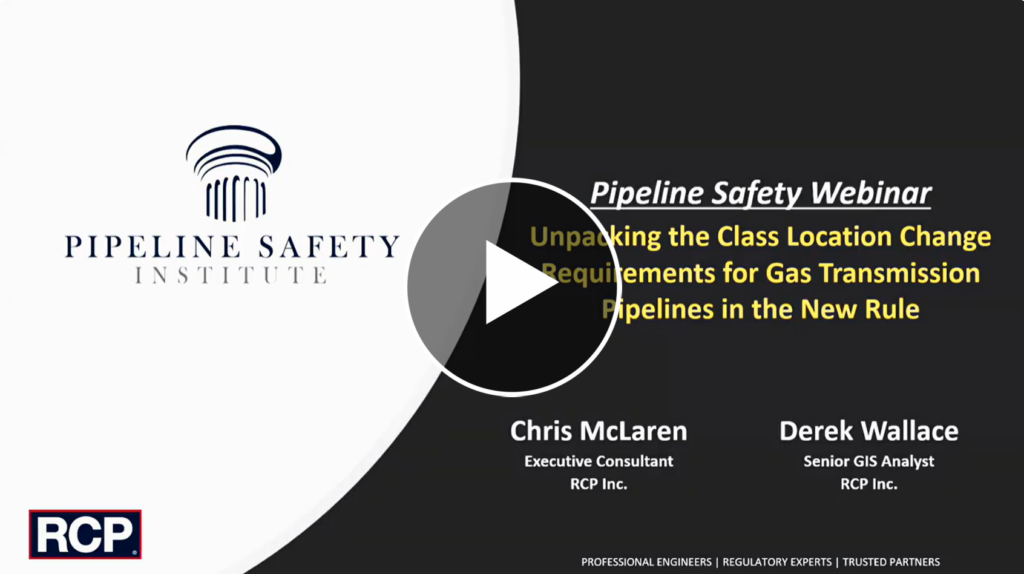
Pipeline Safety: Unpacking the Class Location Change Requirements
Thank you to everyone who attended and participated in this informative webinar. The session recording is posted to our YouTube channel. Please watch, like, and subscribe to our channel!
You asked and we listened!
Advanced DOT Pipeline Compliance Workshop is on the calendar!
This intensive and interactive 3-day, in-person workshop is designed for those who have previously completed our DOT Pipeline Compliance Workshop and are ready to take their knowledge to the next level.
New Workshop Alert!
Prepare Your Team for Pipeline Safety Audits with Confidence!
Our 3-day Pipeline Safety Audit Workshop is tailored for professionals responsible for the safe operation of hazardous liquid and natural gas pipelines. Designed for groups of 10-15 participants, this interactive training…
On-Site Training Request
We have conducted on-site training for oil and gas companies for over 25 years and can provide customized workshops for companies with groups of five or more.
We would welcome the opportunity to discuss our services with you.
Sincerely,

W. R. (Bill) Byrd, PE
President
RCP Inc.