June 2024 Issue
In This Issue
Gas Property Damage Reporting Threshold
Starting July 1, 2024, the property damage threshold for reporting gas pipeline incidents will be updated to $145,400, according to the Pipeline and Hazardous Materials Safety Administration (PHMSA). This adjustment, mandated by procedures in Appendix A to 49 CFR Part 191, ensures that the threshold reflects current economic conditions.
This update follows the “Pipeline Safety: Gas Pipeline Regulatory Reform” rule published on January 11, 2021, which first revised the reporting threshold from $50,000 to $122,000, aligning it with inflation rates between 1984 and 2019. The rule also set forth a formula for regular adjustments based on the Consumer Price Index – Urban (CPI-U). This year’s increase from $139,700 to $145,400 is a result of applying this formula, ensuring that the threshold keeps pace with inflation and remains relevant for accurate incident reporting.
For more information on the updated Gas Property Damage Reporting Threshold, message Jessica Foley.
PHMSA 49 CFR Parts 192 & 195 Periodic Updates to Final Rule
[Docket No. PHMSA-2016-0002; Amdt. Nos. 192-135, 195-107]
In April of 2024, PHMSA sent “Pipeline Safety: Periodic Updates of Regulatory References to Technical Standards and Miscellaneous Amendments” to the Federal Register for publication of a final rule amending the Federal pipeline safety regulations to incorporate by reference all or parts of more than 20 new or updated voluntary, consensus industry technical standards (Standards Update I). This action allows pipeline operators to use current technologies, improved materials, and updated industry and management practices. Additionally, PHMSA is clarifying certain regulatory provisions and making several editorial corrections. The effective date of this final rule will be 60 days from the date of publication in the Federal Register.
For a copy of the final rule, please message Jessica Foley
PHMSA Extends Public Comment Period for Proposed Pipeline Safety Measures
[Docket No.: PHMSA–2022–0085]
PHMSA has extended the public comment period for a notice published on March 25, 2024 (89 FR 20751), which requested feedback on proposed changes to PHMSA forms. These changes aim to gather data on the use of rupture mitigation valves and blending hydrogen gas with other natural gases in pipelines. These adjustments are intended to address Recommendation P-11-11 from the National Transportation Safety Board and track trends related to gas pipeline operations.
In response to a joint petition from trade associations, the deadline for public comments has been extended from May 24, 2024, to June 24, 2024. This extension was announced on May 3, 2024, and published in the Federal Register on May 6, 2024.
For a copy of this notice, please message Jessica Foley.
Pipeline Safety Trust: Remembering 25 Years
June marks the anniversary of the tragic Olympic pipeline rupture in Bellingham, WA, which spilled nearly 250,000 gallons of gasoline into a local creek, ignited, and killed two boys and a young man. In response to this senseless tragedy, the community demanded change, leading to significant restoration of the creek and improvements in pipeline safety. On June 10, 25 years later, the Pipeline Safety Trust, in partnership with the City of Bellingham and other local organizations, hosted a remembrance event. This discussion focused on the community’s response to the tragedy and its significant impact on national pipeline safety.
Did you know?
In Katy, TX, there is an interactive park where people of all ages can operate full-sized construction equipment. That’s right! With summer here, Dig World is the perfect place for your kids to sit in the driver’s seat of a Skid Steer or an Excavator. RCP hosted a team-building event at Dig World, and the adults had a blast too. Use code PIPELINE20 to save 20% on online general admission tickets through July 31st.
Dig World very well might be the only place you can safely dig without calling 811!
Click here for more information about Dig World.

Q&A Section
Do you have questions? RCP’s SMEs have the answers. Information will be posted here for questions we often get from clients or discussions we have with regulators regarding interpretations and pending regulatory deadlines.
Q: What burial depths are pipelines required to maintain after installation?
A: Pipeline installation burial depths are not a maintenance requirement. After installation, pipeline cover may be lost and pipeline depths may be less than the installation requirement. The operator is required to ensure that their pipelines are safe whatever their existing depth. Acceptable approaches to address shallow pipelines may include warning signs, farming / tilling restrictions in agreement with the landowner, concrete caps, and / or continued monitoring.
Ask the Experts
Do you have a question for the experts at RCP? Submit your question using this form. If your question is selected for a future newsletter, you will be eligible for a gift of your choice from RCP’s online Store.
Upcoming Deadlines:
- The deadline to submit written comments in response to PHMSA’s forthcoming NPRM on Pipeline Safety: Safety of Gas Distribution Pipeline and Other Pipeline Safety Initiatives will be 60 days from the date of publication in the Federal Register. Comments may be filed at https://www.regulations.gov/ Docket No. PHMSA-2021-0046.
- And as a reminder, the “Stay of Enforcement” does not mean regulators don’t expect work toward getting compliance activities in place can be ignored.
If we can help, contact Jessica Foley.
The Enforcement Corner
The Enforcement Corner summarizes recent PHMSA enforcement actions, indicating where PHMSA is putting its enforcement efforts and the fines they are proposing for various types of violations.
In April 2024, PHMSA issued 5 NOAs, 3 NOPVs, and 9 WLs accompanied by $353,300 in proposed fines. Significant proposed fines were attributed to the following code sections:
- $20,400 – 49 CFR 192.616(c) – Public Awareness
Please note:
- Pipeline operators may disagree in whole or in part with each proposed violation cited by PHMSA.
- Proposed Civil Penalties (PCP) may be reduced or eliminated before an enforcement action becomes final.
- A Corrective Action Order (CAO) usually addresses urgent situations arising out of an accident, spill, or other significant, immediate, or imminent safety or environmental concerns.
- A Notice of Amendment (NOA) is frequently a result of a difference of opinion regarding written procedure requirements.
- A Notice of Proposed Safety Order (NOPSO) addresses pipeline integrity risks that may not constitute a hazardous facility requiring immediate corrective action (see Corrective Action Order described above), but do need to be addressed over time.
- A Notice of Probable Violation (NOPV) is not proof that a violation actually occurred.
- Proposed Compliance Orders (PCO) frequently document actions the pipeline operator already planned to do.
- Warning Letter (WL) is an official notice by PHMSA that an operator needs to make improvements but that no further enforcement is proposed for those findings at this time.
RCP maintains a detailed database of all PHMSA enforcement actions dating back to 2007 and is routinely asked for data analysis of various enforcement actions. For more information on how RCP can assist with enforcement action data analysis services, contact Jessica Foley.
Need to respond to a PHMSA enforcement action?
Need to know if your enforcement action is an outlier, or par for the course?
RCP maintains a detailed database of all PHMSA enforcement actions and their resolution which enables us to compare and contrast individual enforcement actions to nationwide actions and trends. We can help put things into context to ensure an effective reply for each citation. For more information on how RCP can assist with enforcement action data analysis services, contact Jessica Foley.
PSI Training Schedule
|
DATE |
COURSE | FEE |
| Nov. 17-19, 2026 |
DOT Pipeline Compliance Workshop (49 CFR 191, 192, 194, 195 & 199) |
SOLD OUT |
| Feb. 16-18, 2027 |
Pipeline Safety Audit Training (Comprehensive Training with Technical & Soft Skills) |
$2,150 |
| Feb. 23-25, 2027 |
Advanced Pipeline Risk Assessment Workshop (Gain practical insights, build stronger risk models, & make more informed integrity management decisions) |
$2,150 |
| Mar. 23-25, 2027 |
DOT Pipeline Compliance Workshop (49 CFR 191, 192, 194, 195 & 199) |
$2,150 |
WEBINAR RECORDING!
Unpacking the Key Updates in API RP 1170 & 1171, 2nd Edition
| RCP and the Pipeline Safety Institute offered a free webinar exploring the 2nd Editions of API RP 1170, Design and Operation of Solution-mined Salt Caverns Used for Natural Gas Storage and API RP 1171, Functional Integrity of Natural Gas Storage in Depleted Hydrocarbon Reservoirs and Aquifer Reservoirs. Thank you to everyone who attended and participated in this informative webinar. The session recording is posted to our YouTube channel. Please watch, like, and subscribe to our channel! |

WEBINAR RECORDING
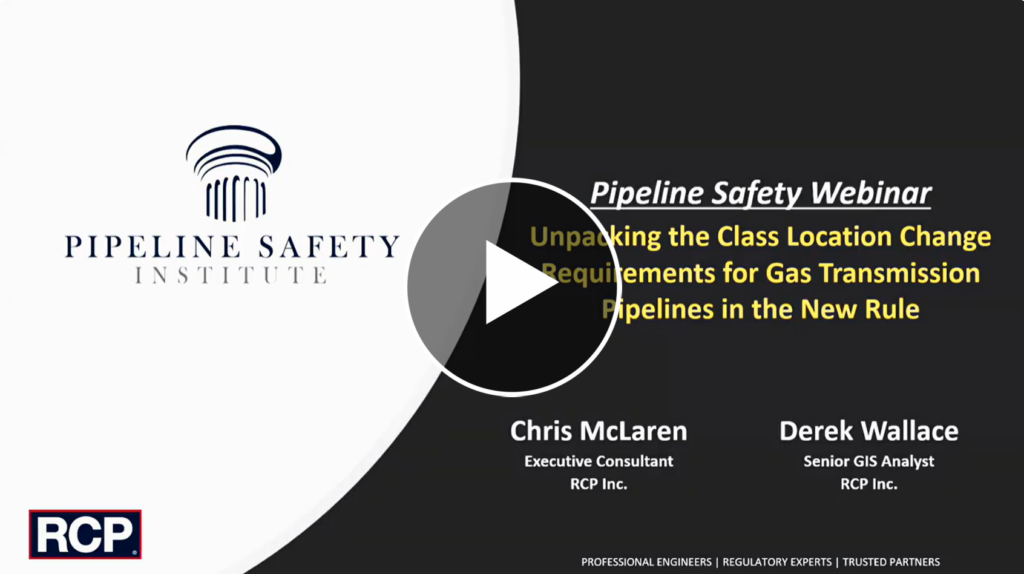
Pipeline Safety: Unpacking the Class Location Change Requirements
Thank you to everyone who attended and participated in this informative webinar. The session recording is posted to our YouTube channel. Please watch, like, and subscribe to our channel!
You asked and we listened!
Advanced DOT Pipeline Compliance Workshop is on the calendar!
This intensive and interactive 3-day, in-person workshop is designed for those who have previously completed our DOT Pipeline Compliance Workshop and are ready to take their knowledge to the next level.
New Workshop Alert!
Prepare Your Team for Pipeline Safety Audits with Confidence!
Our 3-day Pipeline Safety Audit Workshop is tailored for professionals responsible for the safe operation of hazardous liquid and natural gas pipelines. Designed for groups of 10-15 participants, this interactive training…
On-Site Training Request
We have conducted on-site training for oil and gas companies for over 25 years and can provide customized workshops for companies with groups of five or more.
We would welcome the opportunity to discuss our services with you.
Sincerely,

W. R. (Bill) Byrd, PE
President
RCP Inc.