March 2024 Issue
In This Issue
National Academy of Sciences Valve Report
As part of the Protecting Our Infrastructure of Pipelines and Enhancing Safety (PIPES) Act of 2020, PHMSA was directed under Section 119 to have the National Academies of Sciences, Engineering, and Medicine (The National Academies) to conduct a study of potential methodologies or standards for the installation of automatic or remote-controlled shut-off valves on existing pipelines. The NAS has completed an encompassing report that you can read or download from their website.
GPAC Meeting Notice March 2024
The next Gas Pipeline Advisory Committee (GPAC) meeting will discuss the Leak Detection and Repair (LDAR) and Class Location Notice of Proposed Rule Makings (NPRM). The meeting is set to take place March 25-29, 2024. The plan is to start each day at 8:30 AM and continue through Friday until both rules are completed. However, the meeting may end early if the GPAC completes its review of the proposed rules. Members of the public who wish to attend are requested to register no later than March 18, 2024.
For more information regarding the meeting location, agenda, and any additional information, including on how to participate in the meeting, click here.
For a copy of the meeting notice, please message Jessica Foley.
EPA Grants Louisiana Class VI Primacy Over Carbon Storage Wells
Louisiana Senator Bill Cassidy’s announcement on December 29th, regarding the Environmental Protection Agency (EPA) granting Class VI primacy to the state for regulating carbon storage wells, marks a significant milestone in Louisiana’s carbon capture efforts. For further details on this development, you can find more information here.
Unlocking the Power of Legacy Knowledge: A Knowledge Transfer Success Story
In 2023, RCP had the opportunity to collaborate with an Operator on a vital knowledge transfer project, aiming to preserve valuable insights from the client’s retiring staff. Below is a summary of the effort in the form of a case study:
This case study illuminates how ‘Operator,’ a prominent utility company, effectively confronted the challenge of retaining and leveraging knowledge from departing employees. Faced with the imminent loss of crucial expertise, ‘Operator’ initiated a robust knowledge transfer program. The comprehensive approach encompassed identifying key knowledge domains, fostering collaborative mentorship and documentation processes, revising standard operating procedures, and incorporating regular feedback and evaluation. The outcomes were transformative, resulting in a seamless transition, heightened productivity, enhanced collaboration, significant cost savings, and a newfound competitive advantage. The success of this initiative underscores the critical importance of strategic investment in knowledge preservation for sustained success amidst the dynamism of today’s business environment. The unwavering commitment to knowledge transfer not only ensured a smooth transition during a pivotal retirement but also elevated the company’s overall efficiency and competitiveness.
To read the full case study and for details of how RCP can help facilitate a knowledge transfer effort for you, please contact Jessica Foley.
Q&A Section
Do you have questions? RCP’s SMEs have the answers. Information will be posted here for questions we often get from clients or discussions we have with regulators regarding interpretations and pending regulatory deadlines.
Q: If a liquid pipeline operator installs the wrong style of gasket in a flange during a maintenance repair, and then the joint leaks 1 barrel of oil during startup, is that considered a maintenance-related release? Does the spill need to be reported?
A: Liquid pipelines report spills larger than 5 gallons, unless the release is “resulting from a pipeline maintenance activity”, in which case the volume threshold is 5 barrels. To qualify for the higher maintenance-related reporting threshold, the spill must occur as part of the maintenance activity. Installing the wrong style of gasket is due to operator error and falls under the 5 gallon, not the 5 barrel, reporting threshold.
Ask the Experts
Do you have a question for the experts at RCP? Submit your question using this form. If your question is selected for a future newsletter, you will be eligible for a gift of your choice from RCP’s online Store.
Upcoming Deadlines:
- The deadline to submit written comments in response to PHMSA’s forthcoming NPRM on Pipeline Safety: Safety of Gas Distribution Pipeline and Other Pipeline Safety Initiatives will have 60 days from the date of publication in the Federal Register. Comments may be filed at https://www.regulations.gov/ Docket No. PHMSA-2021-0046.
- And as a reminder, the “Stay of Enforcement” does not mean regulators don’t expect work toward getting compliance activities in place can be ignored.
If we can help, contact Jessica Foley.
Did you know?
Smart energy policies should include ways to reduce energy consumption by utilizing current energy infrastructure efficiently and planning for our energy future in a way that protects consumer choice. This strategy would balance energy needs and ultimately ensure energy infrastructure is secure and economically viable for future generations. Learn more by clicking here.

The Enforcement Corner
The Enforcement Corner summarizes recent PHMSA enforcement actions, indicating where PHMSA is focusing its enforcement efforts and the fines they are proposing for various types of violations.
In January 2024, PHMSA issued 2 NOAs, 4 NOPVs, and 3 WLs, accompanied by $81,800 in proposed fines. Significant proposed fines were attributed to the following code sections:
- $40,900 49 CFR 191.5(a) Immediate Notice of Accidents
- $40,900 49 CFR 191.9(a) Incident Reports
Please note:
- Pipeline operators may disagree, in whole or in part, with each proposed violation cited by PHMSA.
- Proposed Civil Penalties (PCP) may be reduced or eliminated before an enforcement action becomes final.
- A Corrective Action Order (CAO) usually addresses urgent situations arising out of an accident, spill, or other significant, immediate, or imminent safety or environmental concerns.
- A Notice of Amendment (NOA) is frequently a result of a difference of opinion regarding written procedure requirements.
- A Notice of Proposed Safety Order (NOPSO) addresses pipeline integrity risks that may not constitute a hazardous facility requiring immediate corrective action (see Corrective Action Order described above), but do need to be addressed over time.
- A Notice of Probable Violation (NOPV) is not proof that a violation actually occurred.
- Proposed Compliance Orders (PCO) frequently document actions the pipeline operator already planned to do.
- Warning Letter (WL) is an official notice by PHMSA that an operator needs to make improvements, but that no further enforcement is proposed for those findings at this time.
RCP maintains a detailed database of all PHMSA enforcement actions dating back to 2007 and is routinely asked for data analysis of various enforcement actions. For more information on how RCP can assist with enforcement action data analysis services, contact Jessica Foley.
Need to respond to a PHMSA enforcement action?
Need to know if your enforcement action is an outlier, or par for the course?
RCP maintains a detailed database of all PHMSA enforcement actions and their resolution which enables us to compare and contrast individual enforcement actions to nationwide actions and trends. We can help put things into context to ensure an effective reply for each citation. For more information on how RCP can assist with enforcement action data analysis services, contact Jessica Foley.
PSI Training Schedule
|
DATE |
COURSE | FEE |
| Nov. 17-19, 2026 |
DOT Pipeline Compliance Workshop (49 CFR 191, 192, 194, 195 & 199) |
SOLD OUT |
| Feb. 16-18, 2027 |
Pipeline Safety Audit Training (Comprehensive Training with Technical & Soft Skills) |
$2,150 |
| Feb. 23-25, 2027 |
Advanced Pipeline Risk Assessment Workshop (Gain practical insights, build stronger risk models, & make more informed integrity management decisions) |
$2,150 |
| Mar. 23-25, 2027 |
DOT Pipeline Compliance Workshop (49 CFR 191, 192, 194, 195 & 199) |
$2,150 |
WEBINAR RECORDING!
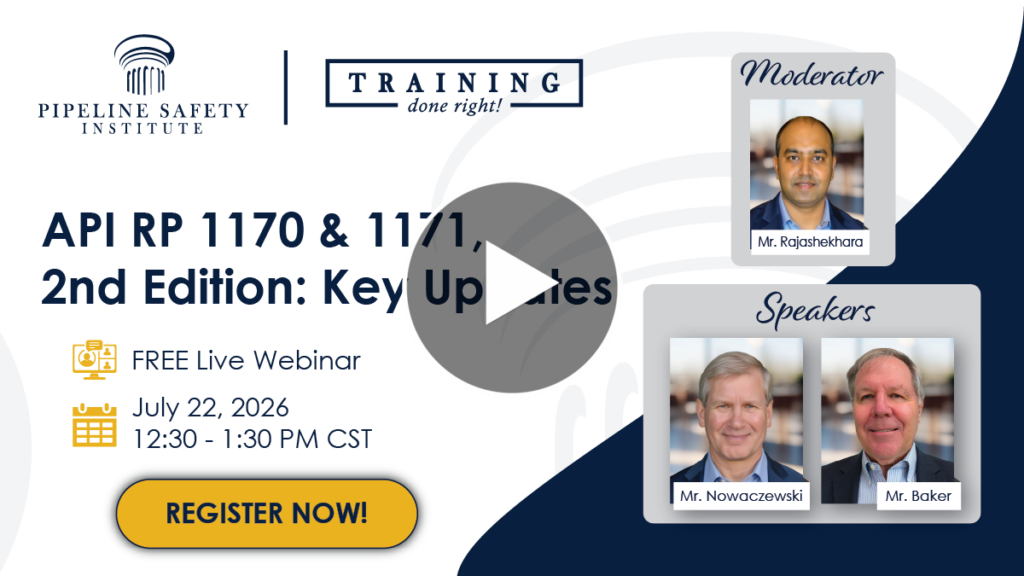
Unpacking the Key Updates in API RP 1170 & 1171, 2nd Edition
| RCP and the Pipeline Safety Institute offered a free webinar exploring the 2nd Editions of API RP 1170, Design and Operation of Solution-mined Salt Caverns Used for Natural Gas Storage and API RP 1171, Functional Integrity of Natural Gas Storage in Depleted Hydrocarbon Reservoirs and Aquifer Reservoirs. Thank you to everyone who attended and participated in this informative webinar. The session recording is posted to our YouTube channel. Please watch, like, and subscribe to our channel! |
WEBINAR RECORDING
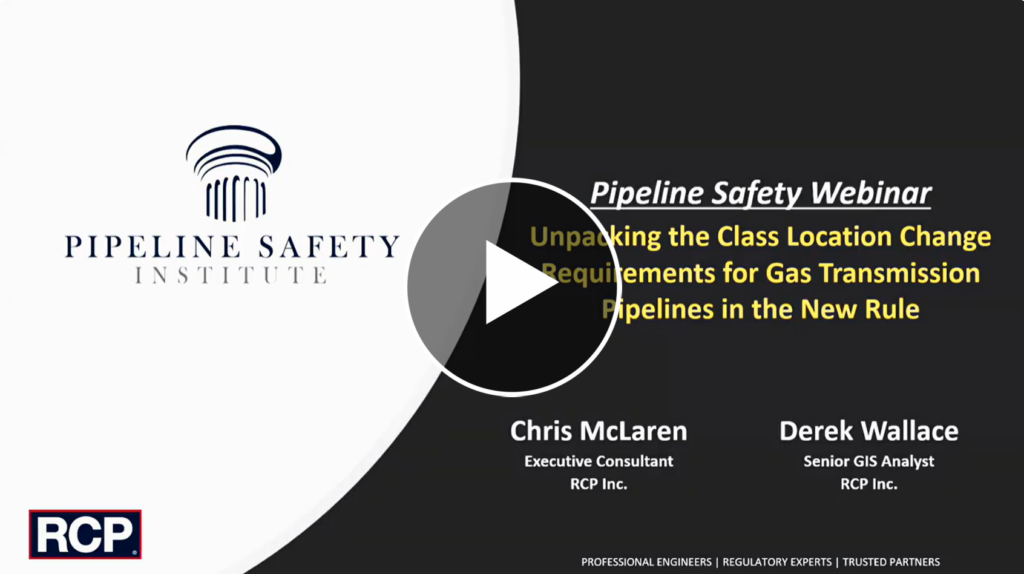
Pipeline Safety: Unpacking the Class Location Change Requirements
Thank you to everyone who attended and participated in this informative webinar. The session recording is posted to our YouTube channel. Please watch, like, and subscribe to our channel!
You asked and we listened!
Advanced DOT Pipeline Compliance Workshop is on the calendar!
This intensive and interactive 3-day, in-person workshop is designed for those who have previously completed our DOT Pipeline Compliance Workshop and are ready to take their knowledge to the next level.
New Workshop Alert!
Prepare Your Team for Pipeline Safety Audits with Confidence!
Our 3-day Pipeline Safety Audit Workshop is tailored for professionals responsible for the safe operation of hazardous liquid and natural gas pipelines. Designed for groups of 10-15 participants, this interactive training…
On-Site Training Request
We have conducted on-site training for oil and gas companies for over 25 years and can provide customized workshops for companies with groups of five or more.
We would welcome the opportunity to discuss our services with you.
Sincerely,

W. R. (Bill) Byrd, PE
President
RCP Inc.