August 2026 Issue
In This Issue
- Louisiana Updates Underground Utility Damage Prevention Law
- PHMSA Releases Gas Transmission Pipelines Repair Criteria NPRM
- PHMSA Announces Summer Research & Development Public Debriefs
- Regulatory Watch: Key Dates & Deadlines
- Featured Service
- The Enforcement Corner
- Did You Know?
- Q&A Section
- 2026 Conference News
- PSI Training Schedule
Louisiana Updates Underground Utility Damage Prevention Law
Louisiana enacted two measures during the 2026 Regular Session that update the state’s Underground Utilities and Facilities Damage Prevention Law.
Act 161 “Mandatory Reporting of Damage to Utilities” – When underground facilities or utilities are damaged by excavation or demolition, in addition to notifying the owner or operator the excavator or demolisher must notify the regional notification center (La 811). La 811 will alert other facility owners or operators in the area that may also have been affected.
Act 902 “Damage Prevention Law” was updated to strengthen communication and coordination between excavators, utility operators, and La 811, and help reduce the risk of damage to underground infrastructure. Key changes address material provided to an excavator/demolisher when utilities are present but not marked, positive responses through La 811, making mandatory the participation of most municipality or parish governments, annual training requirements, and enforcement. The law also establishes additional coordination and notification requirements for certain BEAD-funded broadband projects.
The changes are intended to strengthen communication and coordination between excavators/demolishers, utility operators, and La 811 to help reduce the risk of damage to underground infrastructure.
For a copy of Act 161 or Act 902, please message Jessica Foley.
PHMSA Releases Gas Transmission Pipelines Repair Criteria NPRM
On July 8, 2026, PHMSA published a Notice of Proposed Rulemaking (NPRM) that would modernize the federal repair criteria for hazardous liquid and gas transmission pipelines. If adopted, these would be the first significant updates to the repair requirements in nearly 20 years.
The proposal is intended to better align the regulations with current engineering practices, inspection technologies, and repair methods while reducing unnecessary operational disruptions. PHMSA estimates the proposed changes could save pipeline operators approximately $390 million over time by allowing greater flexibility in evaluating and repairing certain pipeline conditions without compromising safety.
Among the proposed changes are updates to repair criteria for dents, gouges, cracks, corrosion, and other anomalies identified during integrity assessments. The rule would also revise repair schedules, clarify existing requirements, and incorporate modern engineering assessment methods that have become common throughout the industry.
This proposed rule follows PHMSA’s 2025 Advance Notice of Proposed Rulemaking, which sought public feedback on opportunities to improve the effectiveness and efficiency of the current repair regulations.
Pipeline operators, engineers, and integrity management professionals should review the proposal carefully to understand how the revisions may affect inspection programs, repair decision-making, and compliance strategies. Comments on the proposed rule are due by September 8, 2026.
Click here to view the full NPRM. If you have any questions, please contact Jessica Foley.
PHMSA Announces Summer Research & Development Public Debriefs
PHMSA’s Office of Pipeline Safety (OPS) has announced a series of upcoming virtual events. We’ve provided a summary of the schedule below.
| Date | Research Topic | Register |
| August 24 | Nondestructive Diagnosis and Probabilistic Prognosis of Aging Plastic Pipe | More Info |
| August 24 | Holistic Electromagnetic and Ultrasonic NDE Techniques for Plastic Pipeline Aging and Degradation Characterization | More Info |
| August 24 | AI-Enabled ILI Robot with Integrated Structured Light NDE for Distribution Pipelines | More Info |
| August 25 | Hydrostatic Retesting Optimization for Older Liquid Pipelines | More Info |
| August 26 | Assessment of Nondestructive Examination (NDE) and Condition Monitoring Technologies for Defect Detection in Non-Metallic Pipe | More Info |
| August 27 | Dynamic Geohazard Risk and Decision Support Platform | More Info |
| August 27 | Monitoring the Long-Term Compatibility of VCI and CP Associated Components | More Info |
| August 28 | Pipeline Risk Management Using Artificial Intelligence-Enabled Modeling and Decision Making | More Info |
| August 31 | Easy Deployed Distributed Acoustic Sensing System for Remotely Assessing Potential and Existing Risks to Pipeline Integrity | More Info |
| September 2 | Liquefied Natural Gas (LNG) Tanks Without Bottom Fill | More Info |
| September 2 | Advancement of Through-Tubing Casing Inspection For Underground Storage Wells | More Info |
| September 9 | Implement Fiber Optic Technology for Underground Gas Storage Well Monitoring | More Info |
| September 9 | Feasibility of Using Alternative-Steel and Composite Material in Gas and Hazardous Liquid Pipeline Systems | More Info |
| September 11 | Risk-Based Decision Support for Rehabilitation of Natural Gas Distribution Pipelines | More Info |
Each meeting includes a presentation of the project’s findings, an overview of its safety benefits, and an opportunity for attendees to ask questions. The completed research reports are intended to provide practical guidance that operators can use to improve pipeline integrity, reduce risk, and support regulatory compliance.
Registration information, meeting agendas, and final project reports are available through PHMSA’s Pipeline Safety Research & Development Program.
Regulatory Watch: Key Dates & Deadlines
Welcome to Regulatory Watch! In this monthly update, we’ll keep you informed on proposed rule comment periods, effective dates, and upcoming deadlines for various compliance requirements.
Final Rule Stage
| Final Rule | Regulatory Agenda | Federal Register Document |
| Safety of Gas Distribution Pipelines and Other Pipeline Safety Initiatives | 2137-AF53 | PHMSA-2021-0046 |
| Coastal Ecological Unusually Sensitive Areas | 2137-AF31 | PHMSA-2017-0152, Amdt. No. 195-104 |
| Gas Pipeline Leak Detection and Repair | 2137-AF51 | PHMSA-2021-0039 |
| Cost Recovery for Siting Reviews for LNG Facilities | 2137-AF61 | PHMSA-2022-0118 |
Sprint I
To further the Administration’s deregulatory policies, PHMSA has published in today’s Federal Register twenty-eight (28) separate rulemaking actions affecting the pipeline safety regulations (PSR; Parts 190-199). Click here to access the documents.
| Pipeline Safety: Rationalize Special Permit Conditions | PHMSA proposes to amend its special permit procedures to ensure permit conditions are directly tied to the specific pipeline safety regulations being waived. | NPRM | 49 CFR Part 190 |
| Pipeline Safety: Rationalize Calculation of Regulatory Filing and Compliance Deadlines | PHMSA will clarify that regulatory filing and compliance deadlines falling on weekends or Federal holidays automatically move to the next business day. | DFR | 49 CFR Part 190 |
| Pipeline Safety: Adjust Annual Report Filing Timelines | PHMSA will amend annual reporting requirements to move the gas pipeline annual report submission deadline from March to June. | DFR | 49 CFR Part 191 |
| Pipeline Safety: Property Damage Definition for Incident Reporting | PHMSA will clarify incident reporting property damage calculations for gas pipelines and update hazardous liquid accident reporting thresholds using inflation-adjusted criteria. | DFR | 49 CFR Parts 191 & 195 |
| Pipeline Safety: Exception for In-Plant Piping Systems | PHMSA proposes to clarify that in-plant piping systems are not subject to federal pipeline safety regulations. | NPRM | 49 CFR Part 192 |
| Pipeline Safety: Codify Enforcement Discretion on Incidental Gathering Lines | PHMSA proposes to codify enforcement discretion clarifying that restrictions on the historical incidental gathering line exemption apply only to newly constructed lines. | NPRM | 49 CFR Part 192 |
| Pipeline Safety: Eliminate Burdensome Coating Assessment Deadlines | PHMSA proposes to replace prescriptive deadlines for coating damage assessments and remediation with a requirement that activities be completed before the pipeline is placed in service. | NPRM | 49 CFR Part 192 |
| Pipeline Safety: Atmospheric Corrosion Reassessment for Pipeline Replacements | PHMSA proposes to remove the 3-year reassessment interval following replacement of atmospheric corrosion defects and allow use of the standard 5-year reassessment interval. | NPRM | 49 CFR Part 192 |
| Pipeline Safety: Harmonize Class Change Pressure Test Requirements | PHMSA proposes to reduce the minimum pressure test duration following certain class location changes from 8 hours to 4 hours, aligning with existing Subpart J requirements. | NPRM | 49 CFR Part 192 |
| Pipeline Safety: Clarify MAOP Reconfirmation Testing Records | PHMSA will issue a technical correction clarifying that operators may use pre-1970s pressure test records when reconfirming MAOP under §192.624. | Final Rule | 49 CFR Part 192 |
| Pipeline Safety: Remote Sensing Technologies for ROW Patrols | PHMSA will explicitly allow right-of-way patrols to be conducted using unmanned aircraft systems, satellites, and other remote sensing technologies. | DFR | 49 CFR Parts 192 & 195 |
| Pipeline Safety: Technical Standards Updates and Amendments | PHMSA will update incorporated standards and make technical amendments in response to an industry petition for reconsideration. | Final Rule | 49 CFR Part 192 |
| Pipeline Safety Program: Update of Standards Incorporated by Reference | PHMSA issued multiple direct final rules updating incorporated industry consensus standards used throughout Parts 192 and 195, replacing outdated editions with current versions. | Multiple DFRs | 49 CFR Parts 192 & 195 |
Sprint II
The following is a summary of the 40 rulemakings that PHMSA published in the Federal Register on April 24, 2026. If any adverse comment is received to a DFR PHMSA must rescind the rule and repropose. Click here to access the documents.
| Pipeline Safety and Hazardous Materials Safety: Amendments to PHMSA Procedural Regulations | PHMSA proposed miscellaneous amendments to procedural regulations governing informal rulemaking for both pipeline safety and hazardous materials programs. | NPRM | 49 CFR Part 190 |
| Pipeline Safety: Interpretation Request Procedures | PHMSA amended interpretation procedures to require publication of interpretation requests on its website and provide an opportunity for public comment. | Final Rule | 49 CFR Part 190 |
| Pipeline Safety: Declaratory Order Procedures | PHMSA established formal procedures for issuing declaratory orders through a new section in Part 190. | Final Rule | 49 CFR Part 190 |
| Pipeline Safety: Consent Orders | PHMSA clarified that consent agreements may be used to resolve enforcement actions, including cases involving civil penalties. | Final Rule | 49 CFR Part 190 |
| Pipeline Safety: Adjustment to OPID Notifications for Construction | PHMSA proposed adjusting the inflation-based threshold that triggers OPID notifications for certain construction and facility modification activities. | NPRM | 49 CFR Part 191 |
| Pipeline Safety: Eliminating Limitations on Welders and Welding Operators | PHMSA proposed allowing welders qualified through non-destructive testing methods to perform compressor station welding activities currently subject to additional restrictions. | NPRM | 49 CFR Part 192 |
| Pipeline Safety: Material Properties Verification During MAOP Reconfirmation | PHMSA proposed clarifying that material testing at pressure test manifold sites is not required when traceable, verifiable, and complete material records already exist. | NPRM | 49 CFR Part 192 |
| Pipeline Safety: Electronic Retention of Part 194 Response Plans | PHMSA amended regulations to allow operators to maintain electronic copies of response plans instead of paper copies. | DFR | 49 CFR Part 194 |
| Pipeline Safety: Remote Monitoring of Rectifiers | PHMSA proposed allowing remote monitoring technologies for rectifiers used in external corrosion control programs. | NPRM | 49 CFR Part 195 |
| Pipeline Safety: Clarifying Hazardous Liquid High-Consequence Area Designations | PHMSA amended HCA guidance to clarify spill considerations in agricultural fields and reorganize threat identification guidance. | DFR | 49 CFR Part 195 |
| Pipeline Safety: Timeframe to Make Rupture-Mitigation Valves Operational | PHMSA proposed extending the deadline for placing rupture-mitigation valves into operation from 14 days to 90 days after a pipeline enters service. | NPRM | 49 CFR Part 192 |
| Pipeline Safety: Hazardous Liquid Valve Maintenance Schedule | PHMSA proposed allowing operators to implement risk-based valve maintenance schedules, subject to a maximum inspection interval of one year. | NPRM | 49 CFR Part 195 |
| Pipeline Safety: Property Damage Definition for Incident Reporting | PHMSA proposes revising property damage thresholds for reportable gas and hazardous liquid pipeline incidents and clarifying applicability to telephonic notifications. | NPRM | 49 CFR Parts 192 & 195 |
| Pipeline Safety: Remote Sensing Technologies for ROW Patrols | PHMSA proposes clarifying that unmanned aerial systems, satellites, and other remote-sensing technologies may be used to satisfy right-of-way patrol requirements. | NPRM | 49 CFR Parts 192 & 195 |
| Pipeline Safety: Adjust Annual Report and NPMS Filing Timelines | PHMSA proposes extending annual report and NPMS submission deadlines for gas pipeline and storage operators to June 15 each year. | NPRM | 49 CFR Part 191 |
| Pipeline Safety: Editorial Corrections and Clarifications | PHMSA issued multiple final rules correcting editorial errors, updating references, removing obsolete submission methods, and improving regulatory clarity. | Final Rules | Various |
| Pipeline Safety: Update of Standards Incorporated by Reference | PHMSA issued multiple direct final rules updating incorporated industry consensus standards, including NFPA, ASTM, MSS, NACE, and ASME standards. | Multiple DFRs | 49 CFR Parts 192 & 195 |
Have questions about an upcoming deadline? Please reach out to Jessica Foley for assistance!
Featured Service

CorrosionIQ is a complete corrosion compliance and integrity management platform for pipeline operators.
From cathodic protection monitoring and CIS surveys to remediation tracking and compliance reporting, CorrosionIQ brings every component of your corrosion program together in a single system.
Collect data, manage inspections, track corrective actions, analyze trends, and demonstrate compliance with confidence.
Everything Your Corrosion Program Needs
CorrosionIQ covers the full corrosion lifecycle:
- Corrosion Work Management
- Cathodic Protection Monitoring
- CIS, DCVG, ACVG & ACCA Surveys
- Corrosion Remediation Tracking
- Corrosion Analytics & Reporting
- Dynamic Alignment Sheets
- GIS Mapping & Spatial Analysis
- Mobile Data Collection
- Compliance Documentation & Audit Support
Whether you’re managing transmission, gathering, distribution, hazardous liquid, or underground storage assets, CorrosionIQ provides a single source of truth for your entire corrosion program—helping your team spend less time managing data and more time protecting pipeline integrity.
Built for Pipeline Compliance
CorrosionIQ supports corrosion control requirements under 49 CFR Part 192 and 49 CFR Part 195, including:
- Cathodic protection (§192.463, §192.465, §195.573)
- Internal corrosion control (§§192.475–192.476, §195.579)
- Atmospheric inspections (§192.481, §195.583)
- External corrosion control (§§192.451–192.459, §§195.551–195.559)
- Integrity management programs (§§192.907–192.951, §195.452)
- Inline inspection and direct assessment (§192.921, §192.923, §195.452)
- Anomaly evaluation and repair (§192.933, §195.452)
- Reassessment intervals (§192.939, §195.452)
- Recordkeeping and documentation (§192.491, §195.589)
All requirements are tracked, scheduled, and documented in one place.
Why It Works
Most corrosion programs are spread across multiple systems. CorrosionIQ brings everything together so your team can:
- See the full picture
- Identify risk earlier
- Manage work in one place
- Reduce manual effort
- Stay compliant without the scramble
The Enforcement Corner
The Enforcement Corner summarizes recent PHMSA enforcement actions, indicating where PHMSA is putting its enforcement efforts and the fines they are proposing for various types of violations.
In July 2026, PHMSA issued 1 CAO, 1 NOA, and 3 NOPVs accompanied by $901,930 in proposed fines.
- $143,300 § 195.452(g)(xxi) Integrity Management
- $84,900 § 195.452(j)(2) Integrity Management
- $53,900 § 195.402(a) Procedure Manual
- $266,015 § 195.402(c)(11) Procedure Manual
- $266,015 § 195.422(a) Pipeline Repairs
- $87,800 § 195.505(b) Qualification Program
Please note:
- Pipeline operators may disagree in whole or in part with each proposed violation cited by PHMSA.
- Proposed Civil Penalties (PCP) may be reduced or eliminated before an enforcement action becomes final.
- A Corrective Action Order (CAO) usually addresses urgent situations arising out of an accident, spill, or other significant, immediate, or imminent safety or environmental concerns.
- A Notice of Amendment (NOA) is frequently a result of a difference of opinion regarding written procedure requirements.
- A Notice of Proposed Safety Order (PSO) addresses pipeline integrity risks that may not constitute a hazardous facility requiring immediate corrective action (see Corrective Action Order described above), but do need to be addressed over time.
- A Notice of Probable Violation (NOPV) is not proof that a violation actually occurred.
- Proposed Compliance Orders (PCO) frequently document actions the pipeline operator already planned to do.
- Warning Letter (WL) is an official notice by PHMSA that an operator needs to make improvements but that no further enforcement is proposed for those findings at this time.
RCP maintains a detailed database of all PHMSA enforcement actions dating back to 2007 and is routinely asked for data analysis of various enforcement actions. For more information on how RCP can assist with enforcement action data analysis services, contact Jessica Foley.
Need to respond to a PHMSA enforcement action?
Need to know if your enforcement action is an outlier, or par for the course?
RCP maintains a detailed database of all PHMSA enforcement actions and their resolution which enables us to compare and contrast individual enforcement actions to nationwide actions and trends. We can help put things into context to ensure an effective reply for each citation. For more information on how RCP can assist with enforcement action data analysis services, contact Jessica Foley.
Did You Know?
On August 1, 1872, one of the earliest large-scale natural gas pipeline systems in the U.S. began delivering gas in Titusville, Pennsylvania. The 2-inch iron pipeline stretched five miles and supplied natural gas to more than 250 homes and businesses.
That means pipeline-delivered natural gas has been serving U.S. communities for 154 years this month.

Q&A Section
Do you have questions? RCP’s SMEs have the answers. Information will be posted here for questions we often get from clients or discussions we have with regulators regarding interpretations and pending regulatory deadlines.
Q: What do PHMSA’s proposed repair criteria changes mean for gas transmission and hazardous liquid pipeline operators?
A: PHMSA’s July 8, 2026 proposed rule would modernize how operators determine which pipeline anomalies need repair and how quickly they must be addressed. It affects both 49 CFR Parts 192 and 195, although the changes are more substantial for hazardous liquid operators.
Ask the Experts
Do you have a question for the experts at RCP? Submit your question using this form. If your question is selected for a future newsletter, you will be eligible for a gift of your choice from RCP’s online Store.
Upcoming Deadlines:
- And as a reminder, the “Stay of Enforcement” does not mean regulators don’t expect work toward getting compliance activities in place can be ignored.
If we can help, contact Jessica Foley.
2026 Conference News
Western Regional Gas Conference
August 25-26, 2026 | Scottsdale Resort | Scottsdale, AZ
The 2026 Western Regional Gas Conference (WRGC) will take place August 25–26 at The Scottsdale Resort at McCormick Ranch in Scottsdale, Arizona. This nonprofit, volunteer-organized event brings together natural gas distribution and transmission professionals, regulators, and vendors for two days of industry education and networking. Topics will include PHMSA rulemaking updates, DIMP, integrity management, emergency response, Pipeline Safety Management Systems (PSMS), corrosion control, and Pipeline Safety Act reauthorization. PHMSA Administrator Paul Roberti will deliver the keynote address, and RCP’s Chris McLaren & John Gale will provide updates on the regulatory agenda, PHMSA rulemaking, DIMP, the Plastic Pipe Rule, and other key topics.
Click here to register for this event.
We’re Exhibiting & Speaking!
Join RCP at the Western Regional Gas Conference. John Gale, Chris McLaren, and Randall Rogers will be on-site throughout the event and look forward to connecting with attendees.
Be sure to attend Chris McLaren & John Gale’s presentations:
Pipeline Safety Rulemaking Updates, Notices, and Advisories: Perspectives
on PHMSA Rulemaking and the 2026 Reauthorization
Tuesday, August 25 at 9:05AM
Using Your DIMP and IMP Plans to Justify Proposed Pipeline System
Replacements in Rate Cases
Wednesday, August 26 at 8:15AM
GPA Midstream Convention
September 20-23, 2026 | San Antonio Marriott Rivercenter on the River Walk | San Antonio, TX
This gathering is the ultimate destination for more than 1,800 midstream professionals from around the world. It’s your chance to connect, collaborate, and explore the latest industry trends and innovations.
Whether you’re an entry-level engineer, a seasoned technical expert, or a C-suite executive, the GPA Midstream Convention has something for everyone. Our diverse attendees hail from leading operating and supplier companies, ensuring a rich exchange of ideas and opportunities.
Click here to register for this event.
We’re Speaking!
Be sure to attend Chris McLaren’s presentation:
DOT Regulatory Update: PHMSA Priorities, Enforcement Trends, and the PIPES Act of 2026/ PHMSA and RRC Enforcement Trends and Updates
Monday, September 21 at 1PM
PSI Training Schedule
\|
DATE |
COURSE | FEE |
| Nov. 17-19, 2026 |
DOT Pipeline Compliance Workshop (49 CFR 191, 192, 194, 195 & 199) |
$2,150 |
WEBINAR RECORDING!
Unpacking the Key Updates in API RP 1170 & 1171, 2nd Edition
| RCP and the Pipeline Safety Institute offered a free webinar exploring the 2nd Editions of API RP 1170, Design and Operation of Solution-mined Salt Caverns Used for Natural Gas Storage and API RP 1171, Functional Integrity of Natural Gas Storage in Depleted Hydrocarbon Reservoirs and Aquifer Reservoirs. Thank you to everyone who attended and participated in this informative webinar. The session recording is posted to our YouTube channel. Please watch, like, and subscribe to our channel! |

WEBINAR RECORDING
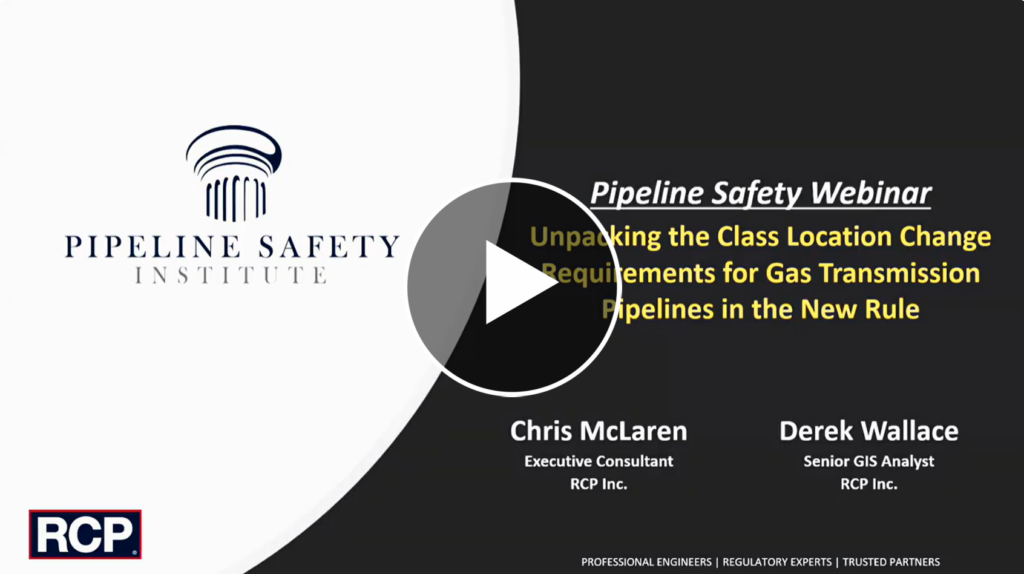
Pipeline Safety: Unpacking the Class Location Change Requirements
Thank you to everyone who attended and participated in this informative webinar. The session recording is posted to our YouTube channel. Please watch, like, and subscribe to our channel!
You asked and we listened!
Advanced DOT Pipeline Compliance Workshop is on the calendar!
This intensive and interactive 3-day, in-person workshop is designed for those who have previously completed our DOT Pipeline Compliance Workshop and are ready to take their knowledge to the next level.
New Workshop Alert!
Prepare Your Team for Pipeline Safety Audits with Confidence!
Our 3-day Pipeline Safety Audit Workshop is tailored for professionals responsible for the safe operation of hazardous liquid and natural gas pipelines. Designed for groups of 10-15 participants, this interactive training…
On-Site Training Request
We have conducted on-site training for oil and gas companies for over 25 years and can provide customized workshops for companies with groups of five or more.
We would welcome the opportunity to discuss our services with you.
Sincerely,

W. R. (Bill) Byrd, PE
President
RCP Inc.