August 2026 Issue
In This Issue
Louisiana Updates Underground Utility Damage Prevention Law
Louisiana enacted two measures during the 2026 Regular Session that update the state’s Underground Utilities and Facilities Damage Prevention Law.
Act 161 “Mandatory Reporting of Damage to Utilities” – When underground facilities or utilities are damaged by excavation or demolition, in addition to notifying the owner or operator the excavator or demolisher must notify the regional notification center (La 811). La 811 will alert other facility owners or operators in the area that may also have been affected.
Act 902 “Damage Prevention Law” was updated to strengthen communication and coordination between excavators, utility operators, and La 811, and help reduce the risk of damage to underground infrastructure. Key changes address material provided to an excavator/demolisher when utilities are present but not marked, positive responses through La 811, making mandatory the participation of most municipality or parish governments, annual training requirements, and enforcement. The law also establishes additional coordination and notification requirements for certain BEAD-funded broadband projects.
The changes are intended to strengthen communication and coordination between excavators/demolishers, utility operators, and La 811 to help reduce the risk of damage to underground infrastructure.
For a copy of Act 161 or Act 902, please message Jessica Foley.
PHMSA Releases Gas Transmission Pipelines Repair Criteria NPRM
On July 8, 2026, PHMSA published a Notice of Proposed Rulemaking (NPRM) that would modernize the federal repair criteria for hazardous liquid and gas transmission pipelines. If adopted, these would be the first significant updates to the repair requirements in nearly 20 years.
The proposal is intended to better align the regulations with current engineering practices, inspection technologies, and repair methods while reducing unnecessary operational disruptions. PHMSA estimates the proposed changes could save pipeline operators approximately $390 million over time by allowing greater flexibility in evaluating and repairing certain pipeline conditions without compromising safety.
Among the proposed changes are updates to repair criteria for dents, gouges, cracks, corrosion, and other anomalies identified during integrity assessments. The rule would also revise repair schedules, clarify existing requirements, and incorporate modern engineering assessment methods that have become common throughout the industry.
This proposed rule follows PHMSA’s 2025 Advance Notice of Proposed Rulemaking, which sought public feedback on opportunities to improve the effectiveness and efficiency of the current repair regulations.
Pipeline operators, engineers, and integrity management professionals should review the proposal carefully to understand how the revisions may affect inspection programs, repair decision-making, and compliance strategies. Comments on the proposed rule are due by September 8, 2026.
Click here to view the full NPRM. If you have any questions, please contact Jessica Foley.
The Enforcement Corner
The Enforcement Corner summarizes recent PHMSA enforcement actions, indicating where PHMSA is putting its enforcement efforts and the fines they are proposing for various types of violations.
In July 2026, PHMSA issued 1 CAO, 1 NOA, and 3 NOPVs accompanied by $901,930 in proposed fines.
- $143,300 § 195.452(g)(xxi) Integrity Management
- $84,900 § 195.452(j)(2) Integrity Management
- $53,900 § 195.402(a) Procedure Manual
- $266,015 § 195.402(c)(11) Procedure Manual
- $266,015 § 195.422(a) Pipeline Repairs
- $87,800 § 195.505(b) Qualification Program
Please note:
- Pipeline operators may disagree in whole or in part with each proposed violation cited by PHMSA.
- Proposed Civil Penalties (PCP) may be reduced or eliminated before an enforcement action becomes final.
- A Corrective Action Order (CAO) usually addresses urgent situations arising out of an accident, spill, or other significant, immediate, or imminent safety or environmental concerns.
- A Notice of Amendment (NOA) is frequently a result of a difference of opinion regarding written procedure requirements.
- A Notice of Proposed Safety Order (PSO) addresses pipeline integrity risks that may not constitute a hazardous facility requiring immediate corrective action (see Corrective Action Order described above), but do need to be addressed over time.
- A Notice of Probable Violation (NOPV) is not proof that a violation actually occurred.
- Proposed Compliance Orders (PCO) frequently document actions the pipeline operator already planned to do.
- Warning Letter (WL) is an official notice by PHMSA that an operator needs to make improvements but that no further enforcement is proposed for those findings at this time.
RCP maintains a detailed database of all PHMSA enforcement actions dating back to 2007 and is routinely asked for data analysis of various enforcement actions. For more information on how RCP can assist with enforcement action data analysis services, contact Jessica Foley.
Need to respond to a PHMSA enforcement action?
Need to know if your enforcement action is an outlier, or par for the course?
RCP maintains a detailed database of all PHMSA enforcement actions and their resolution which enables us to compare and contrast individual enforcement actions to nationwide actions and trends. We can help put things into context to ensure an effective reply for each citation. For more information on how RCP can assist with enforcement action data analysis services, contact Jessica Foley.
Did You Know?
On August 1, 1872, one of the earliest large-scale natural gas pipeline systems in the U.S. began delivering gas in Titusville, Pennsylvania. The 2-inch iron pipeline stretched five miles and supplied natural gas to more than 250 homes and businesses.
That means pipeline-delivered natural gas has been serving U.S. communities for 154 years this month.

Q&A Section
Do you have questions? RCP’s SMEs have the answers. Information will be posted here for questions we often get from clients or discussions we have with regulators regarding interpretations and pending regulatory deadlines.
Q: What do PHMSA’s proposed repair criteria changes mean for gas transmission and hazardous liquid pipeline operators?
A: PHMSA’s July 8, 2026 proposed rule would modernize how operators determine which pipeline anomalies need repair and how quickly they must be addressed. It affects both 49 CFR Parts 192 and 195, although the changes are more substantial for hazardous liquid operators.
Ask the Experts
Do you have a question for the experts at RCP? Submit your question using this form. If your question is selected for a future newsletter, you will be eligible for a gift of your choice from RCP’s online Store.
Upcoming Deadlines:
- And as a reminder, the “Stay of Enforcement” does not mean regulators don’t expect work toward getting compliance activities in place can be ignored.
If we can help, contact Jessica Foley.
Conference News
PPIM 2027
January 25-28 | George R. Brown Convention Center | Houston, TX
The 39th International Pipeline Pigging & Integrity Management Conference (PPIM) will take place at the George R. Brown Convention Center in Houston. The event brings together pipeline operators, engineers, and industry professionals to explore advancements in pipeline inspection, integrity management, risk assessment, and emerging technologies. Attendees can participate in technical presentations, training courses, and an exhibition showcasing the latest industry solutions.
Click here to register for this event.
PSI Training Schedule
|
DATE |
COURSE | FEE |
| Nov. 17-19, 2026 |
DOT Pipeline Compliance Workshop (49 CFR 191, 192, 194, 195 & 199) |
$2,150 |
| Feb. 16-18, 2027 |
Pipeline Safety Audit Training (Comprehensive Training with Technical & Soft Skills) |
$2,150 |
| Mar. 23-25, 2027 |
DOT Pipeline Compliance Workshop (49 CFR 191, 192, 194, 195 & 199) |
$2,150 |
WEBINAR RECORDING!
Unpacking the Key Updates in API RP 1170 & 1171, 2nd Edition
| RCP and the Pipeline Safety Institute offered a free webinar exploring the 2nd Editions of API RP 1170, Design and Operation of Solution-mined Salt Caverns Used for Natural Gas Storage and API RP 1171, Functional Integrity of Natural Gas Storage in Depleted Hydrocarbon Reservoirs and Aquifer Reservoirs. Thank you to everyone who attended and participated in this informative webinar. The session recording is posted to our YouTube channel. Please watch, like, and subscribe to our channel! |

WEBINAR RECORDING
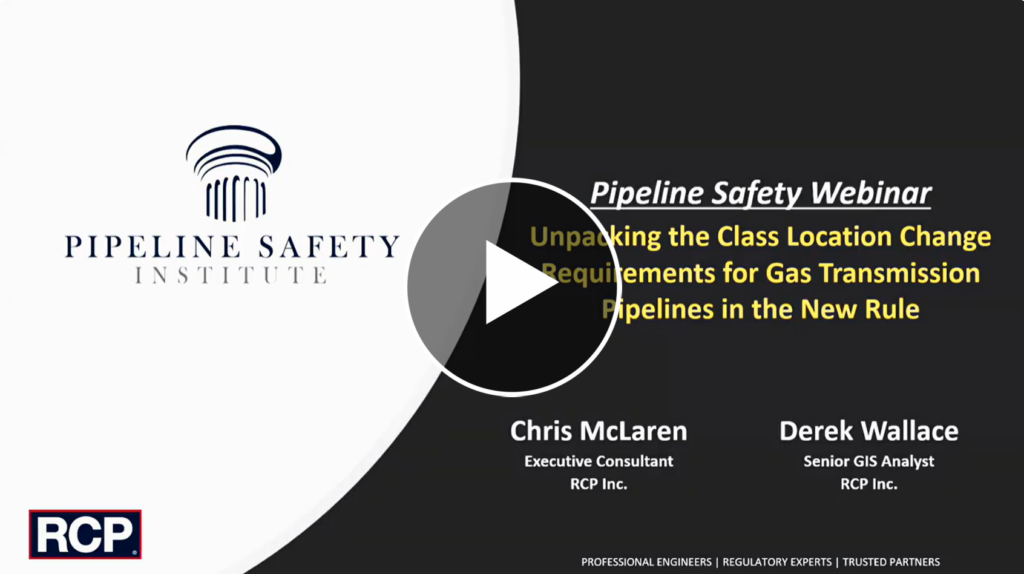
Pipeline Safety: Unpacking the Class Location Change Requirements
Thank you to everyone who attended and participated in this informative webinar. The session recording is posted to our YouTube channel. Please watch, like, and subscribe to our channel!
You asked and we listened!
Advanced DOT Pipeline Compliance Workshop is on the calendar!
This intensive and interactive 3-day, in-person workshop is designed for those who have previously completed our DOT Pipeline Compliance Workshop and are ready to take their knowledge to the next level.
New Workshop Alert!
Prepare Your Team for Pipeline Safety Audits with Confidence!
Our 3-day Pipeline Safety Audit Workshop is tailored for professionals responsible for the safe operation of hazardous liquid and natural gas pipelines. Designed for groups of 10-15 participants, this interactive training…
On-Site Training Request
We have conducted on-site training for oil and gas companies for over 25 years and can provide customized workshops for companies with groups of five or more.
We would welcome the opportunity to discuss our services with you.
Sincerely,

W. R. (Bill) Byrd, PE
President
RCP Inc.