July 2024 Issue
In This Issue
PHMSA Risk Ranking Index Modeling (RRIM) Webinar
On Wednesday, July 24 from 1pm to 2pm Eastern, PHMSA will be holding an informational webinar to provide an overview of their Risk Ranking Index Model (RRIM), the primary tool utilized by PHMSA on an annual basis to establish inspection schedules for pipeline systems throughout the country. The webinar is being held due to interest expressed by industry members during last year’s information exchange with PHMSA HQ and Region leadership. The goal of the webinar is to provide greater transparency and better understanding as to how decisions are made with respect to the prioritization of pipeline systems, type of inspections and frequency of inspections. During the webinar PHMSA will walk through the various criteria that factor into the overall risk score and are highlighted in the RRIM Summary that can be accessed here. The webinar will be held virtually via Microsoft Teams and can be accessed via the following link.
API Pipeline Information eXchange (PIX) Workshop
The American Petroleum Institute (API) is sponsoring the annual Pipeline Information eXchange (PIX) on November 6, 2024, at the JW Marriott Houston Downtown. The event runs from 9:00 am to 5:00 pm, followed by a reception, and is exclusive to pipeline operators. PIX offers a platform for sharing information and lessons on pipeline safety, incidents, and best practices.
API is also hosting a half-day pipeline safety workshop on November 5, 2024, from 1:00 pm to 5:00 pm at the same venue. This workshop, open to all, will cover best practices for corrosion assessment and integrity management.
Please Note: The PIX on November 6 is for operators only. The workshop on November 5 is open to all interested participants.
Click here to register for this workshop.
Standards Update Final Rule – Stay of Enforcement
On April 29, 2024, the Pipeline and Hazardous Materials Safety Administration (PHMSA) published a final rule titled “Pipeline Safety: Periodic Updates of Regulatory References to Technical Standards and Miscellaneous Amendments,” effective June 28, 2024. This rule updates the Federal Pipeline Safety Regulations by incorporating over 20 new or revised industry technical standards in 49 CFR parts 192 and 195. Following its publication, several industry associations, including GPA Midstream Association and the American Petroleum Institute, filed petitions for reconsideration and motions to stay the rule’s effective date, citing the need for more time to comply with the new standards to avoid significant disruptions and costs.
In response, PHMSA has issued a notice of limited enforcement discretion, allowing operators to comply with either the updated standards or the previous ones until January 1, 2025. This flexibility aims to help pipeline operators transition smoothly during the 2024 construction season while maintaining safety standards. PHMSA also recommends that state partners adopt similar enforcement discretion during this period.
For a copy of this stay of enforcement notice, please message Jessica Foley.
Valve Rule Correction
The Pipeline and Hazardous Materials Safety Administration (PHMSA) has announced a significant update under Docket No. PHMSA-2013-0255, identified as Amendment No. 192-136. This amendment follows a Petition for Reconsideration filed by the American Petroleum Institute and GPA Midstream Association on August 23, 2023, and aims to clarify the applicability of certain regulations to gas gathering lines.
Key Changes:
- Revisions Following Petition: PHMSA is revising § 192.617(b) through (d) to remove references to Type A gas gathering lines and clarify that these provisions are inapplicable to gas gathering lines.
- Clarification on Applicability: PHMSA is adding a disclaimer to § 192.635, explicitly stating that this section does not apply to gas gathering lines, aligning with the revised definition for “notification of potential rupture” at § 192.3.
- Enhanced Safety Measures: New protocols introduced for natural gas pipelines to improve overall safety.
- Stricter Compliance Requirements: Pipeline operators must now adhere to more stringent compliance measures.
- Advanced Monitoring: Implementation of advanced monitoring technologies for better risk management and early detection of issues.
- Improved Maintenance Standards: Updated maintenance requirements to ensure pipeline integrity and prevent failures.
For a copy of this valve rule correction, please message Jessica Foley.
Featured Service

TaskOp Highlight: Underground Gas Storage
RCP has earned a worldwide reputation for providing professional engineering services and regulatory expertise to oil and gas operators, including underground gas storage in depleted reservoirs, aquifers and salt caverns.
We have the RESOURCES, SOFTWARE and the KNOWLEDGE to assist clients with building, implementing, and improving comprehensive operational integrity management programs in response to the PHMSA rule incorporating API RP 1171/1170 v2 (Jan. 1st, 2026) on underground gas storage.
Experienced Resources
- Highly respected underground storage industry & risk management SMEs
- Professional engineering support
- Knowledgeable technical standards developers
- Regulatory expertise
Asset Management Tools
- Gap assessment protocols
- Comprehensive risk analysis program through software
- Out-of-the-box risk model designed by RCP SMEs
- Operator-specific risk models
- Full-featured workflow & asset management software
- Track, verify and complete all work done on a well
- Wellsite/valve inspections, annulus pressure, well logging, well swabbing, capital projects, etc.
Gap Analysis/Effective Evaluation
- PHMSA Final Rule: Safety of Underground Natural Gas Storage
- API RP 1171/1170 v2
- PHMSA Advisory Bulletins
- State-Specific Regulations
Process Development and Continuous Improvement
- Storage risk management plan
- Site-specific operations & integrity standards
- Key performance indicators
Risk Analysis Model
- API RP 1171 v2, Section 8
- Out-of-the-box risk model designed by RCP SMEs
- Configurable to client and/or state needs
- Separate models for depleted reservoirs and caverns
- Deterministic Approach
- SME/Documentation
- Data (ex. Well Log)
- Captures documents used in risk analysis and sub-surface safety valve assessment tools
- Customizable queries & reporting, including a fully revamped risk analysis dashboard experience to easily see what the risk model is trying to tell you
Asset Integrity Assessment & Remediation Progress Tracking
- Asset change management
- Traceable, verifiable, and complete record management
- Audit-ready software
- Schedule and progress reporting
- Integrity assessment and repairs
- Regulatory inspections
- Preventative Maintenance
- Capital Projects
- Well Logging
- Data capture & analysis
- Data trends for all the inspection data you are capturing
- Data overlays to help make better, actionable decisions
- Well log comparison (ex. corrosion rate)
- Documentation linkage to work activity
Q&A Section
Do you have questions? RCP’s SMEs have the answers. Information will be posted here for questions we often get from clients or discussions we have with regulators regarding interpretations and pending regulatory deadlines.
Q: What burial depths are pipelines required to maintain after installation?
A: Pipeline installation burial depths are not a maintenance requirement. After installation, pipeline cover may be lost and pipeline depths may be less than the installation requirement. The operator is required to ensure that their pipelines are safe, whatever their existing depth. Acceptable approaches to address shallow pipelines may include warning signs, farming / tilling restrictions in agreement with the landowner, concrete caps, and / or continued monitoring.
Ask the Experts
Do you have a question for the experts at RCP? Submit your question using this form. If your question is selected for a future newsletter, you will be eligible for a gift of your choice from RCP’s online Store.
Upcoming Deadlines:
- The deadline to submit written comments in response to PHMSA’s forthcoming NPRM on Pipeline Safety: Safety of Gas Distribution Pipeline and Other Pipeline Safety Initiatives will be 60 days from the date of publication in the Federal Register. Comments may be filed at https://www.regulations.gov/ Docket No. PHMSA-2021-0046.
- And as a reminder, the “Stay of Enforcement” does not mean regulators don’t expect work toward getting compliance activities in place can be ignored.
If we can help, contact Jessica Foley.
Did you know?
About the affordability of natural gas…
At one-third of the cost of electricity, the cost savings of natural gas means real money that can be used for home repairs and upgrades, unplanned emergencies, and financial security.
The decision to use natural gas in your home brings a variety of financial benefits and many see the difference in cost as soon as they open up that first utility bill.
Natural gas provides a reliable and cost-effective energy source for families throughout the country due to its abundance and the efficiency associated with direct use in the home.
Households that use electric appliances for heating, cooking, and clothes drying pay almost $1,132 a year more than those that use natural gas for those applications, according to the American Gas Association (https://playbook.aga.org) .
Residential natural gas prices are expected to reach their lowest level since 1977 next year after adjusting for inflation, according to the Energy Information Administration (EIA) Short-Term Energy Outlook. (https://www.eia.gov/outlooks/steo/archives/Mar24.pdf)
Seniors and low-income families would be impacted the most by the move to a higher-cost all electric system. Eliminating cost-effective and reliable natural gas as an energy source is bad policy for low-income families and seniors.

The Enforcement Corner
The Enforcement Corner summarizes recent PHMSA enforcement actions, indicating where PHMSA is putting its enforcement efforts and the fines they are proposing for various types of violations.
In May 2024, PHMSA issued 6 NOAs, 8 NOPVs, 1 PSO, and 5 WLs accompanied by $413,800 in proposed fines. Significant proposed fines were attributed to the following code sections:
- $60,300 – 49 CFR 195.446(e)(2) – Control Room Management
- $39,100 – 49 CFR 195.446(e)(5) – Control Room Management
- $89,000 – 49 CFR 195.428(a) – Overpressure Safety Devices
- $46,500 – 49 CFR 195.420(b) – Valve Maintenance
- $50,200 – 49 CFR 192.907(b) – Integrity Management
- $90,800 – 49 CFR 195.403(b)(1) – Emergency Response Training
- $20,400 – 49 CFR 195.402(a) – Procedure Manual
- $17,500 – 49 CFR 195.452(a)(1)(ii) – Integrity Management
Please note:
- Pipeline operators may disagree in whole or in part with each proposed violation cited by PHMSA.
- Proposed Civil Penalties (PCP) may be reduced or eliminated before an enforcement action becomes final.
- A Corrective Action Order (CAO) usually addresses urgent situations arising out of an accident, spill, or other significant, immediate, or imminent safety or environmental concerns.
- A Notice of Amendment (NOA) is frequently a result of a difference of opinion regarding written procedure requirements.
- A Notice of Proposed Safety Order (PSO) addresses pipeline integrity risks that may not constitute a hazardous facility requiring immediate corrective action (see Corrective Action Order described above), but do need to be addressed over time.
- A Notice of Probable Violation (NOPV) is not proof that a violation actually occurred.
- Proposed Compliance Orders (PCO) frequently document actions the pipeline operator already planned to do.
- Warning Letter (WL) is an official notice by PHMSA that an operator needs to make improvements but that no further enforcement is proposed for those findings at this time.
RCP maintains a detailed database of all PHMSA enforcement actions dating back to 2007 and is routinely asked for data analysis of various enforcement actions. For more information on how RCP can assist with enforcement action data analysis services, contact Jessica Foley.
Need to respond to a PHMSA enforcement action?
Need to know if your enforcement action is an outlier, or par for the course?
RCP maintains a detailed database of all PHMSA enforcement actions and their resolution which enables us to compare and contrast individual enforcement actions to nationwide actions and trends. We can help put things into context to ensure an effective reply for each citation. For more information on how RCP can assist with enforcement action data analysis services, contact Jessica Foley.
PSI Training Schedule
|
DATE |
COURSE | FEE |
| Nov. 17-19, 2026 |
DOT Pipeline Compliance Workshop (49 CFR 191, 192, 194, 195 & 199) |
$2,150 |
| Feb. 16-18, 2027 |
Pipeline Safety Audit Training (Comprehensive Training with Technical & Soft Skills) |
$2,150 |
| Mar. 23-25, 2027 |
DOT Pipeline Compliance Workshop (49 CFR 191, 192, 194, 195 & 199) |
$2,150 |
WEBINAR RECORDING!
Unpacking the Key Updates in API RP 1170 & 1171, 2nd Edition
| RCP and the Pipeline Safety Institute offered a free webinar exploring the 2nd Editions of API RP 1170, Design and Operation of Solution-mined Salt Caverns Used for Natural Gas Storage and API RP 1171, Functional Integrity of Natural Gas Storage in Depleted Hydrocarbon Reservoirs and Aquifer Reservoirs. Thank you to everyone who attended and participated in this informative webinar. The session recording is posted to our YouTube channel. Please watch, like, and subscribe to our channel! |

WEBINAR RECORDING
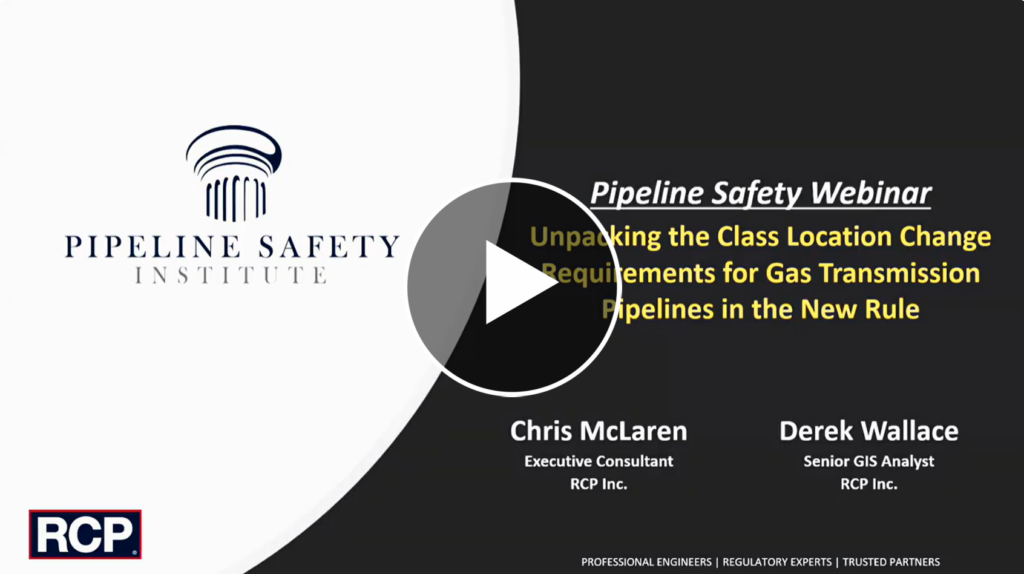
Pipeline Safety: Unpacking the Class Location Change Requirements
Thank you to everyone who attended and participated in this informative webinar. The session recording is posted to our YouTube channel. Please watch, like, and subscribe to our channel!
You asked and we listened!
Advanced DOT Pipeline Compliance Workshop is on the calendar!
This intensive and interactive 3-day, in-person workshop is designed for those who have previously completed our DOT Pipeline Compliance Workshop and are ready to take their knowledge to the next level.
New Workshop Alert!
Prepare Your Team for Pipeline Safety Audits with Confidence!
Our 3-day Pipeline Safety Audit Workshop is tailored for professionals responsible for the safe operation of hazardous liquid and natural gas pipelines. Designed for groups of 10-15 participants, this interactive training…
On-Site Training Request
We have conducted on-site training for oil and gas companies for over 25 years and can provide customized workshops for companies with groups of five or more.
We would welcome the opportunity to discuss our services with you.
Sincerely,

W. R. (Bill) Byrd, PE
President
RCP Inc.