October 2026 Issue
In This Issue
- PHMSA Announces $128.2 Million in Pipeline and Hazardous Materials Safety Grants
- PHMSA NPRM for Liquified Natural Gas (LNG)
- PHMSA Hiring Deputy Associate Administrator for Field Operations
- PHMSA Seeks Public Comments on Pending Pipeline Regulatory Interpretations
- PHMSA Announces Summer Research & Development Public Debriefs
- Colorado Methane Tracking: New Requirements, One Practical Solution
- Regulatory Watch: Key Dates & Deadlines
- Featured Service
- The Enforcement Corner
- Did You Know?
- Q&A Section: What’s Lurking Beneath the Surface?
- Conference News
- PSI Training Schedule
PHMSA Announces $128.2 Million in Pipeline and Hazardous Materials Safety Grants
The Pipeline and Hazardous Materials Safety Administration (PHMSA) announced $128.2 million in federal funding on September 30, 2026, to support pipeline safety, hazardous materials transportation, emergency response training, and inspection programs nationwide.
The funding includes 164 grants, with $97.3 million allocated to pipeline safety programs and $30.8 million to hazardous materials safety initiatives.
The grants will support several key activities:
- Pipeline Safety Inspections: Provide state inspectors with equipment and resources to conduct safety inspections and enforcement activities involving natural gas pipelines, hazardous liquid pipelines, and underground natural gas storage facilities.
- Emergency Response Training: Support training programs and exercises to prepare emergency responders for hazardous materials incidents, including rail derailments and industrial spills.
- Advanced Inspection Technology: Fund drone technology for aerial hazard mapping and thermal imaging along pipeline corridors.
- Hazardous Materials Oversight: Support inspections of hazardous materials shippers to identify packaging violations before transportation.
The investment is intended to strengthen federal and state safety oversight, improve emergency preparedness, and expand the use of technology in pipeline and hazardous materials safety programs.
PHMSA has also made state-specific funding allocations available for review.
PHMSA NPRM for Liquified Natural Gas (LNG)
The Pipeline and Hazardous Materials Safety Administration (PHMSA) is expected to publish a Notice of Proposed Rulemaking (NPRM) proposing updates to federal safety regulations for liquefied natural gas (LNG) facilities under 49 CFR Part 193.
The anticipated rulemaking, Pipeline Safety: Amendments to Liquefied Natural Gas Facilities (RIN 2137-AF45), is intended to modernize existing requirements, incorporate updated industry standards, and address safety considerations associated with today’s LNG facilities.
RCP will continue monitoring this rulemaking and provide updates as additional information becomes available.
PHMSA Hiring Deputy Associate Administrator for Field Operations
The Pipeline and Hazardous Materials Safety Administration (PHMSA) has announced an opening for the Deputy Associate Administrator for Field Operations within its Office of Pipeline Safety (OPS). The position plays a key leadership role in overseeing PHMSA’s nationwide pipeline safety compliance and enforcement program, including inspections, accident investigations, and enforcement activities aimed at improving safety and ensuring regulatory compliance across the nation’s high-pressure energy pipeline system. PHMSA is seeking highly qualified candidates to join its executive leadership team and has encouraged interested professionals to apply through the USAJOBS vacancy announcement. The Senior Executive Service position is based in Washington, D.C.
Why it matters: The Deputy AA for Field Operations helps shape and direct federal pipeline safety oversight, making this a significant leadership position for professionals with extensive pipeline operations, compliance, and regulatory experience.
Applications will be accepted through October 19, 2026. Click here to learn more about this opportunity.
PHMSA Seeks Public Comments on Pending Pipeline Regulatory Interpretations
The Pipeline and Hazardous Materials Safety Administration (PHMSA) has published two pending regulatory interpretation requests for public review and comment under 49 CFR § 190.11(b).
The requests address the following topics:
- PI-26-0007 – Portable Gas Supply Systems: Submitted by Schoonover Executive Solutions. Comments are due October 29, 2026.
- PI-26-0006 – Pipeline Classification Definitions: Submitted by Martin Operating Partnership LP. The request addresses definitions of service, distribution, and transmission lines under 49 CFR § 192.3. The comment period closed October 9, 2026.
PHMSA provides a 30-day public comment period for each posted request. Comments received will be considered before the agency issues a written regulatory interpretation.
Pipeline operators are encouraged to review pending interpretations that may affect their operations or regulatory compliance programs.
Click here to view Pending Pipeline Interpretations and Submit Comments.
PHMSA Announces Summer Research & Development Public Debriefs
PHMSA’s Office of Pipeline Safety (OPS) has announced a series of upcoming virtual events. We’ve provided a summary of the remaining meeting on the schedule below.
| Date | Event | Location | |
| Oct 21 2026 | Pipeline Safety: Meeting of the Liquid Pipeline Advisory Committee | Virtual | More Info |
The virtual discussion on October 21st will cover “Breakout Tank Inspection,” “Remote Monitoring of Hazardous Liquid Pipeline Rectifiers,” and “Hazardous Liquid Valve Maintenance Schedule.” Click the link above to register.
These meetings include a presentation of the project’s findings, an overview of its safety benefits, and an opportunity for attendees to ask questions. The completed research reports from all the meetings in this series are intended to provide practical guidance that operators can use to improve pipeline integrity, reduce risk, and support regulatory compliance.
Registration information, meeting agendas, and final project reports are available through PHMSA’s Pipeline Safety Research & Development Program.
Colorado Methane Tracking: New Requirements, One Practical Solution
Colorado’s Greenhouse Gas Intensity Program is moving beyond traditional emissions reporting toward measurement-informed emissions inventories.
Under Regulation 7, Part B, Section VIII, operators subject to the state’s greenhouse gas intensity requirements must use a measurement-informed inventory to demonstrate compliance. Operators can use Colorado’s state default intensity verification factor or an operator-specific program that incorporates methane measurement data into the emissions inventory.
For operators choosing an operator-specific program, the requirements go well beyond simply collecting methane measurements. Operators must maintain the measurement strategy, monitoring records, emissions calculations and supporting documentation necessary to demonstrate how their reported emissions were developed.
What This Means for Colorado Operators
The challenge isn’t just measuring methane. It’s managing the data behind it. Operators need a reliable way to:
- Maintain asset and emissions data
- Track methane emissions across facilities and components
- Calculate emissions and emissions intensity
- Incorporate field information and measurement data
- Maintain supporting records and documentation
- Analyze emissions trends
- Prepare consistent, defensible reports
And those records become increasingly important as Colorado’s verification program matures. Operator-specific programs include third-party audits of measurement-informed inventories for specified reporting years, including calendar year 2025.
RCP has the expertise and the tools to assist Operators in managing the verification requirements.
Meet MethOp: Simplifying Methane Emissions Management
Managing methane emissions requires more than collecting measurements. Operators must organize asset information, maintain accurate calculations, and document the data supporting their emissions reports.
RCP developed MethOp to simplify this process. By bringing emissions tracking, calculations, field data, and supporting documentation into one centralized platform, MethOp helps operators manage their reporting responsibilities without relying on disconnected spreadsheets.
Track it. Calculate it. Document it. Report it.
Learn more about MethOp or contact RCP to discuss your methane emissions management needs.
Regulatory Watch: Key Dates & Deadlines
Welcome to Regulatory Watch! In this monthly update, we’ll keep you informed on proposed rule comment periods, effective dates, and upcoming deadlines for various compliance requirements.
Final Rule Stage
| Final Rule | Regulatory Agenda | Federal Register Document |
| Safety of Gas Distribution Pipelines and Other Pipeline Safety Initiatives | 2137-AF53 | PHMSA-2021-0046 |
| Coastal Ecological Unusually Sensitive Areas | 2137-AF31 | PHMSA-2017-0152, Amdt. No. 195-104 |
| Gas Pipeline Leak Detection and Repair | 2137-AF51 | PHMSA-2021-0039 |
| Cost Recovery for Siting Reviews for LNG Facilities | 2137-AF61 | PHMSA-2022-0118 |
Sprint I
To further the Administration’s deregulatory policies, PHMSA has published in today’s Federal Register twenty-eight (28) separate rulemaking actions affecting the pipeline safety regulations (PSR; Parts 190-199). Click here to access the documents.
| Pipeline Safety: Rationalize Special Permit Conditions | PHMSA proposes to amend its special permit procedures to ensure permit conditions are directly tied to the specific pipeline safety regulations being waived. | NPRM | 49 CFR Part 190 |
| Pipeline Safety: Rationalize Calculation of Regulatory Filing and Compliance Deadlines | PHMSA will clarify that regulatory filing and compliance deadlines falling on weekends or Federal holidays automatically move to the next business day. | DFR | 49 CFR Part 190 |
| Pipeline Safety: Adjust Annual Report Filing Timelines | PHMSA will amend annual reporting requirements to move the gas pipeline annual report submission deadline from March to June. | DFR | 49 CFR Part 191 |
| Pipeline Safety: Property Damage Definition for Incident Reporting | PHMSA will clarify incident reporting property damage calculations for gas pipelines and update hazardous liquid accident reporting thresholds using inflation-adjusted criteria. | DFR | 49 CFR Parts 191 & 195 |
| Pipeline Safety: Exception for In-Plant Piping Systems | PHMSA proposes to clarify that in-plant piping systems are not subject to federal pipeline safety regulations. | NPRM | 49 CFR Part 192 |
| Pipeline Safety: Codify Enforcement Discretion on Incidental Gathering Lines | PHMSA proposes to codify enforcement discretion clarifying that restrictions on the historical incidental gathering line exemption apply only to newly constructed lines. | NPRM | 49 CFR Part 192 |
| Pipeline Safety: Eliminate Burdensome Coating Assessment Deadlines | PHMSA proposes to replace prescriptive deadlines for coating damage assessments and remediation with a requirement that activities be completed before the pipeline is placed in service. | NPRM | 49 CFR Part 192 |
| Pipeline Safety: Atmospheric Corrosion Reassessment for Pipeline Replacements | PHMSA proposes to remove the 3-year reassessment interval following replacement of atmospheric corrosion defects and allow use of the standard 5-year reassessment interval. | NPRM | 49 CFR Part 192 |
| Pipeline Safety: Harmonize Class Change Pressure Test Requirements | PHMSA proposes to reduce the minimum pressure test duration following certain class location changes from 8 hours to 4 hours, aligning with existing Subpart J requirements. | NPRM | 49 CFR Part 192 |
| Pipeline Safety: Clarify MAOP Reconfirmation Testing Records | PHMSA will issue a technical correction clarifying that operators may use pre-1970s pressure test records when reconfirming MAOP under §192.624. | Final Rule | 49 CFR Part 192 |
| Pipeline Safety: Remote Sensing Technologies for ROW Patrols | PHMSA will explicitly allow right-of-way patrols to be conducted using unmanned aircraft systems, satellites, and other remote sensing technologies. | DFR | 49 CFR Parts 192 & 195 |
| Pipeline Safety: Technical Standards Updates and Amendments | PHMSA will update incorporated standards and make technical amendments in response to an industry petition for reconsideration. | Final Rule | 49 CFR Part 192 |
| Pipeline Safety Program: Update of Standards Incorporated by Reference | PHMSA issued multiple direct final rules updating incorporated industry consensus standards used throughout Parts 192 and 195, replacing outdated editions with current versions. | Multiple DFRs | 49 CFR Parts 192 & 195 |
Sprint II
The following is a summary of the 40 rulemakings that PHMSA published in the Federal Register on April 24, 2026. If any adverse comment is received to a DFR PHMSA must rescind the rule and repropose. Click here to access the documents.
| Pipeline Safety and Hazardous Materials Safety: Amendments to PHMSA Procedural Regulations | PHMSA proposed miscellaneous amendments to procedural regulations governing informal rulemaking for both pipeline safety and hazardous materials programs. | NPRM | 49 CFR Part 190 |
| Pipeline Safety: Interpretation Request Procedures | PHMSA amended interpretation procedures to require publication of interpretation requests on its website and provide an opportunity for public comment. | Final Rule | 49 CFR Part 190 |
| Pipeline Safety: Declaratory Order Procedures | PHMSA established formal procedures for issuing declaratory orders through a new section in Part 190. | Final Rule | 49 CFR Part 190 |
| Pipeline Safety: Consent Orders | PHMSA clarified that consent agreements may be used to resolve enforcement actions, including cases involving civil penalties. | Final Rule | 49 CFR Part 190 |
| Pipeline Safety: Adjustment to OPID Notifications for Construction | PHMSA proposed adjusting the inflation-based threshold that triggers OPID notifications for certain construction and facility modification activities. | NPRM | 49 CFR Part 191 |
| Pipeline Safety: Eliminating Limitations on Welders and Welding Operators | PHMSA proposed allowing welders qualified through non-destructive testing methods to perform compressor station welding activities currently subject to additional restrictions. | NPRM | 49 CFR Part 192 |
| Pipeline Safety: Material Properties Verification During MAOP Reconfirmation | PHMSA proposed clarifying that material testing at pressure test manifold sites is not required when traceable, verifiable, and complete material records already exist. | NPRM | 49 CFR Part 192 |
| Pipeline Safety: Electronic Retention of Part 194 Response Plans | PHMSA amended regulations to allow operators to maintain electronic copies of response plans instead of paper copies. | DFR | 49 CFR Part 194 |
| Pipeline Safety: Remote Monitoring of Rectifiers | PHMSA proposed allowing remote monitoring technologies for rectifiers used in external corrosion control programs. | NPRM | 49 CFR Part 195 |
| Pipeline Safety: Clarifying Hazardous Liquid High-Consequence Area Designations | PHMSA amended HCA guidance to clarify spill considerations in agricultural fields and reorganize threat identification guidance. | DFR | 49 CFR Part 195 |
| Pipeline Safety: Timeframe to Make Rupture-Mitigation Valves Operational | PHMSA proposed extending the deadline for placing rupture-mitigation valves into operation from 14 days to 90 days after a pipeline enters service. | NPRM | 49 CFR Part 192 |
| Pipeline Safety: Hazardous Liquid Valve Maintenance Schedule | PHMSA proposed allowing operators to implement risk-based valve maintenance schedules, subject to a maximum inspection interval of one year. | NPRM | 49 CFR Part 195 |
| Pipeline Safety: Property Damage Definition for Incident Reporting | PHMSA proposes revising property damage thresholds for reportable gas and hazardous liquid pipeline incidents and clarifying applicability to telephonic notifications. | NPRM | 49 CFR Parts 192 & 195 |
| Pipeline Safety: Remote Sensing Technologies for ROW Patrols | PHMSA proposes clarifying that unmanned aerial systems, satellites, and other remote-sensing technologies may be used to satisfy right-of-way patrol requirements. | NPRM | 49 CFR Parts 192 & 195 |
| Pipeline Safety: Adjust Annual Report and NPMS Filing Timelines | PHMSA proposes extending annual report and NPMS submission deadlines for gas pipeline and storage operators to June 15 each year. | NPRM | 49 CFR Part 191 |
| Pipeline Safety: Editorial Corrections and Clarifications | PHMSA issued multiple final rules correcting editorial errors, updating references, removing obsolete submission methods, and improving regulatory clarity. | Final Rules | Various |
| Pipeline Safety: Update of Standards Incorporated by Reference | PHMSA issued multiple direct final rules updating incorporated industry consensus standards, including NFPA, ASTM, MSS, NACE, and ASME standards. | Multiple DFRs | 49 CFR Parts 192 & 195 |
Have questions about an upcoming deadline? Please reach out to Jessica Foley for assistance!
Featured Service

CorrosionIQ is a complete corrosion compliance and integrity management platform for pipeline operators.
From cathodic protection monitoring and CIS surveys to remediation tracking and compliance reporting, CorrosionIQ brings every component of your corrosion program together in a single system.
Collect data, manage inspections, track corrective actions, analyze trends, and demonstrate compliance with confidence.
Everything Your Corrosion Program Needs
CorrosionIQ covers the full corrosion lifecycle:
- Corrosion Work Management
- Cathodic Protection Monitoring
- CIS, DCVG, ACVG & ACCA Surveys
- Corrosion Remediation Tracking
- Corrosion Analytics & Reporting
- Dynamic Alignment Sheets
- GIS Mapping & Spatial Analysis
- Mobile Data Collection
- Compliance Documentation & Audit Support
Whether you’re managing transmission, gathering, distribution, hazardous liquid, or underground storage assets, CorrosionIQ provides a single source of truth for your entire corrosion program—helping your team spend less time managing data and more time protecting pipeline integrity.
Built for Pipeline Compliance
CorrosionIQ supports corrosion control requirements under 49 CFR Part 192 and 49 CFR Part 195, including:
- Cathodic protection (§192.463, §192.465, §195.573)
- Internal corrosion control (§§192.475–192.476, §195.579)
- Atmospheric inspections (§192.481, §195.583)
- External corrosion control (§§192.451–192.459, §§195.551–195.559)
- Integrity management programs (§§192.907–192.951, §195.452)
- Inline inspection and direct assessment (§192.921, §192.923, §195.452)
- Anomaly evaluation and repair (§192.933, §195.452)
- Reassessment intervals (§192.939, §195.452)
- Recordkeeping and documentation (§192.491, §195.589)
All requirements are tracked, scheduled, and documented in one place.
Why It Works
Most corrosion programs are spread across multiple systems. CorrosionIQ brings everything together so your team can:
- See the full picture
- Identify risk earlier
- Manage work in one place
- Reduce manual effort
- Stay compliant without the scramble
The Enforcement Corner
The Enforcement Corner summarizes recent PHMSA enforcement actions, indicating where PHMSA is putting its enforcement efforts and the fines they are proposing for various types of violations.
In September 2026, PHMSA issued 4 CAOs, 2 NOAs, 1 WL, and 5 NOPVs accompanied by $1,953,719 in proposed fines.
- $818,778 – § 195.402(a) – Procedure Manual
- $272,926 – § 195.446(a) – Control Room Management
- $266,015 – § 192.605(a) – Procedure Manual
- $60,700 – § 192.617(a) – Operation and/or Maintenance
- $52,800 – § 192.617(b) – Operation and/or Maintenance
- $32,800 – § 195.401(b)(1) – Pipeline Repairs
- $69,200 – § 195.444(b) – Leak Detection
- $20,800 – § 195.446(c)(2) – Control Room Management
- $17,100 – § 195.446(j)(1) – Control Room Management
- $342,600 – § 192.605(a) – Procedure Manual
Please note:
- Pipeline operators may disagree in whole or in part with each proposed violation cited by PHMSA.
- Proposed Civil Penalties (PCP) may be reduced or eliminated before an enforcement action becomes final.
- A Corrective Action Order (CAO) usually addresses urgent situations arising out of an accident, spill, or other significant, immediate, or imminent safety or environmental concerns.
- A Notice of Amendment (NOA) is frequently a result of a difference of opinion regarding written procedure requirements.
- A Notice of Proposed Safety Order (PSO) addresses pipeline integrity risks that may not constitute a hazardous facility requiring immediate corrective action (see Corrective Action Order described above), but do need to be addressed over time.
- A Notice of Probable Violation (NOPV) is not proof that a violation actually occurred.
- Proposed Compliance Orders (PCO) frequently document actions the pipeline operator already planned to do.
- Warning Letter (WL) is an official notice by PHMSA that an operator needs to make improvements but that no further enforcement is proposed for those findings at this time.
RCP maintains a detailed database of all PHMSA enforcement actions dating back to 2007 and is routinely asked for data analysis of various enforcement actions. For more information on how RCP can assist with enforcement action data analysis services, contact Jessica Foley.
Need to respond to a PHMSA enforcement action?
Need to know if your enforcement action is an outlier, or par for the course?
RCP maintains a detailed database of all PHMSA enforcement actions and their resolution which enables us to compare and contrast individual enforcement actions to nationwide actions and trends. We can help put things into context to ensure an effective reply for each citation. For more information on how RCP can assist with enforcement action data analysis services, contact Jessica Foley.
Did You Know?
Natural Gas Doesn’t Smell. It’s Just Dressed Up for Halloween.
Natural gas is naturally odorless, but odorants like mercaptans give it that unmistakable rotten egg smell.
While most people associate the smell with a gas leak, pipeline professionals know it’s actually a carefully engineered safety feature.
Turns out, natural gas wears a disguise year-round. 👻

Q&A Section: What’s Lurking Beneath the Surface?
Do you have questions? RCP’s SMEs have the answers. Information will be posted here for questions we often get from clients or discussions we have with regulators regarding interpretations and pending regulatory deadlines.
Q: Can a pipeline pass an integrity assessment and still have threats lurking in the shadows?
A: Yes. Yes! An integrity assessment provides a snapshot of pipeline conditions at a specific point in time. Threats such as corrosion, cracking, and third-party damage can develop or worsen between assessments.
That’s why 49 CFR Parts 192 and 195 include ongoing integrity management requirements, including preventive and mitigative measures, monitoring, and reassessments, as applicable.
The takeaway? Just because nothing showed up during the last inspection doesn’t mean there’s nothing lurking in the pipeline. 👻
Ask the Experts
Do you have a question for the experts at RCP? Submit your question using this form. If your question is selected for a future newsletter, you will be eligible for a gift of your choice from RCP’s online Store.
Upcoming Deadlines:
- And as a reminder, the “Stay of Enforcement” does not mean regulators don’t expect work toward getting compliance activities in place can be ignored.
If we can help, contact Jessica Foley.
Conference News
PPIM 2027
January 25-28 | George R. Brown Convention Center | Houston, TX
The 39th International Pipeline Pigging & Integrity Management Conference (PPIM) will take place at the George R. Brown Convention Center in Houston. The event brings together pipeline operators, engineers, and industry professionals to explore advancements in pipeline inspection, integrity management, risk assessment, and emerging technologies. Attendees can participate in technical presentations, training courses, and an exhibition showcasing the latest industry solutions.
Click here to register for this event.
PSI Training Schedule
|
DATE |
COURSE | FEE |
| Nov. 17-19, 2026 |
DOT Pipeline Compliance Workshop (49 CFR 191, 192, 194, 195 & 199) |
SOLD OUT |
| Feb. 16-18, 2027 |
Pipeline Safety Audit Training (Comprehensive Training with Technical & Soft Skills) |
$2,150 |
| Feb. 23-25, 2027 |
Advanced Pipeline Risk Assessment Workshop (Gain practical insights, build stronger risk models, & make more informed integrity management decisions) |
$2,150 |
| Mar. 23-25, 2027 |
DOT Pipeline Compliance Workshop (49 CFR 191, 192, 194, 195 & 199) |
$2,150 |
WEBINAR RECORDING!
Unpacking the Key Updates in API RP 1170 & 1171, 2nd Edition
| RCP and the Pipeline Safety Institute offered a free webinar exploring the 2nd Editions of API RP 1170, Design and Operation of Solution-mined Salt Caverns Used for Natural Gas Storage and API RP 1171, Functional Integrity of Natural Gas Storage in Depleted Hydrocarbon Reservoirs and Aquifer Reservoirs. Thank you to everyone who attended and participated in this informative webinar. The session recording is posted to our YouTube channel. Please watch, like, and subscribe to our channel! |

WEBINAR RECORDING
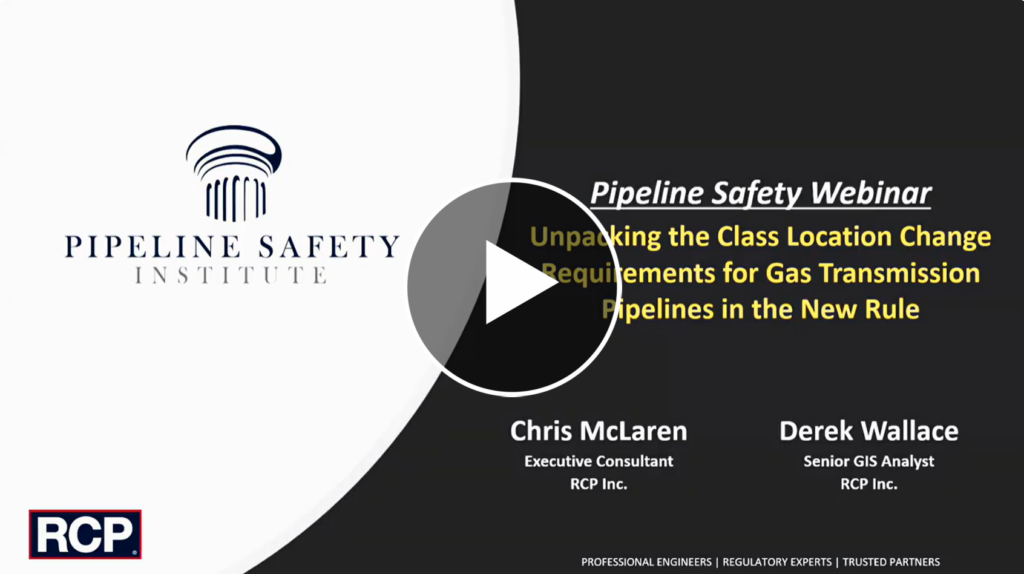
Pipeline Safety: Unpacking the Class Location Change Requirements
Thank you to everyone who attended and participated in this informative webinar. The session recording is posted to our YouTube channel. Please watch, like, and subscribe to our channel!
You asked and we listened!
Advanced DOT Pipeline Compliance Workshop is on the calendar!
This intensive and interactive 3-day, in-person workshop is designed for those who have previously completed our DOT Pipeline Compliance Workshop and are ready to take their knowledge to the next level.
New Workshop Alert!
Prepare Your Team for Pipeline Safety Audits with Confidence!
Our 3-day Pipeline Safety Audit Workshop is tailored for professionals responsible for the safe operation of hazardous liquid and natural gas pipelines. Designed for groups of 10-15 participants, this interactive training…
On-Site Training Request
We have conducted on-site training for oil and gas companies for over 25 years and can provide customized workshops for companies with groups of five or more.