June 2026 Issue
In This Issue
The Enforcement Corner
The Enforcement Corner summarizes recent PHMSA enforcement actions, indicating where PHMSA is putting its enforcement efforts and the fines they are proposing for various types of violations.
In May 2026, PHMSA issued 1 CAO, 3 NOA, 6 NOPVs, and 4 WLs accompanied by $673,930 in proposed fines.
- $62,900 – § 195.402(c)(12) – Procedure Manual
- $53,900 – § 195.420(a) – Valve Maintenance
- $25,100 – § 195.452(h)(4)(iii)(B) – Evaluation & Remediation
- $266,015 – § 195.402(a) – Procedure Manual
- $266,015 – § 195.422(a) – Pipeline Repairs
Please note:
- Pipeline operators may disagree in whole or in part with each proposed violation cited by PHMSA.
- Proposed Civil Penalties (PCP) may be reduced or eliminated before an enforcement action becomes final.
- A Corrective Action Order (CAO) usually addresses urgent situations arising out of an accident, spill, or other significant, immediate, or imminent safety or environmental concerns.
- A Notice of Amendment (NOA) is frequently a result of a difference of opinion regarding written procedure requirements.
- A Notice of Proposed Safety Order (PSO) addresses pipeline integrity risks that may not constitute a hazardous facility requiring immediate corrective action (see Corrective Action Order described above), but do need to be addressed over time.
- A Notice of Probable Violation (NOPV) is not proof that a violation actually occurred.
- Proposed Compliance Orders (PCO) frequently document actions the pipeline operator already planned to do.
- Warning Letter (WL) is an official notice by PHMSA that an operator needs to make improvements but that no further enforcement is proposed for those findings at this time.
RCP maintains a detailed database of all PHMSA enforcement actions dating back to 2007 and is routinely asked for data analysis of various enforcement actions. For more information on how RCP can assist with enforcement action data analysis services, contact Jessica Foley.
Need to respond to a PHMSA enforcement action?
Need to know if your enforcement action is an outlier, or par for the course?
RCP maintains a detailed database of all PHMSA enforcement actions and their resolution which enables us to compare and contrast individual enforcement actions to nationwide actions and trends. We can help put things into context to ensure an effective reply for each citation. For more information on how RCP can assist with enforcement action data analysis services, contact Jessica Foley.
PHMSA Proposes Updates to Breakout Tank Inspection Requirements
[Docket No. PHMSA-2025-1271]
PHMSA has published a Notice of Proposed Rulemaking (NPRM) that would update the agency’s breakout tank inspection regulations under 49 CFR Part 195. The proposal would incorporate the 5th Edition of API Standard 653, replacing the currently referenced 3rd Edition, and would authorize operators to use Risk-Based Inspection (RBI) procedures when establishing inspection intervals for in-service breakout tanks.
A key feature of the proposal is the ability for operators to extend internal inspection intervals based on a documented RBI assessment. PHMSA is proposing a maximum interval of 20 years for an initial internal inspection and 25 years for subsequent inspections when supported by an RBI analysis. Operators choosing this approach would be required to maintain records supporting the assessment and identify RBI-managed tanks in annual reporting and NPMS submissions.
PHMSA estimates the proposed changes could save the industry between approximately $25 million and $150 million annually by reducing unnecessary internal inspections while maintaining safety through risk-informed decision-making. The agency is accepting comments on the proposal for 60 days following publication in the Federal Register.
Please message Jessica Foley for a copy of this NPRM.
Expert Insight from John Gale, Senior Executive Consultant
RCP’s SME Mr. John Gale provides his insight on this rule change:
“PHMSA isn’t slowing down on storage tank oversight.
In this rulemaking, PHMSA is proposing to update Part 195 to incorporate the 5th Edition of API Standard 653 for breakout tanks. The agency is also proposing revisions to §195.432 that would formally authorize the use of Risk-Based Inspection (RBI) procedures to establish inspection intervals for in-service breakout tanks.
For operators, this signals continued movement toward modern risk management practices. Incorporating API 653 (5th Edition) aligns federal regulations with current industry standards, while RBI flexibility could allow operators to tailor inspection intervals based on actual risk, not just fixed timelines.
If adopted as proposed, these updates could have practical implications for inspection planning, documentation, and integrity programs. Now is the time to evaluate how your breakout tank program aligns with API 653 (5th Edition) and whether RBI methodologies are ready to support compliance under Part 195.”
PHMSA Names Thomas Correll as Associate Administrator for Pipeline Safety
PHMSA has named Thomas (Tom) Correll as its new Associate Administrator for Pipeline Safety. Correll brings more than 30 years of experience in pipeline safety, integrity management, environmental compliance, and risk management.
Prior to joining PHMSA, Correll served as Vice President of Pipeline Safety and Risk at Northern Natural Gas, where he led compliance and integrity management programs for a major interstate natural gas pipeline system. His experience includes PHMSA compliance, environmental permitting, engineering oversight, and large-scale infrastructure projects.
Correll’s appointment places an experienced pipeline industry leader at the helm of PHMSA’s pipeline safety program. Operators will be watching closely to see how his extensive background in pipeline operations and regulatory compliance influences the agency’s future priorities and initiatives.
Click here to access the official announcement from PHMSA.
PHMSA Clarifies MAOP Restoration Timeline Under Class Location Change Rule
[Docket No. PHMSA-2017-0151]
PHMSA has issued a technical correction to its January 14, 2026, final rule on Class Location Change requirements in 49 CFR §192.611.
The original rule allows operators to use an Integrity Management (IM) alternative to confirm or restore Maximum Allowable Operating Pressure (MAOP) on eligible gas transmission pipeline segments impacted by a class location change.
This latest action does not change the rule. It simply clarifies when the 24-month compliance timeline begins for MAOP restorations.
What Changed?
For operators restoring MAOP under the IM alternative, PHMSA confirms that the 24-month deadline runs from:
- The effective date of the final rule, or
- The date the operator decides to initiate the MAOP restoration,
whichever is later.
The correction makes clear that the decision date to restore MAOP is treated as the class location change date for purposes of starting the compliance clock.
Why This Matters for Pipeline Operators
This clarification removes ambiguity for both engineering and compliance teams.
If a Class 3 gas transmission segment was previously pressure-reduced due to a class location change, and you are now considering restoring MAOP using the IM alternative:
- Your 24-month window starts when you formally decide to move forward with restoration (if later than the rule’s effective date).
- There are no new technical requirements.
- PHMSA confirms there are no additional compliance costs.
Practical Takeaway
For operators managing gas transmission pipelines, MAOP restoration, and integrity management programs, documentation matters.
Make sure your internal records clearly establish the date the MAOP restoration decision is made. That date now drives your compliance timeline under §192.611.
This correction provides regulatory clarity—not new obligations—but it reinforces the importance of coordination between engineering, regulatory, and administrative teams when planning MAOP restoration activities.
Please message Jessica Foley for a copy of this rule change.
Featured Service

TaskOp Highlight: Underground Gas Storage
RCP has earned a worldwide reputation for providing professional engineering services and regulatory expertise to oil and gas operators, including underground gas storage in depleted reservoirs, aquifers and salt caverns.
We have the RESOURCES, SOFTWARE and the KNOWLEDGE to assist clients with building, implementing, and improving comprehensive operational integrity management programs in response to the PHMSA rule incorporating API RP 1171/1170 v2 (Jan. 1st, 2026) on underground gas storage.
Experienced Resources
- Highly respected underground storage industry & risk management SMEs
- Professional engineering support
- Knowledgeable technical standards developers
- Regulatory expertise
Asset Management Tools
- Gap assessment protocols
- Comprehensive risk analysis program through software
- Out-of-the-box risk model designed by RCP SMEs
- Operator-specific risk models
- Full-featured workflow & asset management software
- Track, verify and complete all work done on a well
- Wellsite/valve inspections, annulus pressure, well logging, well swabbing, capital projects, etc.
Gap Analysis/Effective Evaluation
- PHMSA Final Rule: Safety of Underground Natural Gas Storage
- API RP 1171/1170 v2
- PHMSA Advisory Bulletins
- State-Specific Regulations
Process Development and Continuous Improvement
- Storage risk management plan
- Site-specific operations & integrity standards
- Key performance indicators
Risk Analysis Model
- API RP 1171 v2, Section 8
- Out-of-the-box risk model designed by RCP SMEs
- Configurable to client and/or state needs
- Separate models for depleted reservoirs and caverns
- Deterministic Approach
- SME/Documentation
- Data (ex. Well Log)
- Captures documents used in risk analysis and sub-surface safety valve assessment tools
- Customizable queries & reporting, including a fully revamped risk analysis dashboard experience to easily see what the risk model is trying to tell you
Asset Integrity Assessment & Remediation Progress Tracking
- Asset change management
- Traceable, verifiable, and complete record management
- Audit-ready software
- Schedule and progress reporting
- Integrity assessment and repairs
- Regulatory inspections
- Preventative Maintenance
- Capital Projects
- Well Logging
- Data capture & analysis
- Data trends for all the inspection data you are capturing
- Data overlays to help make better, actionable decisions
- Well log comparison (ex. corrosion rate)
- Documentation linkage to work activity
Conference News
PPIM 2027
January 25-28 | George R. Brown Convention Center | Houston, TX
The 39th International Pipeline Pigging & Integrity Management Conference (PPIM) will take place at the George R. Brown Convention Center in Houston. The event brings together pipeline operators, engineers, and industry professionals to explore advancements in pipeline inspection, integrity management, risk assessment, and emerging technologies. Attendees can participate in technical presentations, training courses, and an exhibition showcasing the latest industry solutions.
Click here to register for this event.
PSI Training Schedule
|
DATE |
COURSE | FEE |
| Nov. 17-19, 2026 |
DOT Pipeline Compliance Workshop (49 CFR 191, 192, 194, 195 & 199) |
$2,150 |
| Feb. 16-18, 2027 |
Pipeline Safety Audit Training (Comprehensive Training with Technical & Soft Skills) |
$2,150 |
| Mar. 23-25, 2027 |
DOT Pipeline Compliance Workshop (49 CFR 191, 192, 194, 195 & 199) |
$2,150 |
WEBINAR RECORDING!
Unpacking the Key Updates in API RP 1170 & 1171, 2nd Edition
| RCP and the Pipeline Safety Institute offered a free webinar exploring the 2nd Editions of API RP 1170, Design and Operation of Solution-mined Salt Caverns Used for Natural Gas Storage and API RP 1171, Functional Integrity of Natural Gas Storage in Depleted Hydrocarbon Reservoirs and Aquifer Reservoirs. Thank you to everyone who attended and participated in this informative webinar. The session recording is posted to our YouTube channel. Please watch, like, and subscribe to our channel! |

WEBINAR RECORDING
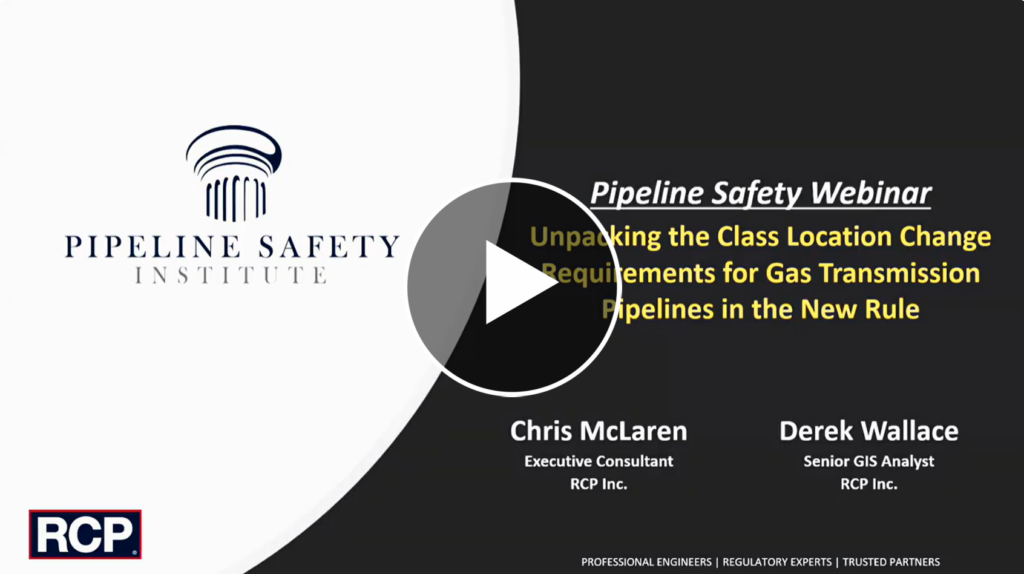
Pipeline Safety: Unpacking the Class Location Change Requirements
Thank you to everyone who attended and participated in this informative webinar. The session recording is posted to our YouTube channel. Please watch, like, and subscribe to our channel!
You asked and we listened!
Advanced DOT Pipeline Compliance Workshop is on the calendar!
This intensive and interactive 3-day, in-person workshop is designed for those who have previously completed our DOT Pipeline Compliance Workshop and are ready to take their knowledge to the next level.
New Workshop Alert!
Prepare Your Team for Pipeline Safety Audits with Confidence!
Our 3-day Pipeline Safety Audit Workshop is tailored for professionals responsible for the safe operation of hazardous liquid and natural gas pipelines. Designed for groups of 10-15 participants, this interactive training…
On-Site Training Request
We have conducted on-site training for oil and gas companies for over 25 years and can provide customized workshops for companies with groups of five or more.
We would welcome the opportunity to discuss our services with you.
Sincerely,

W. R. (Bill) Byrd, PE
President
RCP Inc.