February 2025 Issue
In This Issue
President Trump Nominates Paul Roberti to Lead PHMSA
Paul Roberti has been nominated by President Donald Trump to lead the Pipeline and Hazardous Materials Safety Administration (PHMSA), marking the potential for the agency’s first Senate-confirmed administrator in years. Roberti, who previously served as PHMSA’s chief counsel during Trump’s first term, was among 28 nominees submitted to the Senate without a formal White House announcement. His nomination has been met with strong industry support, with the Interstate Natural Gas Association of America urging a swift confirmation and the Liquid Energy Pipeline Association praising his leadership experience.
PHMSA NPRMs Withdrawn: CO2 & LDAR
PHMSA issued a Notice of Proposed Rulemaking (NPRM) proposing updates to the Pipeline Safety Regulations for gas- and liquid-phase carbon dioxide pipelines and Leak Detection and Repair (LDAR). These changes aimed to enhance safety standards and reporting requirements. However, both notices have been withdrawn from publication in the Federal Register, pausing their progress in the rulemaking process.
For more information, please contact Jessica Foley.
API On-Demand Webinar: Key Insights from API 1104, 22nd Edition Update
API hosted an in-depth webinar on January 9th, focusing on the 22nd Edition of API Standard 1104, Welding Pipelines and Related Facilities. Presented by the API/AGA Joint Committee on Pipeline Field Welding Practices, this session covered the key updates and improvements in the latest edition of the standard. Attendees learned about the rationale behind these changes and had the opportunity to engage in a live Q&A with industry experts. The webinar is highly relevant for operating companies, contractors, and regulators involved in pipeline welding.
For those who missed the live session, the recording is now available on API’s Learning website.
The Enforcement Corner
The Enforcement Corner summarizes recent PHMSA enforcement actions, indicating where PHMSA is putting its enforcement efforts and the fines they are proposing for various types of violations.
In December 2024, PHMSA issued 5 NOA, 8 NOPV, 1 PSO, and 1 WL accompanied by $0 in proposed fines. Significant proposed fines were attributed to the following code sections:
Please note:
- Pipeline operators may disagree in whole or in part with each proposed violation cited by PHMSA.
- Proposed Civil Penalties (PCP) may be reduced or eliminated before an enforcement action becomes final.
- A Corrective Action Order (CAO) usually addresses urgent situations arising out of an accident, spill, or other significant, immediate, or imminent safety or environmental concerns.
- A Notice of Amendment (NOA) is frequently a result of a difference of opinion regarding written procedure requirements.
- A Notice of Proposed Safety Order (PSO) addresses pipeline integrity risks that may not constitute a hazardous facility requiring immediate corrective action (see Corrective Action Order described above), but do need to be addressed over time.
- A Notice of Probable Violation (NOPV) is not proof that a violation actually occurred.
- Proposed Compliance Orders (PCO) frequently document actions the pipeline operator already planned to do.
- Warning Letter (WL) is an official notice by PHMSA that an operator needs to make improvements but that no further enforcement is proposed for those findings at this time.
RCP maintains a detailed database of all PHMSA enforcement actions dating back to 2007 and is routinely asked for data analysis of various enforcement actions. For more information on how RCP can assist with enforcement action data analysis services, contact Jessica Foley.
Need to respond to a PHMSA enforcement action?
Need to know if your enforcement action is an outlier, or par for the course?
RCP maintains a detailed database of all PHMSA enforcement actions and their resolution which enables us to compare and contrast individual enforcement actions to nationwide actions and trends. We can help put things into context to ensure an effective reply for each citation. For more information on how RCP can assist with enforcement action data analysis services, contact Jessica Foley.
Did you know?
Did You Know? RCP’s Version 2.0 of its TaskOp Underground Storage Reservoir Risk Module is officially live!
Developed in response to the release of API 1171’s 2nd Version, RCP has added a number of new, premium features, including robust threat interaction tables, to enable users to comply with the new recommended practices being introduced.
Click here to learn more.

Q&A Section
Do you have questions? RCP’s SMEs have the answers. Information will be posted here for questions we often get from clients or discussions we have with regulators regarding interpretations and pending regulatory deadlines.
Q: Does any portion of 192.635 “Notification of Potential Rupture” require OQ training as a covered task?
A: Yes, 192.635 “Notification of Potential Rupture” implicitly requires that employes and contractors who work along the ROW (or who remotely monitor pipelines) are able to identify potential ruptures and know how to respond. This competency should be incorporated into the operator’s Operator Qualification (OQ) program, as well as into Control Room Management (CRM) training.
Ask the Experts
Do you have a question for the experts at RCP? Submit your question using this form. If your question is selected for a future newsletter, you will be eligible for a gift of your choice from RCP’s online Store.
Upcoming Deadlines:
- The deadline to submit written comments in response to PHMSA’s forthcoming NPRM on Pipeline Safety: Safety of Gas Distribution Pipeline and Other Pipeline Safety Initiatives will be 60 days from the date of publication in the Federal Register. Comments may be filed at https://www.regulations.gov/ Docket No. PHMSA-2021-0046.
- And as a reminder, the “Stay of Enforcement” does not mean regulators don’t expect work toward getting compliance activities in place can be ignored.
If we can help, contact Jessica Foley.
Featured Service

TaskOp Highlight: Underground Gas Storage
RCP has earned a worldwide reputation for providing professional engineering services and regulatory expertise to oil and gas operators, including underground gas storage in depleted reservoirs, aquifers and salt caverns.
We have the RESOURCES, SOFTWARE and the KNOWLEDGE to assist clients with building, implementing, and improving comprehensive operational integrity management programs in response to the PHMSA rule incorporating API RP 1171/1170 v2 (Jan. 1st, 2026) on underground gas storage.
Experienced Resources
- Highly respected underground storage industry & risk management SMEs
- Professional engineering support
- Knowledgeable technical standards developers
- Regulatory expertise
Asset Management Tools
- Gap assessment protocols
- Comprehensive risk analysis program through software
- Out-of-the-box risk model designed by RCP SMEs
- Operator-specific risk models
- Full-featured workflow & asset management software
- Track, verify and complete all work done on a well
- Wellsite/valve inspections, annulus pressure, well logging, well swabbing, capital projects, etc.
Gap Analysis/Effective Evaluation
- PHMSA Final Rule: Safety of Underground Natural Gas Storage
- API RP 1171/1170 v2
- PHMSA Advisory Bulletins
- State-Specific Regulations
Process Development and Continuous Improvement
- Storage risk management plan
- Site-specific operations & integrity standards
- Key performance indicators
Risk Analysis Model
- API RP 1171 v2, Section 8
- Out-of-the-box risk model designed by RCP SMEs
- Configurable to client and/or state needs
- Separate models for depleted reservoirs and caverns
- Deterministic Approach
- SME/Documentation
- Data (ex. Well Log)
- Captures documents used in risk analysis and sub-surface safety valve assessment tools
- Customizable queries & reporting, including a fully revamped risk analysis dashboard experience to easily see what the risk model is trying to tell you
Asset Integrity Assessment & Remediation Progress Tracking
- Asset change management
- Traceable, verifiable, and complete record management
- Audit-ready software
- Schedule and progress reporting
- Integrity assessment and repairs
- Regulatory inspections
- Preventative Maintenance
- Capital Projects
- Well Logging
- Data capture & analysis
- Data trends for all the inspection data you are capturing
- Data overlays to help make better, actionable decisions
- Well log comparison (ex. corrosion rate)
- Documentation linkage to work activity
PSI Training Schedule
|
DATE |
COURSE | FEE |
| Nov. 17-19, 2026 |
DOT Pipeline Compliance Workshop (49 CFR 191, 192, 194, 195 & 199) |
$2,150 |
| Feb. 16-18, 2027 |
Pipeline Safety Audit Training (Comprehensive Training with Technical & Soft Skills) |
$2,150 |
| Mar. 23-25, 2027 |
DOT Pipeline Compliance Workshop (49 CFR 191, 192, 194, 195 & 199) |
$2,150 |
WEBINAR RECORDING!
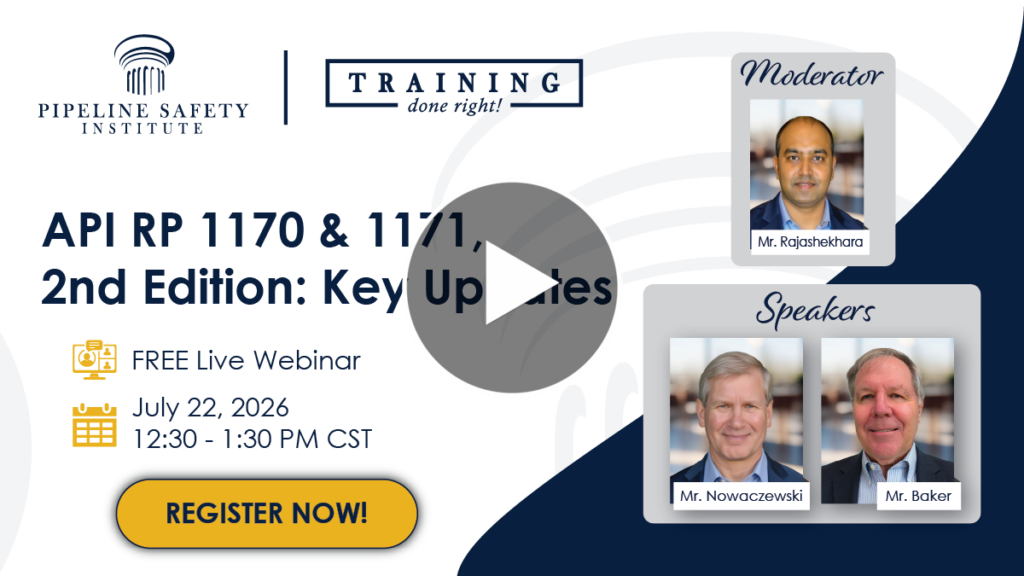
Unpacking the Key Updates in API RP 1170 & 1171, 2nd Edition
| RCP and the Pipeline Safety Institute offered a free webinar exploring the 2nd Editions of API RP 1170, Design and Operation of Solution-mined Salt Caverns Used for Natural Gas Storage and API RP 1171, Functional Integrity of Natural Gas Storage in Depleted Hydrocarbon Reservoirs and Aquifer Reservoirs. Thank you to everyone who attended and participated in this informative webinar. The session recording is posted to our YouTube channel. Please watch, like, and subscribe to our channel! |
WEBINAR RECORDING
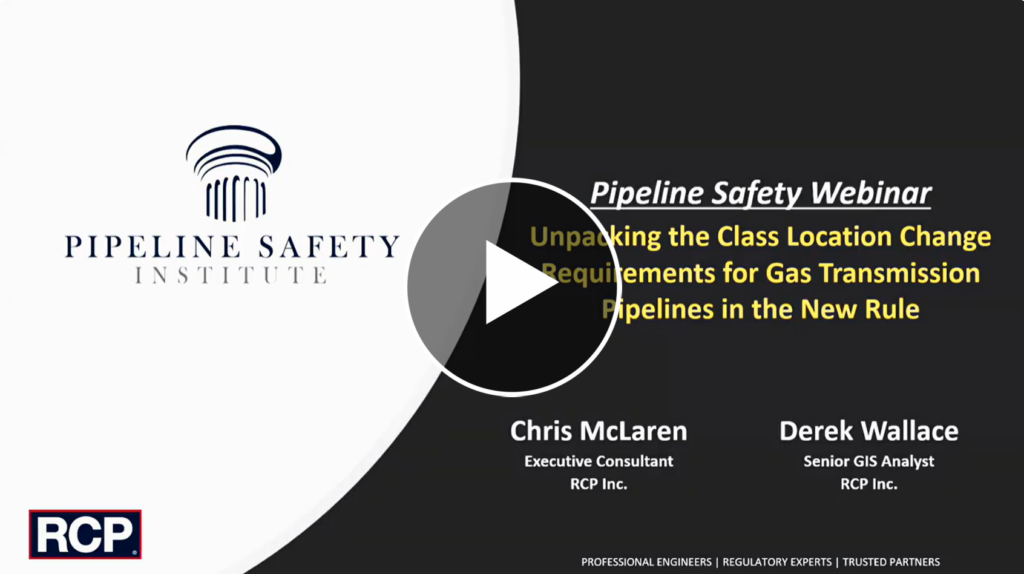
Pipeline Safety: Unpacking the Class Location Change Requirements
Thank you to everyone who attended and participated in this informative webinar. The session recording is posted to our YouTube channel. Please watch, like, and subscribe to our channel!
You asked and we listened!
Advanced DOT Pipeline Compliance Workshop is on the calendar!
This intensive and interactive 3-day, in-person workshop is designed for those who have previously completed our DOT Pipeline Compliance Workshop and are ready to take their knowledge to the next level.
New Workshop Alert!
Prepare Your Team for Pipeline Safety Audits with Confidence!
Our 3-day Pipeline Safety Audit Workshop is tailored for professionals responsible for the safe operation of hazardous liquid and natural gas pipelines. Designed for groups of 10-15 participants, this interactive training…
On-Site Training Request
We have conducted on-site training for oil and gas companies for over 25 years and can provide customized workshops for companies with groups of five or more.
We would welcome the opportunity to discuss our services with you.
Sincerely,

W. R. (Bill) Byrd, PE
President
RCP Inc.